Vinay Rao
The Boy Who Allegedly Paid Rs 25 Lakhs to Play for Hyderabad
A complaint is lying inside the grievance system of the Hyderabad Cricket Association. A copy has already been marked to the Single Member Committee headed by Justice P. Naveen Rao. Weeks have passed. Nothing visible has moved. Nobody appears suspended. Nobody appears questioned. Nobody appears disturbed.
And that silence may be the most damning indictment of all.
Because the complaint is not about a procedural lapse, an administrative misunderstanding, or an internal dispute between rival factions. It is an explosive allegation that strikes at the very soul of Hyderabad cricket — the allegation that selection into Hyderabad teams was allegedly available for a price.
If true, this is not merely corruption. This is the commercialisation of dreams.
For years, Hyderabad cricket has lived under a cloud of whispers. Parents spoke quietly. Players exchanged stories in dressing rooms. Coaches hinted at “managing things.” Young cricketers from ordinary middle-class families were repeatedly told that talent alone was not enough. That access had a price. That selection had a rate card.
Now, one cricketer has formally put those whispers on record.
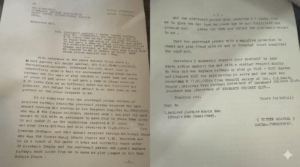
On May 1, 2026, Rithik Agarwal, son of Sanjay Agarwal from Uppuguda, Hyderabad, submitted a signed, typed complaint to HCA authorities. A copy was also sent to the Single Member Committee overseeing HCA affairs. The complaint names individuals, specifies amounts, identifies roles, and details how money allegedly changed hands in exchange for promises of selection into Hyderabad teams.
The allegation is staggering.
According to the complaint, nearly Rs 25 lakhs was allegedly paid across different transactions to secure opportunities in Hyderabad cricket, including assurances relating to Under-16 and Under-25 selection. An additional Rs 5 lakhs was allegedly paid for a team lease arrangement that, according to the complainant, never materialised.
But what makes the complaint even more disturbing is that it does not describe the conduct of one isolated individual operating alone in secrecy. It paints the picture of an ecosystem.
The complaint reportedly refers to intermediaries, conduits, assurances from individuals connected to selection structures, involvement of persons holding positions within HCA’s cricketing framework, and the alleged use of influence to create credibility around the promises being made. A serving selector’s name reportedly figures in the complaint. A former Ranji cricketer functioning within HCA structures is allegedly mentioned as a facilitator. Other individuals linked to club administration and league participation are also reportedly named.
If even a fraction of these allegations are proven, the implications are devastating.
Because this ceases to be about one player losing money. It becomes about every honest cricketer Hyderabad may have betrayed.
Every young player who spent years training in the heat, believing merit would prevail, now has a right to ask a painful question: Were selections earned — or purchased?
And every player who was dropped, ignored, or denied opportunity has a right to wonder whether the system was ever fair to begin with.
This is precisely why the issue cannot be brushed aside as a “private complaint.” A selector allegedly accepting money for team access is not an internal matter. It is an attack on the integrity of competitive cricket itself.
Ironically, this is exactly the rot Justice L. Nageswara Rao had warned about.
When the former Supreme Court judge delivered his landmark findings after extensive hearings in July 2023, he did not merely expose irregularities in club structures. He exposed a culture where access to HCA — votes, influence, positions, and power — had allegedly become monetised over many years.
The “57 clubs issue” was never the disease. It was merely one symptom.
The real disease was deeper: the conversion of Hyderabad cricket into a marketplace.
A marketplace where affiliations allegedly had rates. Votes allegedly had rates. Influence allegedly had rates. And now, horrifyingly, even a Hyderabad cap appears to have allegedly acquired a price tag.
The April 2026 High Court order recognised this collapse of credibility precisely. That is why the court empowered the Single Member Committee with sweeping authority over cricketing affairs and directed the constitution of a CBCID Special Investigation Team to probe HCA’s functioning comprehensively.
The allegations in this complaint fall squarely within that territory.
More importantly, the matter reportedly lies before the Anti-Corruption Unit. And that raises unavoidable questions.
Has the complaint been formally examined?
Have statements been recorded?
Have bank transactions been scrutinised?
Has anyone named in the complaint been asked to step aside pending inquiry?
Has the Single Member Committee sought a status report?
If not, why not?
Because every day of silence sends a dangerous message.
The selector allegedly named continues functioning. Individuals mentioned continue operating within Hyderabad cricket structures. Cricket activities continue as though nothing serious has happened.
And that is exactly how institutional decay becomes permanent — not merely through corruption itself, but through the normalisation of corruption.
Hyderabad cricket today stands at a defining moment. This is no longer about administrative factions or election politics. This is about whether the system retains even the minimum moral authority to ask young cricketers to believe in merit.
Rithik Agarwal did what very few are willing to do. He did not merely complain privately in corridors. He submitted a documented complaint with names, amounts, dates, and allegations. He approached official channels. He marked constitutional authorities overseeing HCA.
Now the burden shifts to the system.
Not to instantly declare guilt. Not to conduct a media trial. But to demonstrate that credible allegations involving the integrity of selections will be treated with seriousness, urgency, and transparency.
A formal acknowledgment.
A visible inquiry.
An interim review.
A public assurance that the matter is under examination.
These are not unreasonable expectations.
Because if even this does not trigger a visible institutional response, then Hyderabad cricket will have effectively told its next generation of cricketers something devastating:
Do not waste time filing complaints.
Just arrange the money.
And if that becomes the accepted reality, then the greatest tragedy will not be the collapse of one association.
It will be the collapse of faith itself.