



Sanjaya reported to the blind king how, by the divine will of Śrī Krishna, the entire battlefield stood revealed before Arjuna. As Arjuna gazed, his eyes rested not merely on opposing ranks but on faces long known and loved. He saw fathers and grandsires, teachers and venerable elders, brothers and cousins, friends and companions, bound to him by blood, affection, and shared memory. These familiar figures stood arrayed not only within his own host but also among those he must oppose, and the sight awakened in him a sudden vision of the tragic magnitude of the war that was about to unfold.
Until that moment, Arjuna, a warrior trained in action, had not measured the depth of sacrifice that society itself would be compelled to endure for the sake of avenging the cruelties of Duryodhana. Whatever the cause or justification, the vision before him released a flood of pity and tenderness within his heart. Yet this emotion was not wholly honest or instinctive. Had it been natural and sincere, it would have arisen long before the war was set in motion, and his conduct would then have followed a different course. The human heart has a subtle tendency to glorify weakness by adorning it with convenient names, calling it angelic or divine, just as the wealthy sometimes disguise vanity under the title of charity. In the same manner, Arjuna now named his desperation compassion.
Krishna watched him silently, with a knowing smile, aware that Arjuna’s long years of inner repression had generated a powerful current of unresolved energy seeking expression. Arjuna’s mind became divided between his egoistic image of himself as a great hero destined for victory and his growing anxiety at the very prospect of that triumph. Absorbed in dreams of conquest, his practical intelligence became severed from his logical perception, and this inner rupture drove him into confusion. Giving voice to his turmoil, Arjuna said that upon seeing his kinsmen gathered for battle, his limbs trembled, his mouth grew dry, his body quivered, and his hair stood on end. The Gandeeva slipped from his hand, his skin burned, he could no longer stand firm, and his mind reeled as if caught in a whirlpool.
Thus his mind became chaotic and unsteady, stripped of morale and guidance. Bereft of clear intellect, his emotions dominated him, and he declared that he desired neither victory nor dominion, nor even pleasure, though it was for victory and kingdom that he had entered the field. The challenging stance of the Kaurava warriors, eminent and resolute, shattered his hopes, blasted his ambitions, and undermined his confidence. Overcome by grief, Arjuna appealed to Krishna, arguing passionately against a civil war between two branches of the same royal family. In truth, he was constructing a case to justify a cowardly retreat from the duty that destiny had placed upon him.
Seeking Krishna’s moral approval for his condition, Arjuna spoke with increasing urgency, while Krishna, smiling yet firm, withheld any intellectual sanction. Arjuna proclaimed that he would not slay his cousins, even though they sought his death, and he declared that he would refuse to fight even if victory over the three worlds were offered to him, for such gains were insignificant when weighed against kinship. Addressing Krishna as Madhava, he asked how happiness could arise from the destruction of one’s own family. He admitted that the Kauravas, blinded by power and wealth, could not foresee the ruin of social order that would follow such a war, their intelligence and sensibility being clouded. Yet, he insisted that he himself could foresee the coming chaos.
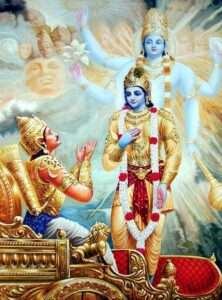
Arjuna reasoned further, saying that when a friend behaves wickedly under the influence of intoxication, retaliation is not righteous, for the offender acts without discriminative awareness. In such moments, forgiveness and forbearance are duties. By this logic, he argued that if Duryodhana and his allies were acting as blind aggressors, the Pandavas should withdraw quietly, accept defeat, and offer their suffering upon the altar of peace. Though resistance to evil lies at the heart of righteousness, Arjuna now argued contrary to it, adorning his retreat with supporting details drawn from his fertile but misguided intelligence.
He warned that the destruction of families would lead to the perishing of ancient traditions and the descent of an age of impiety upon society. When the moral integrity of the household is lost, he said, virtue slowly decays, leading to confusion in social order. In ancient society, social divisions were conceived as an intelligent distribution of human abilities, founded upon aptitude and temperament. Those inclined toward knowledge and inquiry were recognized as scholars, those endowed with courage and leadership upheld governance and protection, those engaged in agriculture and trade sustained the community, and those devoted to service and labor formed the noble foundation of society. This was not hierarchy but functional harmony, essential for balance and productivity. The warning against indiscriminate admixture referred to the confusion of roles, much as calamity would result if a physician were placed in charge of a power station or an engineer entrusted with the care of the sick.
In his confused state, Arjuna pressed on, insisting that each generation must transmit the spirit of culture to the next, and that this sacred duty was now being betrayed. Krishna observed him closely as he appeared like the first conscientious objector to war, presenting a brilliant yet flawed sequence of arguments. At last, Arjuna reached a point where he could neither cease speaking nor find any new reasoning, and the dignity of Krishna’s silence lent a strange gravity to the moment.
Arjuna concluded that when unity in domestic life is shattered, purity of conduct and sanctity of thought are destroyed, and the generation responsible for such ruin condemns society to an era of sorrow and suffering. Krishna beheld Arjuna’s intellectual exhaustion and emotional weariness, seeing how, instead of mastering the situation, he had become its victim. A creeping cowardice overtook him, draining his heroism, and he crowned his weakness with lofty words. He deliberately misread the purpose of war and imputed ignoble motives to a righteous cause, justifying a pacifism born not of wisdom but of a shattered mind.
Finally, Arjuna declared that it would be better for him to die unresisting and unarmed, pierced by the weapons of his foes. He invoked ancient ideals of welfare and liberation, yet in truth, his anxiety for the fruits of action had demoralized him and drawn him deeper into despair. Sanjaya, continuing his narration to Dhritarashtra, described how Arjuna, broken within, sank back upon the chariot seat, casting aside his royal weapons. In a few chosen words, Sanjaya observed that Arjuna’s mind was overwhelmed with pity and sorrow, his grief resembling the silent weeping of a child, the climax of inner hysteria.
Knowing his condition, the Blessed Lord spoke, expressing wonder that one born of noble lineage should be seized by such weakness upon the battlefield. A warrior, he reminded him, is meant to remain balanced in all circumstances and to face challenges with diligence. When life is rightly understood, even the gravest trial can be transformed into triumph, for all depends upon one’s skill in steering oneself along the difficult paths of existence. Thus, Krishna characterized Arjuna’s conduct as unworthy of the noble tradition to which he belonged. Surprised by this unexpected dejection in his friend, Krishna resolved to awaken and enlighten him, asking how such despondency had arisen within him.
It is held in the ancient tradition that to fall in battle while fighting for righteousness is the sacred duty of those born to rule, and that by such sacrifice they attain the realm of heroic honor. With this understanding, Krishna initiated his supreme discourse on duty and resolve, laying the foundation of one of the greatest teachings on action, courage, and inner mastery.

