


Sanjaya’s subtle and poetic presentation of the cosmic form, and Arjuna’s presence of mind in the moment of trial, had no effect upon the blind monarch. He uttered not a single word on this rarest of rare events, leaving Sanjaya astonished at the workings of Dhritarashtra’s heart and mind. Gathering himself, he returned to his faithful narration of the happenings at Kurukshetra, seeking to calm the king’s anxiety.
Your son Duryodhana, inflamed with anger and pride, commanded Dussasana to rouse the forces to battle. Trumpets, conches, cymbals, kettle drums, and horns blared together, filling the air with a confused and unharmonious tumult. At the forefront stood the commander-in-chief Bhishma upon his chariot, bearing a tall and noble banner, towering like a palmyra tree, its fluttering cloth vying with the roar of war instruments from the Kaurava host.
On the opposing side, mighty Bhima advanced to a position near Bhishma. The throbbing energy of the Pandava commanders stirred their troops like unrestrained ocean waves. They surged forward, disregarding your elephant divisions as mere blades of grass, and moved to their chosen targets in orderly remembrance of their martial vows. In the midst of this tumult, Bhimasena, the fearsome son of Vayu, roared like a lion, striking terror into the hearts of warriors, leaping with fierce delight, and shaking your forces with his thunderous cry. The trumpeting of elephants was swallowed by the reverberation of his roar, and when he struck the earth with his might, the ground quaked, horses and elephants faltered, and hearts seemed to shatter.
Surrounded by Dussasana, Durmukha, Dushpraha, Durmarshana, Vivimsati, Vrishasena, and Vikarna, all armed and resolute, Bhima faced fierce resistance, much to the satisfaction of your son Duryodhana. Meanwhile, Nakula, Sahadeva, and Dhrishtadyumna moved like devouring fire, crushing, severing, and casting down the heads of warriors in their path, as though destined for that grim task. Abhimanyu and the sons of Draupadi covered the battlefield with a rain of arrows, scattering your forces and draining their resolve. The Pandavas poured down torrents of shafts like storm clouds with thunder, while the Kauravas responded with unceasing volleys, offering worthy resistance to the sons of Pandu.
The field was enlivened by the young tigers of both houses, the sons of Pandavas and Kauravas, whose youthful ardor surged in chivalric contest. Their swift movements marked the ground, bearing witness to a renaissance of valor and honor. The scene inspired awe in both armies and drew praise and encouragement from Dharmaraja and Duryodhana on their respective sides. Each host, intent on victory in a single decisive stroke, fought in utter disregard of all else. Reinforcements from both sides pressed forward from their ranks, and the dust raised by this do-or-die struggle formed clouds of many hues, mingled with blood, water, severed limbs, shattered weapons, and fallen beasts, all slowly consumed by the lord of time.
Black clouds of dust rose as though the sun itself were seized by Rahu, while white clouds resembled the veils of celestial beings. Red particles floated like pollen from the hair of angels wandering the sky, and golden dust gleamed like radiant ornaments of divine guardians standing watch over the quarters. O King Dhritarashtra, the impact of the forces filled the space between heaven and earth with strange and dreadful sounds, arresting the thought of all creatures. The bells upon elephant herds, the neighing of horses, the clash of swords, the crash of shields, the cries of war instruments, and the blare of horns together deafened the ears.
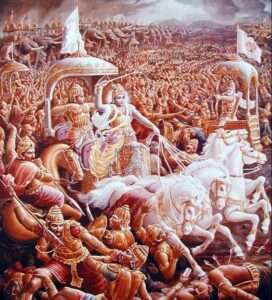
At first, the dust rose high from the collision of mighty hosts, but it was soon subdued by the water sprayed from elephant trunks and the foam flung from the mouths of horses, to the astonishment of all. The ground, once hard and unyielding, was softened by the blood of warriors and beasts, spread evenly by the streams cast like fountains by the elephant herds. The banners and insignia of kings fluttered like the wind and shone like the sun with their rich embellishments, appearing as though heaps of valor had taken form upon the field.
The army chief, your uncle Bhishma, blazed in his appointed place like a fearsome sun in the midst of the sky. The unequaled archer Arjuna engaged Bhishma in a terrible combat. Arjuna twanged his bowstrings, striking terror into Bhishma’s supporting forces, and blew his conch Devadatta, whose sound resounded through sky and earth alike. These twin sounds struck the heart like successive thunderclaps. With mastery and knightly skill, Arjuna clashed with Bhishma, and between these two titans, anger and resolve danced together like wind and fire.
Satyaki, borne upon the waves of martial ardor, dashed against the warrior Krithavarma. They tormented one another with streams of arrows, like scorching heat poured forth from a baleful planet. Their shafts pierced each other’s bodies, and the blood that flowed made them appear like fully blossomed arjuna trees, adorned from root to crown with red flowers. Abhimanyu, in wrath and prowess, confronted Bruhadbala, the king of Kosala, who fought with equal spirit and slew Abhimanyu’s horses and charioteer with his volleys. Abhimanyu swiftly retaliated, killing Bruhadbala’s horses and charioteer, shattering his bow, and piercing his body with deep wounds from which blood gushed like a stream.
Bhishma’s fierce onslaught upon Bhima astonished both armies, and their combat surpassed all former feats. The marvel lay in this: Bhishmacharya was renowned as the supreme master of archery, while Bhimasena was famed for wrestling and the mace, yet here he fought Bhishma with bow and arrows, in a manner fitting the moment and wholly extraordinary. Sanjaya, his eyes wide with wonder at this unique spectacle, narrated it to Dhritarashtra, conveying the same astonishment to the blind king, whose heart throbbed with jealousy and confusion.
Durmukha clashed with Sahadeva, and Dussasana advanced against him, unleashing a volley of arrows with piercing precision. Sahadeva cut them down mid-air and shattered his bow. Dussasana seized another bow and renewed the assault, breaking Sahadeva’s stream of arrows and shattering his flag and pole. Sahadeva, in turn, cut Durmukha’s arrows to pieces and slew his charioteer and steeds. These were among the foremost scenes of the first day’s outbreak of war.

