
Upadhyayula Lakshman Rao
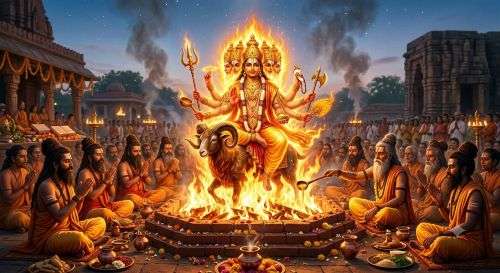
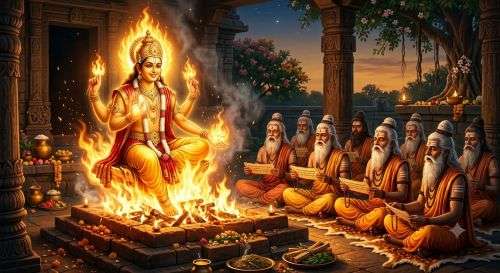
The sage Kutsa, born of the illustrious Angirasa lineage, raises his voice in solemn invocation through the measured cadences of Trishtubh and Jagati metres, addressing Earth and Sky, Agni, and the divine Aśvins. His hymn begins with a reverent salutation to the vast duality of Heaven and Earth, the sustaining parents of existence, and proceeds to welcome the Aśvins to the sacred yajña. With clarity of intent, he kindles the radiant presence of Agni, the blazing mediator between mortal aspiration and divine grace, and offers his prayer with disciplined devotion.
The Aśvins, resplendent and swift, are envisioned as divine responders in times of both ritual and conflict. Their conch resounds in the theatre of war, proclaiming victory and righteous intervention. Ever prepared and fully equipped, they are invoked to descend and protect the seekers of truth. Though exalted, they remain unattached, moving with serene purpose upon their celestial chariot. Like a learned scholar anchored in truth, they offer refuge to those who approach with sincerity, ensuring that the sacred rites conducted by priests are safeguarded and fulfilled in their entirety.
Strengthened by the Soma, born of the cosmic expanse, the Aśvins are depicted as energizers of life across the three worlds. Their acts reveal not merely divine intervention but a profound engagement with transformation: they turn barrenness into productivity, guiding the latent forces of nature into abundance. The hymn subtly reflects an early scientific temperament, where natural processes—rain, fertility, vitality—are observed, understood, and elevated through symbolic reverence. Vāyu, empowered by Agni, is seen shaping the realms, while the sun is acknowledged as the swiftest of all movers, hinting at an intuitive grasp of cosmic order and motion.
The narrative unfolds through a series of compassionate deeds performed by the Aśvins. They rescue the sage Rebha from the depths of a well, deliver Bhujyu and others from the perils of the ocean, and uplift the noble Suchantha to higher assemblies of wisdom. Their interventions span physical, moral, and spiritual dimensions, suggesting a holistic guardianship over human life. They restore sight to the blind, mobility to the lame, and even reconstruct the body, as in the case of Viśpalā, enabling her to walk again with renewed strength. These accounts symbolize healing, resilience, and the restoration of wholeness.
Their benevolence extends to protecting sages, kings, and seekers alike. They release the trapped Varthika bird from the jaws of a wolf, bring life-giving waters into rivers, and gladden the hearts of seers like Vasiṣṭha. They guide the lost, strengthen the weak, and illuminate the path of those striving for knowledge and prosperity. The hymn preserves the memory of numerous individuals—Kakṣīvanta, Bharadvāja, Divodāsa, and others—whose lives were transformed by their grace, reflecting a tradition that values both individual and collective upliftment.
The Aśvins are also portrayed as pioneers of practical knowledge and societal advancement. Their role in providing seeds to Manu signifies the dawn of agriculture, a pivotal step in human civilization. This act embodies innovation, foresight, and the harnessing of natural cycles for sustained growth. Their ability to resolve conflicts, guide rulers, and inspire disciplined action reveals a deep concern for social harmony and ethical governance.
In moments of peril, whether storms at sea or imprisonment within fortified caves, the Aśvins emerge as protectors who defy limitation. Their rescue of Bhujyu from a tempest-tossed ship and their liberation of Atri from a perilous confinement illustrate courage guided by wisdom. These episodes convey not only divine power but also an understanding of adversity as an arena for transformation.
Thus, the hymn of Kutsa stands as a luminous tapestry of devotion, observation, and insight. It blends spiritual aspiration with an intuitive appreciation of natural laws, presenting the Aśvins as embodiments of both compassion and intelligence. At dawn, the sage invokes them for protection, nourishment, and enduring enthusiasm, seeking a life enriched by knowledge and sustained by divine harmony. The closing invocation extends to Varuṇa, Mitra, Aditi, the rivers, and the cosmic expanse, affirming a unified vision where all forces of existence collaborate in the preservation and flourishing of life.