



In politics, outrage is often cheaper than petrol. And in Telangana these days, both seem to be available in abundance.
Chief Minister A. Revanth Reddy recently chose to mount his high-octane attack on the Centre over rising petrol and diesel prices, demanding a rollback with all the theatrical flourish of a seasoned opposition campaigner. Fair enough. Any elected Chief Minister has every right to question fuel hikes that pinch the common citizen. But in a functioning democracy, does responsibility end with press conferences, microphones, and political chest-thumping? Or should it begin with a little thing called fact-checking?
Because once the numbers enter the room, political drama quietly exits through the back door.
The irony of Telangana’s fuel politics is almost poetic. While opposition leaders loudly accuse the Centre of burdening the common man, Telangana itself happens to impose some of the highest state-level taxes on fuel in the country. The base price fixed by oil companies may hover around modest levels, the distributor may receive a relatively tiny commission, but it is the state taxes that transform a litre of petrol into liquid gold for the aam aadmi.
What prompted the Modi government to hike fuel prices after nearly four years of restraint? The answer lies not in political cruelty, as opposition parties would like people to believe, but in global geopolitics and harsh economic realities. The continuing West Asia conflict involving the United States and Iran has severely disrupted crude oil movement, particularly through the Strait of Hormuz — the vital gateway through which a significant portion of the world’s crude oil and cargo shipments pass.
Unlike many countries that immediately transferred the entire burden to consumers, India absorbed the shock for weeks. While nations across Europe, the United States, and even India’s immediate neighbours in the subcontinent sharply increased fuel prices, the Modi government delayed passing on the impact despite international crude prices surging dramatically from nearly $65 per barrel to well above $110. No government, regardless of ideology, can indefinitely shield consumers when import bills explode at such unprecedented levels.
Even then, the Centre passed on only a fraction of the burden — roughly a modest increase compared to the steep hikes witnessed elsewhere, where fuel prices in some regions effectively jumped by 60 to 80 percent. In economic terms, this was less a “price hike” and more a damage-control exercise under extraordinary global circumstances.
That inconvenient truth rarely finds mention in fiery speeches.
This is where Revanth Reddy’s political performance starts resembling one of those old Hindi comedy serials where the hero passionately fights a villain, only to later discover he himself signed the villain’s salary cheque. It is easy to accuse New Delhi of insensitivity. It is much harder to explain why Hyderabad is squeezing motorists harder than many BJP-ruled states.
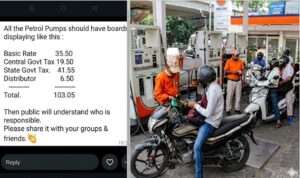
The real political discomfort for Telangana’s ruling establishment is that a substantial portion of what consumers pay at petrol bunks is controlled not by Delhi, but by the state government itself. Yet, blaming the Centre remains politically fashionable because acknowledging the state’s own taxation appetite may puncture the carefully cultivated image of being the sole protector of the common man.
In politics, outrage is often selective. Economics, unfortunately, is not.
Prime Minister Narendra Modi, while responding to repeated complaints from opposition-ruled states about inadequate financial support, subtly suggested something politically uncomfortable but economically logical — states too must cooperate in governance and provide relief wherever possible. Translation: if fuel prices hurt people so much, why not reduce state taxes?
But therein lies the real political dilemma.
Reducing taxes means reducing revenue. Reducing revenue means fewer resources for welfare announcements, populist schemes, political optics, and electoral management. And modern Indian politics, irrespective of party, increasingly runs less on ideology and more on treasury mathematics.
Revanth Reddy, however, is not an ordinary politician. His political journey itself reads like a screenplay written by a sarcastic scriptwriter with a dark sense of humour. Here is a man who rose through the ranks of the N. T. Rama Rao-inspired political ecosystem — a movement born specifically to fight the Congress culture of dynastic politics and centralized power — only to eventually defect to the very Congress he once opposed, become its Telangana president, and lead it back to power.
One must admit: politically, that is no small achievement.
In fact, compared to many armchair politicians, Revanth displayed remarkable survival instincts. He successfully took on the once-invincible K. Chandrashekar Rao and the rebranded BRS machinery that had dominated Telangana politics for nearly a decade. Congress, despite endlessly marketing itself as the party that “gave Telangana,” had actually spent years fumbling politically in the state after bifurcation. The emotional ownership of Telangana’s statehood movement never fully belonged to Congress. It merely arrived at the finishing line and claimed the medal.
Revanth changed that political equation through aggression, relentless campaigning, and anti-incumbency mobilisation.
But political success often carries a dangerous side effect — overconfidence.
And Telangana politics has already seen what happens when leaders begin believing they are politically immortal.
KCR once appeared untouchable. His speeches carried the confidence of a ruler who believed Telangana had no political alternative. Yet democracy has a brutal habit of humiliating leaders who mistake electoral victories for permanent ownership deeds. Public memory is short. Public anger is not.
Instead of learning from KCR’s downfall, Revanth increasingly appears eager to imitate his swagger.
His ambitious declarations about remaining in power till 2034 and eventually entering national politics as a minister in a future Rahul Gandhi government sound less like political strategy and more like an audition tape for “Mungerilal Ke Haseen Sapne.” Indian democracy has buried far bigger political giants than regional strongmen with national dreams.
After all, even Indira Gandhi — arguably among the most powerful leaders independent India ever produced — discovered during the post-Emergency elections that voter arrogance has an expiry date. The electorate can elevate leaders to near-mythical status one year and politically exile them the next. That was precisely the lesson preached by socialist icon Jayaprakash Narayan when he united the opposition against authoritarianism.
History repeatedly warns Indian politicians against confusing mandate with monarchy. Yet few seem interested in reading history before attempting to rewrite it.
Ironically, one Congress leader from undivided Andhra Pradesh understood this reality better than most. Dr Y. S. Rajasekhara Reddy, despite being a mass leader of extraordinary popularity, displayed rare humility after returning to power in 2009 with a reduced mandate. Instead of behaving like a conquering emperor, he openly admitted that voters had given his government only “pass marks” and that the administration needed to improve governance further.
That is the difference between mass leadership and political intoxication.
A mature leader introspects after victory. An insecure leader celebrates victory as permanent destiny.
Unfortunately, much of contemporary politics — not just in Telangana but across India — increasingly rewards noise over nuance. Press conferences are mistaken for governance. Social media trends are mistaken for public approval. Grand declarations are mistaken for administrative competence.
Meanwhile, the ordinary citizen continues paying inflated fuel prices, unbearable electricity bills, rising living costs, and mounting taxes while politicians compete over who delivered the better speech.
Fuel politics itself has become a national hypocrisy competition. Opposition parties demand tax cuts when out of power and defend taxation compulsions when in office. The BJP does it. Congress does it. Regional parties do it. Everyone performs outrage according to political convenience.
But Telangana’s case is especially fascinating because the state leadership wants to simultaneously play victim, warrior, reformer, and future national saviour — all while avoiding uncomfortable questions about its own fiscal decisions.
That balancing act may work temporarily. Indian voters are patient. They are not permanently gullible.
Revanth Reddy undoubtedly possesses political energy, charisma, and street-fighting instincts. Few deny his rise has been impressive. But if he genuinely wishes to emerge as a long-term leader rather than a short-term headline generator, he may need fewer dramatic declarations and more administrative delivery.
Because democracies do not run on political fantasies alone.
And fuel prices, unlike speeches, come with receipts.


