

Special Correspondent
The recent move by the state Crime Investigation Department (CID), directing the Hyderabad Cricket Association (HCA) not to extend the courtesy of issuing passes to 18 clubs—originally under the Hyderabad Municipal Corporation but allegedly taken over by private interests—has triggered more questions than it has answered.
At first glance, the directive appears to be a long-overdue intervention in a system that has, for years, been accused of manipulation and quiet capture. But scratch the surface, and the action appears curiously selective, even hesitant. Why stop at just 18 clubs? Why not widen the net to include the larger universe of 35 to 40 clubs that insiders claim have undergone similar questionable transitions—including those linked to banks and public sector undertakings?
These are not stray allegations whispered in corridors. Former HCA officials and stakeholders have consistently pointed to a pattern where institutional clubs—including those linked to banks such as Bank of Baroda and others—have allegedly been taken over by influential individuals. Among them are former Test cricketers who later occupied powerful positions within the association, as well as businessmen with deep pockets and deeper connections. If the CID probe intends to restore integrity, then limiting its scope raises legitimate doubts about the depth and seriousness of the investigation.
Those opposing the CID’s directive are quick to cite the report of Supreme Court-appointed Ombudsman Justice L. Nageshwar Rao, who, they argue, found no prima facie evidence in these allegations. That report has now become a convenient shield for many. But it also raises an uncomfortable question: was the Ombudsman’s conclusion based on a complete and uncompromised set of facts, or was it shaped—directly or indirectly—by the very ecosystem now under scrutiny?
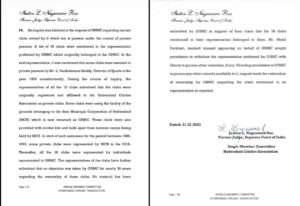
The reliance on that report to challenge the CID’s authority is equally contentious. Investigative agencies are not expected to remain passive merely because an earlier inquiry did not find sufficient grounds. If anything, fresh complaints or new evidence warrant deeper scrutiny—not selective restraint. To suggest that the CID lacks the mandate to issue such directives is to misunderstand both the nature of criminal investigation and the responsibility of state agencies to act when governance failures surface.
Meanwhile, the legal landscape adds another layer of complexity. The Telangana High Court has reserved its judgment on petitions filed by former HCA President Jaganmohan Rao and Secretary Devraj, who challenged their removal following arrests on graft charges. Their defence rests on a well-established legal principle: until proven guilty by a competent court, an individual remains an accused, not a convict. They also maintain that their tenure was free of corruption—a claim that now sits uneasily alongside the circumstances that led to their arrests.
What complicates matters further is the pace of the investigation. Though arrests were made by the state police, charge sheets are still pending. This delay inevitably fuels suspicion. If the evidence was strong enough to justify arrests, what explains the lag in prosecution? Conversely, if the evidence is weak, what warranted such drastic action in the first place?
In the end, the CID’s directive feels less like decisive action and more like a cautious half-step—enough to signal intent, but not enough to inspire confidence. In a system long plagued by allegations of conflict of interest, opaque governance, and institutional capture, anything short of a comprehensive, transparent, and fearless investigation risks being seen as yet another exercise in selective accountability.