We are happy to introduce this new page ‘Smart Investment” – As our Expert’ to enable people who are interested to make their investments and ensure they grow substantially. For this, you can also post your Querries to our seasoned Investment Expert, for Smart Investment. Your queries also need to be marked a copy to orangemultimedianetwork@gmail.com. Our Expert ID is bgs1234@gmail.com – EDITOR
A powerful shift may be brewing inside the world’s most influential central bank. And if former Federal Reserve Governor Kevin Warsh is any indication, the era of easy money that shaped global markets for nearly four decades could be approaching a dramatic turning point.
Warsh has delivered one of the strongest critiques yet of the Federal Reserve’s aggressive money-printing policies, openly arguing that Quantitative Easing (QE) — the strategy of flooding markets with liquidity by buying government bonds and financial assets — has become part of the inflation problem rather than the solution.
“The Fed should exit markets outside of crises,” Warsh recently remarked, signaling a philosophy sharply different from current Fed Chair Jerome Powell.
That distinction matters enormously.
For years, global financial markets thrived on abundant liquidity, near-zero interest rates, and massive central bank support. Under Powell, especially during and after the pandemic, the Fed’s balance sheet ballooned to nearly $6.7 trillion, injecting unprecedented liquidity into the financial system.
Warsh now appears to be advocating the exact opposite approach.
Instead of expanding the Fed’s footprint in markets, he believes the balance sheet must shrink substantially. Instead of easy liquidity supporting asset prices, markets may need to adjust to tighter financial conditions and structurally higher interest rates.
That could fundamentally alter the investing landscape.
A Potential Inflationary Super Cycle
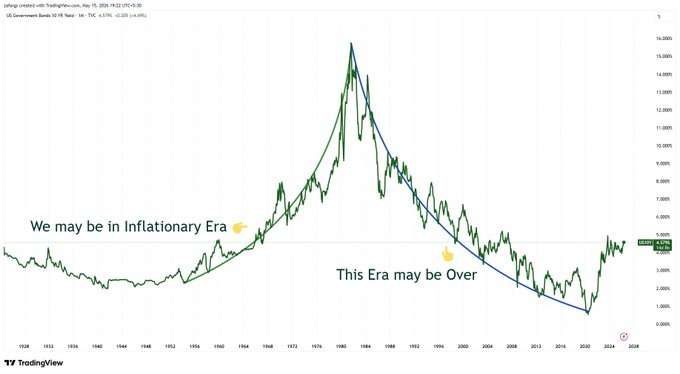
Several global indicators — including rising bond yields, stubborn inflation pressures, geopolitical fragmentation, energy insecurity, and deglobalisation trends — are increasingly pointing toward the possibility of an inflationary super cycle similar to the period seen between the 1950s and 1970s.
During that era, inflation remained persistently elevated, commodity prices surged, and traditional financial assets often struggled to generate real returns after adjusting for inflation.
If such a cycle is indeed emerging, many investment strategies that worked exceptionally well over the last 40 years may no longer deliver the same results.
The classic formula of buying long-duration bonds, high-growth technology stocks, and liquidity-driven assets may face mounting pressure in a world where capital becomes more expensive and central banks withdraw support.
Why Markets Are Nervous
Warsh’s comments have intensified concerns that the global financial system may be entering a prolonged period of tighter monetary conditions.
The implications are enormous:
- Less liquidity circulating in markets
- Interest rates staying higher for longer
- Increased volatility in equities
- Repricing of speculative and high-growth assets
- Rising pressure on heavily leveraged companies
For years, cheap money allowed businesses and investors to take aggressive risks with minimal financing costs. That environment may now be changing rapidly.
As bond yields climb globally, investors are beginning to reassess asset allocation strategies that have dominated portfolios since the early 1980s.
What Could Perform Better?
If inflation remains structurally higher, investors may increasingly shift toward sectors and asset classes with real-world value and pricing power.
Among the areas expected to benefit are:
Commodities
Raw materials historically perform well during inflationary cycles as prices of energy, food, and industrial inputs rise.
Real Estate
Property assets with strong rental demand often act as inflation hedges, especially in urban and infrastructure-linked regions.
Energy & Power
Global energy transition demands, rising electricity consumption, and geopolitical supply risks continue to support the sector.
Metals & Materials
Industrial metals, mining companies, and material producers could benefit from infrastructure spending and supply shortages.
Pharma & Inelastic Demand Sectors
Businesses providing essential goods and services — especially healthcare and pharmaceuticals — tend to remain resilient even during economic slowdowns.
Areas Facing Pressure
Certain asset classes may struggle if higher inflation and tighter monetary policy persist:
- Long-duration bonds
- High PE, high-growth stocks
- Highly leveraged companies
- Consumer discretionary sectors dependent on easy spending
In such an environment, valuation discipline may return as a key investing principle after years of liquidity-driven market expansion.
A Structural Shift, not a Temporary Cycle
The bigger message behind Warsh’s comments is not merely about interest rates. It is about a possible structural reset in how markets function.
For decades, investors operated under the assumption that central banks would step in aggressively whenever markets stumbled. That belief helped fuel one of the greatest bull runs in financial history.
But if the Fed increasingly prioritises inflation control over market support, the rules of investing may begin to change.
The age of abundant liquidity may gradually give way to an era where cash has value again, borrowing becomes expensive, and real assets outperform financial speculation.
And if that transition truly unfolds, global investors may need to rethink not just their portfolios — but the very assumptions that shaped modern investing over the last 40 years.