



Today, we hear a lot of news about 3-D printers and the recent commissioning of the Russian 3-D printer at ISRO’s Vikram Sarabhai Space Centre (VSSC), Thiruvananthapuram, shows its importance in rapid prototyping and producing complex components for future missions like Gaganyaan, Chandrayaan and Bharatiya Antariksh Space Station.
3-D Printing is a marvel of modern and emerging technology that is transitioning from a hobbyist tool to produce toys at the turn of the 21st century to transforming manufacturing processes worldwide. We are all familiar with 2-D inkjet and laser printers to produce flat images, text, or graphics, usually on paper or any other material, from a file on our computers by a simple print command. Here, the printer head moves across a 2-D surface along two axes in the x and y directions to deposit ink or toner (with colour options available) to produce the desired text or image. The ink or the toner, in the case of laser printing, is contained in a replaceable component called a cartridge that acts like a fuel supply for printers. Toner is a fine dry powder made up of finely ground thermoplastic resin (typically polyester), which acts as a binder, making up over 95% of the mixture.
3-D Printer: The 3-D printing as the name suggests, operates in three spatial dimensions, that is x, y (2 horizontal axes) and z (vertical axis) directions to produce a three-dimensional solid object. There are several key components of a 3-D printer; the main ones are described: i) A frame that holds all other components, ii) Print bed at the bottom where the object is built layer by layer, iii) Stepper motors that control movement along x, y and z axes, iv) A spool that holds the raw material filament (plastic or composite plastic, metal or any other substance), v) An extruder that feeds the raw material filament into the hot end of the nozzle to melt, and vi) A control board acting as the brain of the printer managing all the instructions.
The 4-step process: (1) A 3-D model is designed on a computer using CAD (Computer Aided Design) software. A few examples are, Tinkercad, SelfCAD, and Sketchup (for beginners), Shapr3D (for beginners to experts), SOLIDWORKS and CATIA (for experts and engineers), and FreeCAD (for tech-savvy CAD users). (2) Once the model is ready, it needs to be converted into a language that a 3-D printer can understand and produce the desired 3-D object. This is done using software called Slicer that converts the 3D computer model into thousands of flat slices of 2D layers and stacks them according to the specific print settings (like infill density, print speed, layer height, nozzle temperature, etc.) into a file with extension .gcode (Geometric code). A few examples of slicer software are OrcaSlicer, Ultimaker Cura, and PrusaSlicer, which are popular today. (3) As the printing starts, the nozzle heats the filament of raw material to soften and then melt slowly. The extruder pushes the melted filament through the nozzle and deposits it layer by layer onto the printing bed, and (4) The deposited raw material, plastic or metal, cools and hardens as each new layer bonds with the previous layer, producing a 3-D object.
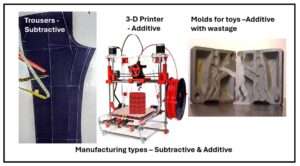
Advantages: There are two types of manufacturing, namely subtractive and additive. In the former, something is cut away from a larger piece of material to make a finished product. A common example that comes to my mind is that of making trousers or any other product we wear by cutting to specifications from a bolt of fabric, then sewing it together. Sculpting statues from a solid rock is another example. In case of additive manufacturing, some material is added to produce a finished product. An example is the injection molding in which plastic or metal is melted and poured into a mold, which is then allowed to cool into the shape of the mold. But this still requires a subtractive step to carve out the shape of the mold, though.
The 3-D printing is an additive manufacturing process that reduces wastage because it adds material layer by layer wherever it is needed. It allows unparalleled design freedom and rapid prototyping, making it cost-efficient. There are several other advantages, like the creation of intricate and lightweight geometries that may be required for space missions and in the aviation and automobile industries. Spare parts of some discontinued commercial machinery can be printed, and finally, it removes the need for expensive, single-purpose molds, saving enormous costs for small-batch personalized products. On the negative side, sophisticated 3-D printers are too expensive, and the raw material is often not very strong. This needs improvement in material technology.
Today, the global 3-D printing industry is valued between $16 billion and $30 billion with a projected growth exceeding 17% annually, driven by demands for rapid prototyping and customized manufacturing as AI-enabled smart factories and Industry applications expand. While the US leads the pack in market share of about 35%, the Asia-Pacific region is close on its heels. India, too, backed by strong government initiatives, shows an expanding market share at around 25% with a promise of faster growth triggered by a strong domestic demand for products of commercial and daily personal use.
Though there is stiff competition in this emerging technology of 3-D printing, the difference with the topmost competitor is achievable much before India completes the first century of our independence in 2047. We need to have this competition going as this will keep us motivated. If you go to a race course and observe how the horses run, it teaches us something. A horse always runs faster till there are other horses to catch up to and outpace them. Of course, you need a fine rider, too, and it’s the right time for India to gallop.


Excellent article Dr Chadda Saab, succinctly explained. I have often wondered how this works & ur article was a revelation Coming from an older generation, 3D printing would often stump me, but no longer after your article. Keep up the good work. Regards Cmde NN Rao
The piece is science without complications. We need such expositions of science more and more. Congratulations to Dr Chaudhary Ji. Mishra
Thank you Dr Chadda for an enlightening piece on 3-D printing. It is now becoming popular in personalized medicine. I’m sure this has the potential to become a household tool in future.
Nice. Today there are many companies offering #D printing services in many different fields. Medicine, Manufacturing of different daily used tools to military equipment and even building bridges and residential and office / commercial buildings. For some reason it did not take off as much as it was expected to be. It is great technological evolution and particularly for countries like India, they can get things done faster and cheaper using 3D printing. Hope it will catchup for the good of economy and make things life easier and better for common man.
Your article has given all of us a 3D knowledge of 3D printing technology a bit away from science articles. TQ.