Upadhyayula Lakshman Rao
The sage Rahugana, born of the illustrious lineage of Gautama, raised his voice in solemn invocation to Indra, employing a rich variety of chandas—Anustup, Ushnik, Pankti, Gayatri, and Brihati. These meters, each with its own cadence and spiritual resonance, were not mere poetic forms but living vessels of consciousness. Through them, the sage conveyed prayers that were at once simple in utterance yet profound in their inward suggestion. They urged a readiness of mind, a delicacy of perception, and a refinement of awareness capable of transcending the ordinary limits of sense and intellect. Beneath the audible hymn, there flowed an invisible thread of spiritual significance, binding the mortal seeker to the cosmic order.
Indra, the mighty lord, was invoked as the recipient of the sacred Soma, the luminous elixir pressed with reverence. The sage invited him to partake of it and to shine forth thereafter with a brilliance akin to the sun illuminating the heavens. Soma was not merely a ritual drink; it symbolized an exalted state of consciousness, a divine exhilaration that awakened strength, clarity, and expansive vision. Indra, invigorated by Soma, was praised as unrelenting in power, the one toward whom both sages and men directed their aspirations.
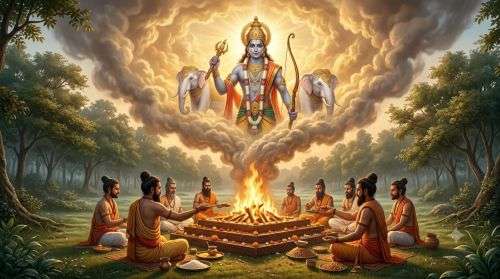
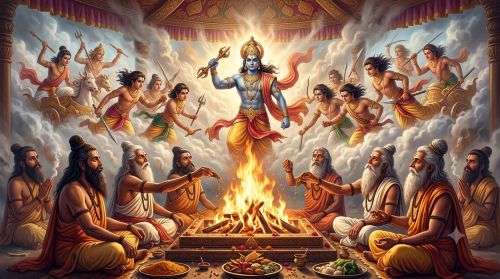
The twin steeds named Hari, radiant and swift, were yoked to Indra’s chariot through the force of sacred hymns. These horses, embodiments of energy and motion, bore the deity to the sacrificial ground where rituals unfolded in disciplined harmony. The pressing stones that extracted Soma resounded with rhythmic intensity, as though anointing Indra through sound itself. Their vibration echoed the cosmic pulse, inviting the god to descend and partake of the offering. The Soma flowed like living streams, filling the sacred space with vitality, while priests hastened their chants, weaving sound into action and action into devotion.
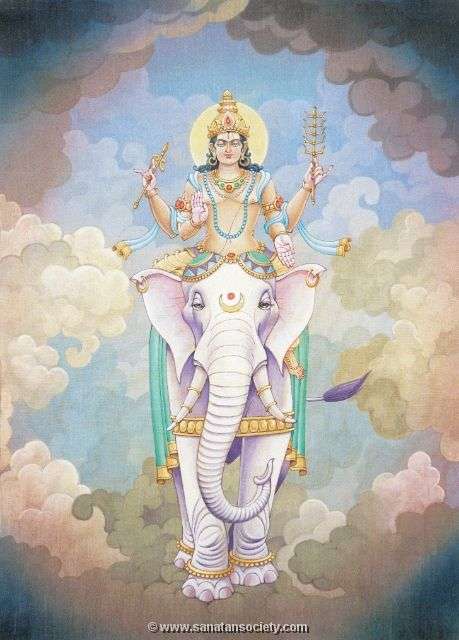
Indra, the slayer of Vritra, was invoked to mount his chariot and accept the homage of those who had yoked his steeds with devotion. His might was declared unmatched, his sovereignty unquestioned. No rival could approach his strength; no wealth could be granted without his will. In him resided the power to bestow abundance upon those who offered oblations with sincerity. Thus, he stood not only as a warrior deity but as the sustainer of prosperity and order, the invincible lord who governed both the seen and the unseen realms.
The hymns reflected a subtle philosophical inquiry: when would Indra subdue those who neglected sacred duties, and when would he turn his awareness toward the sincere invocations of the faithful? Yet the seers also realized that true blessing required no demand. Indra, in his fullness, granted progeny, strength, wealth, and well-being unasked, for he perceived the inner disposition of the devotee. Fear dissolved in his presence, and the need for violence faded before the assurance of divine protection.
A remarkable symbolism arose in the portrayal of cows, which were closely associated with Indra. They moved with him, nourished by the rains he released, and gave forth milk that sustained life. These cows were not merely physical beings but embodiments of abundance, knowledge, and illumination. Their milk represented the essence of nourishment—both material and spiritual. They were described as wise, radiant, and deeply attuned to the rhythms of ritual. In their association with Indra, they reflected a vision of a harmonious kingdom where sustenance, knowledge, and divine order coexisted seamlessly.
The narrative deepened with the account of the sage Dadhichi, whose sacrifice became a cornerstone of cosmic balance. Born of Atharvan lineage, he possessed immense spiritual power. When the forces of disorder grew strong, Indra sought him, and from his very bones was fashioned the Vajra, the thunderbolt weapon of unparalleled potency. With it, Indra overcame Vritra and restored equilibrium to the world. This episode revealed a profound truth: that the highest strength arises from self-offering, and that matter itself can be transformed into a vehicle of divine purpose.
Another strand of the tale described how the Ashvins, seekers of supreme knowledge, approached Dadhichi. Though opposed by Indra, they employed their skill to enable the transmission of wisdom. The substitution of the sage’s head with that of a horse symbolized the transformation and continuity of knowledge beyond physical limitations. Even when severed, truth endured, and wisdom found its path. The restoration of Dadhichi’s original form affirmed the eternal nature of knowledge and the resilience of the enlightened spirit.
The seers also observed natural phenomena with contemplative depth. They perceived the interplay of sun and moon, recognizing how light persists through transformation. They saw in the rains, the cows, and the cycles of nourishment a unified system governed by divine intelligence. Their hymns thus embodied not only devotion but also a keen observation of the natural world—a synthesis of spirituality and proto-scientific inquiry.
In the end, the sages declared Indra as the luminous force sustaining life, the giver of food, strength, and protection. They acknowledged themselves as seers of mantra, channels through which divine insight flowed. Their prayer was not born of need alone but of recognition—of Indra as the source of vitality and order. Through refined perception and disciplined expression, they revealed a universe where every ritual act, every natural phenomenon, and every inner realization was woven into a single, harmonious fabric of existence