



Sanjaya’s report on the battlefield and the preparations of kings, though vast and vivid, failed to satisfy the blind monarch. A lurking doubt troubled his heart regarding the strength of the Pandavas, and the shocking revelation of Sanjaya’s future vision weighed heavily upon his conscience. The sins of past complacency and greed now stood before him like a monstrous apparition, ready to devour his lineage. Yet his motives and intentions were not refined as they should have been, and therefore, he urged Sanjaya to describe in detail the readiness of the Pandavas and their entry into the field of war. Sanjaya, remembering the command of Vyasa to report faithfully and without distortion, slowly abandoned all hope that the king would take initiative to halt the war and began his narration with calm detachment.
Dharmaraja entered the battlefield in a manner that resembled a sacred procession. The pure white royal umbrella above him, with its delicate embellishments, appeared like bumblebees swarming over the head of a mighty elephant, mistaking the flow of his energy for pure honey. The dust raised by the hooves of horses rose like clouds and seemed like clusters of flowers adorning the braids of celestial maidens. The gems studded upon his banner spread tender rays like the rising sun. Trumpets and kettledrums resounded across hills and skies, while the swift movement of his chariot filled the air with waves of thunder. Small bells hanging from elephants and horses jingled softly, filling the atmosphere with soothing music and proclaiming the tranquil mind of Dharmaraja, whose disposition remained equal in war and worship alike. The swords borne by foot soldiers cast sparkling light in all directions. The entry of this son of Dharma brightened the faces of warriors in both camps.
Then Bhimasena entered, gigantic in form, clad in armor, bearing his heavy mace upon his shoulder, his arms and sinews gleaming with strength. His arrival was like a thunderstorm descending upon the earth, shaking the battlefield and striking terror into the hearts of warriors by his mere appearance, bounding forward with the spirit of war and victory. His stride reminded all who beheld him of a celestial elephant descending to crush everything in its path. Soon after, Arjuna entered, a living concentration of power, a moving flash of the thunderbolt. His divine chariot spread celestial light in all directions, its horses galloping as if waves of moonlight danced upon the ground. Krishna sat as the charioteer, holding the reins with the grace of one who directs the universe itself. The sapphires and rubies on his ornaments spread gentle blue rays, blending with the hues of multicolored garments and flower garlands, casting a pleasing glow upon all onlookers. The banner bearing the insignia of Hanuman fluttered, spreading the light of faith and sounding a challenge to all who dared to confront him. The divine arrows in his ever-filled quiver appeared like hissing serpents with jeweled hoods, spreading both light and fear among the warriors. Arjuna reached the field with a look of endurance and grace, his complexion shining like pure radiance. He was accompanied by many war-ready chariots, blowing his divine conch Devadatta, leaving waves of thunder in the air and gripping the hearts of all warriors present. His entry subdued the pride of many kings whose boasts had echoed loudly before his arrival. The entire region where Arjuna stood seemed covered by dark clouds streaked with flashes of lightning, emanating from the divine crown bestowed by Indra, and the vibration of his bowstrings resounded like rolling thunder.
The twin warriors Nakula and Sahadeva reached the battlefield as if they were going forth to sport and delight, yet their forces covered vast stretches of ground. Their vehicles, of varied shapes, types, and colors, each designed for a specific purpose, attracted the curious gaze of opposing warriors. Abhimanyu and the sons of Draupadi entered the field with massive forces, shaking the earth beneath their steps. They appeared like herds of wild elephants, moving with fearful and reckless gait. The sons of Draupadi, Prativindhya, Srutasoma, Srutakirti, Satanika, and Srutasena, guided by Abhimanyu, filled the army with joy and faith, and their acclamations filled the air with laughter and delight. O King Dhritarashtra, with vast herds of elephants, horses, and chariots, and countless foot soldiers, the unconquerable King Drupada entered with his sons, kinsmen, and retinue. With unshakable confidence that none could restrain his forces, the king of Matsya, Virata, entered with a mighty host and firm stride. Then Satyaki arrived, shaking and vibrating the earth with his fourfold army, followed by countless Yadava warriors. The war-loving Chekitana came, born solely to slay Bhishma and shatter the Kaurava forces, and the gifted warrior Shikhandi reached the battlefield with his troops. The king of Magadha, accompanied by his brother and forces, also arrived.
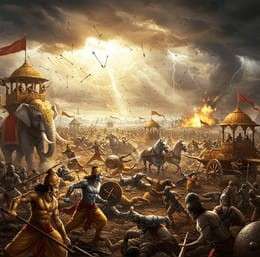
The kettledrums, trumpets, and conches blared, sending thunderous waves through the air as Sahadeva advanced toward the battle lines. The weapons borne by his troops sparkled as if unceasing currents of energy were spreading everywhere. The invincible and famed warrior Dhrishtaketu, along with his brother, arrived with forces that appeared like moving fire. Then the powerhouse, the mighty Ghatotkacha, son of Bhima, came wielding a massive trident, swirling it in the air like flashes of lightning before the battle had even begun. His mouth seemed to spew fire, his fangs resembled swords, and he appeared like darkness itself assuming a demonic form, while his demon forces looked ravenous, as if ready to devour their enemies alive. These forces entered in disciplined ranks, awaiting the command of their lord Ghatotkacha. His arrival sent shockwaves through the demon troops of your son Duryodhana, under the leadership of Alambasa. The Pandava forces, seven Akshauhinis in number, now stood upon the field. The Pandya king, the king of Sibi, the kings of Kashi and Karusha, the Panchalas and the Kekayas, along with their distinctive armies in appearance, attire, weapons, and imposing forms, arrived, drawing the attention of your sons’ forces.
The commander of the Pandava army, Dhrishtadyumna, shone like the sun among the planets. His form was strong and chivalrous, his very presence inspiring confidence. His chariot, built with extraordinary skill and drawn by special steeds, capable of navigating any condition, displayed his divine birth from fire. Leading the Pandava forces, Dhrishtadyumna advanced like the rolling waves of the ocean. Sanjaya described the movement of the Pandava army with poetic beauty. The dust rising from the earth, stirred by the tightly packed march of soldiers rubbing their armor and ornaments, formed clouds of golden dust, which, touched by the rays of the sun, appeared like a vast canopy of gold in the sky, an impression beyond the power of human language to express. The warriors, though sweating, were soothed by the rays reflected from their shining weapons. The kettledrums roared as if to break the sky itself, yet were softened by elephants sprinkling water from their trunks. The gods and celestial beings watched this unprecedented spectacle from the heavens with awe and wonder. The readiness of the Pandavas’ fourfold army shattered the earth, and the very directions seemed to tremble.
Sanjaya reported to Dhritarashtra that the Pandava forces, accompanying the son of Dharma, reached the renowned sacred field of Samantapanchaka. The right eye of Dharmaraja began to throb, indicating a favorable omen of victory. Other auspicious signs also appeared. Gentle breezes passed in soft waves, carrying the mingled fragrances of the pastes applied to elephants, the unguents used by warriors, and the perfumes of the assembled multitudes, soothing both mind and body and leaving a pleasant sensation. Dharmaraja was delighted by these pious omens, and the lords were further energized by these visible signs. Dharmaraja then addressed Virata, Drupada, and the other kings, saying that if they were victorious, they would rule the earth, and if not, they would embrace the comforts of heaven, for whatever happened would be good for them. All the kings agreed, acknowledged his words, and took an oath to fight either to win or to die. Dharmaraja expressed his appreciation and offered greetings and honors with camphor, flowers, sandalwood paste, and black cosmetic for the eyes, according to tradition, wishing success to all.
King Dhritarashtra then raised a question shaped by confusion yet still clouded by greed and selfish desire. He asked Sanjaya why, when the Kaurava forces were vast and the Pandava army smaller, the Pandavas had not realized they would be defeated by such overwhelming numbers, and how they dared to engage in war with a lesser host. Sanjaya replied, “O King, I shall explain this to you.” He said that the eldest son of Kunti, Dharmaraja, was somewhat perturbed by the immensity of your army and said to Arjuna that the Kauravas were physically far greater in number, pointing out the terrifying banner bearing the palmyra tree emblem. Arjuna smiled and replied briefly that the crest jewel among celestial sages, Narada, had once declared that those who destroy righteousness may possess great power and vast armies, but a small force grounded in virtue always prevails. These words were clearly heard by Dronacharya, Bhishma, and sage Vyasa. Sanjaya then continued to narrate this conversation so that the king might grasp the true picture and understand the deeper meaning behind their resolve.

