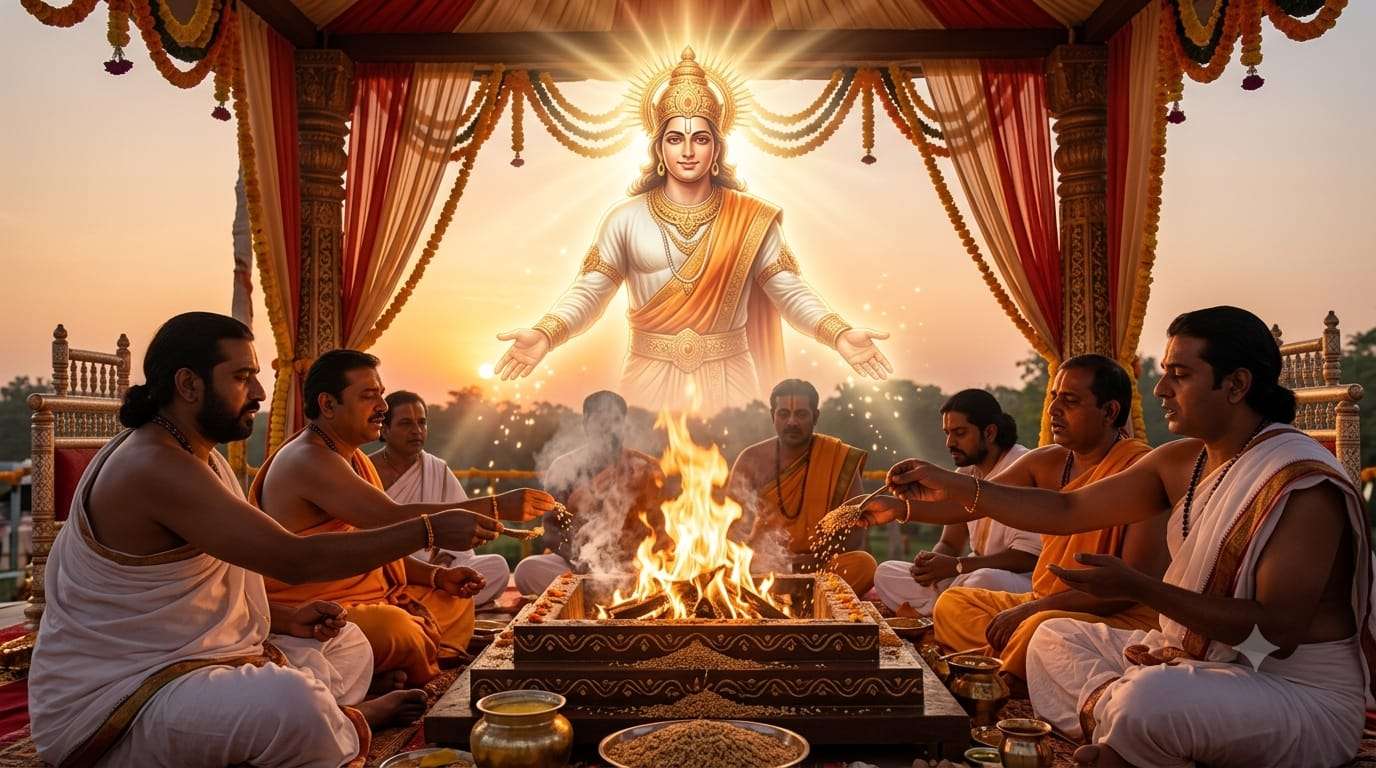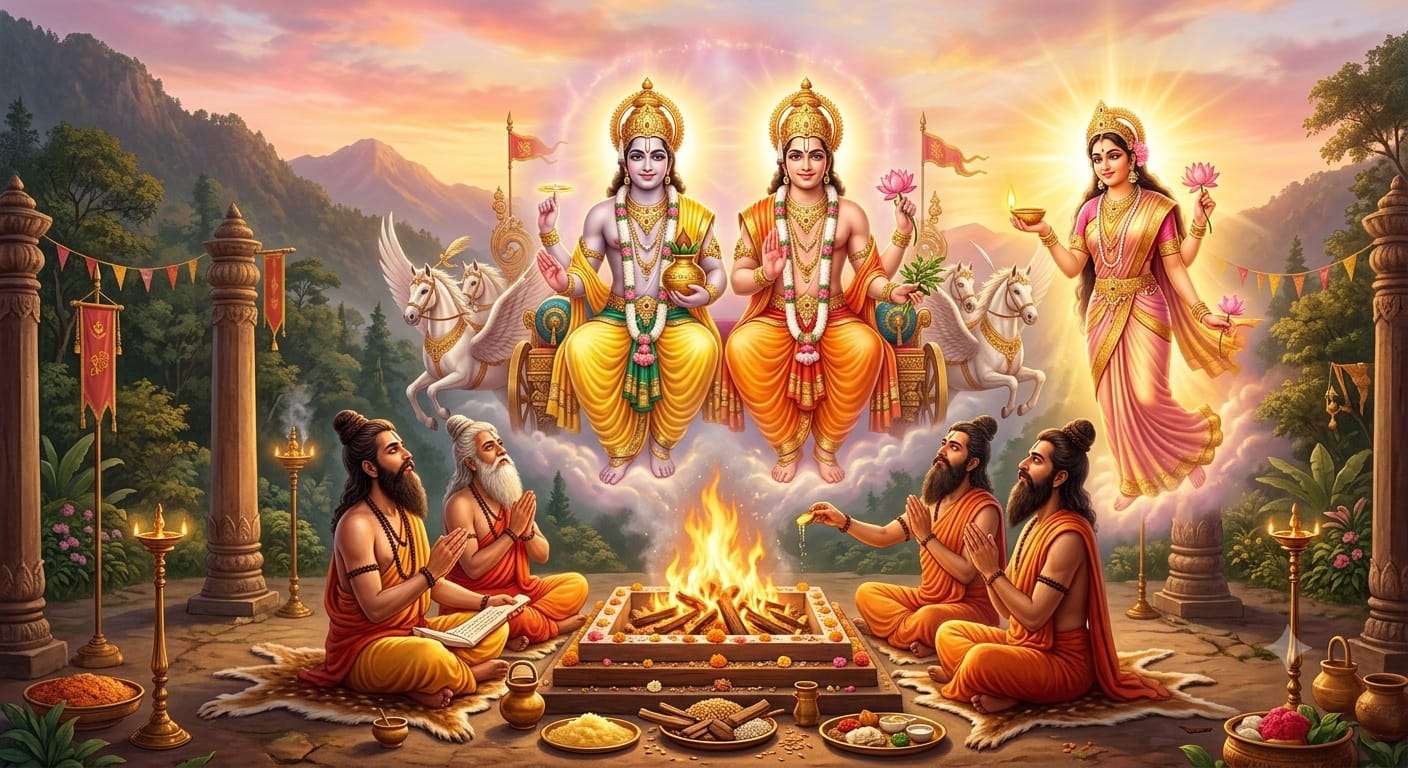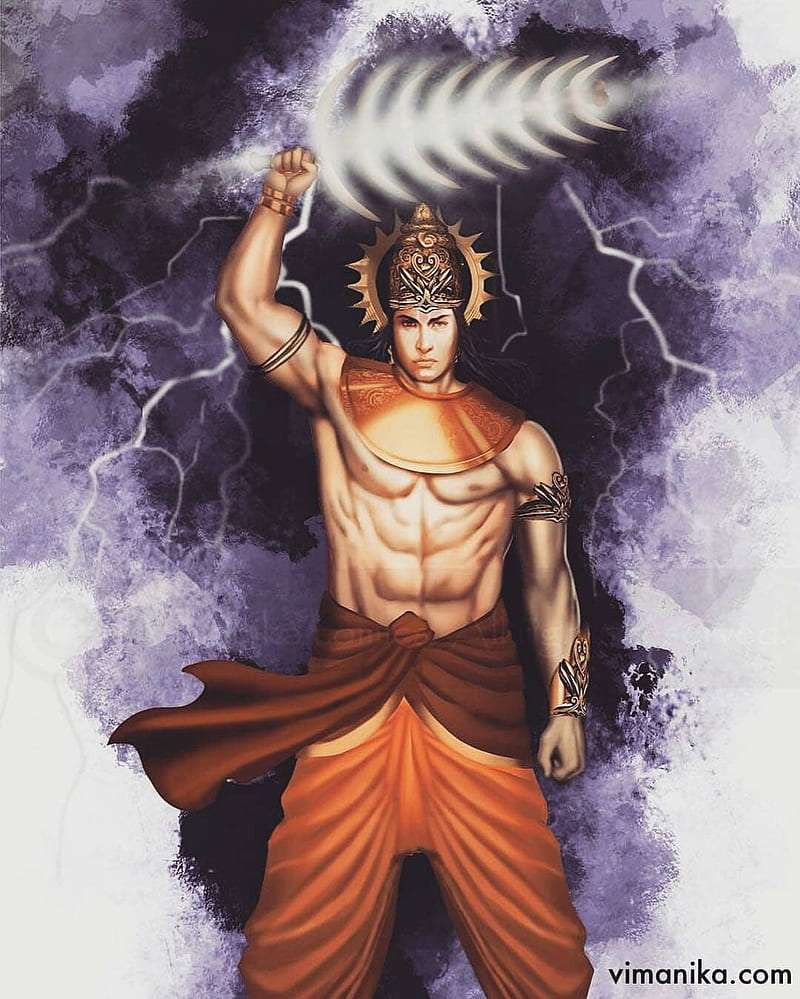
In the solemn cadence of the Jagatī chandas of the Rigveda, the sage Gouthama, born of Rahugana, lifts his contemplative voice in serene exaltation toward Indra, the guardian of cosmic and human order. In the quiet majesty of the sacrificial ground, he beholds Indra not merely as a warrior of celestial might, but as the vigilant protector of humankind, whose unseen strength secures their dwellings, enriches their fields with swift horses, and answers their prayers for the gentle abundance of cows. The sage, attuned to the rhythm of existence, invokes Indra to fill the human mind with wisdom and prosperity, even as the vast oceans are filled with inexhaustible waters, thus reflecting a profound harmony between natural plenitude and inner enlightenment.
The ritual unfolds with purified waters descending into the sacred vessel known as Chyamana, a symbol of receptivity and transformation. In the radiant expanse of the heavens, the gods direct their luminous gaze upon this sanctified vessel, their rays of perception falling upon it as streams of subtle energy. Just as a noble maiden, adorned with virtue and grace, becomes the object of desire for many worthy suitors, so too does this consecrated vessel attract the divine attention of many gods, each seeking to partake in the sanctity of the offering. The imagery reveals a refined understanding of sacred focus, wherein the ritual object becomes a convergence point of divine consciousness and human aspiration.
With reverence and precision, the priests prepare the purified sacrificial ladle, and the twin altars stand as embodiments of dual principles—earth and heaven, matter and spirit—harmoniously united in worship of Indra. The sacred utterance “yujevam,” woven into the mantras, resonates as a subtle force aligning the human will with cosmic intention. The patron who offers Soma, the divine elixir, along with oblations into the fire, attains a strength that transcends the need for conflict; though he does not enter battle, his inner power and stability render him invincible, reflecting a scientific temperament of energy conservation and spiritual equilibrium.
The ancient lineage of the Angirasas is recalled with reverence, for they, having once lost their cows and wealth to the cunning Phani, did not succumb to despair. Clad in devotion and sustained by sacred offerings, they kindled the divine fires and invoked Indra with unwavering faith. Through this disciplined act of ritual and consciousness, they regained their stolen herds and horses, illustrating the principle that order can be restored through alignment with cosmic forces. When Phani concealed the cows, the sage Atharva performed the Indra-yajña, rectifying the pathways of existence and restoring clarity to the hidden channels of life. Thus, he received the cows directly, face to face, symbolizing the unveiling of truth through sacred action.
In this divine enterprise, Nusana, the son of Kavi, emerges as a luminous assistant to Indra, representing the continuity of wisdom across generations. Through the meditative power of sacred vows, the Sun itself rises as a conscious force, dispelling darkness and subduing demonic obstructions. The immortal Indra is thus celebrated not only as a conqueror but as a harmonizer of energies, one who delights in the simple yet profound acts of ritual—the cutting of sacred grass, the chanting of hymns, and the rhythmic pressing of the Soma creeper by resonant stones. In these moments, the physical and metaphysical converge, revealing a scientific precision in ritual practice, where each action is both symbolic and energetically potent, sustaining the eternal dialogue between humanity and the divine.