Upadhyayula Lakshman Rao
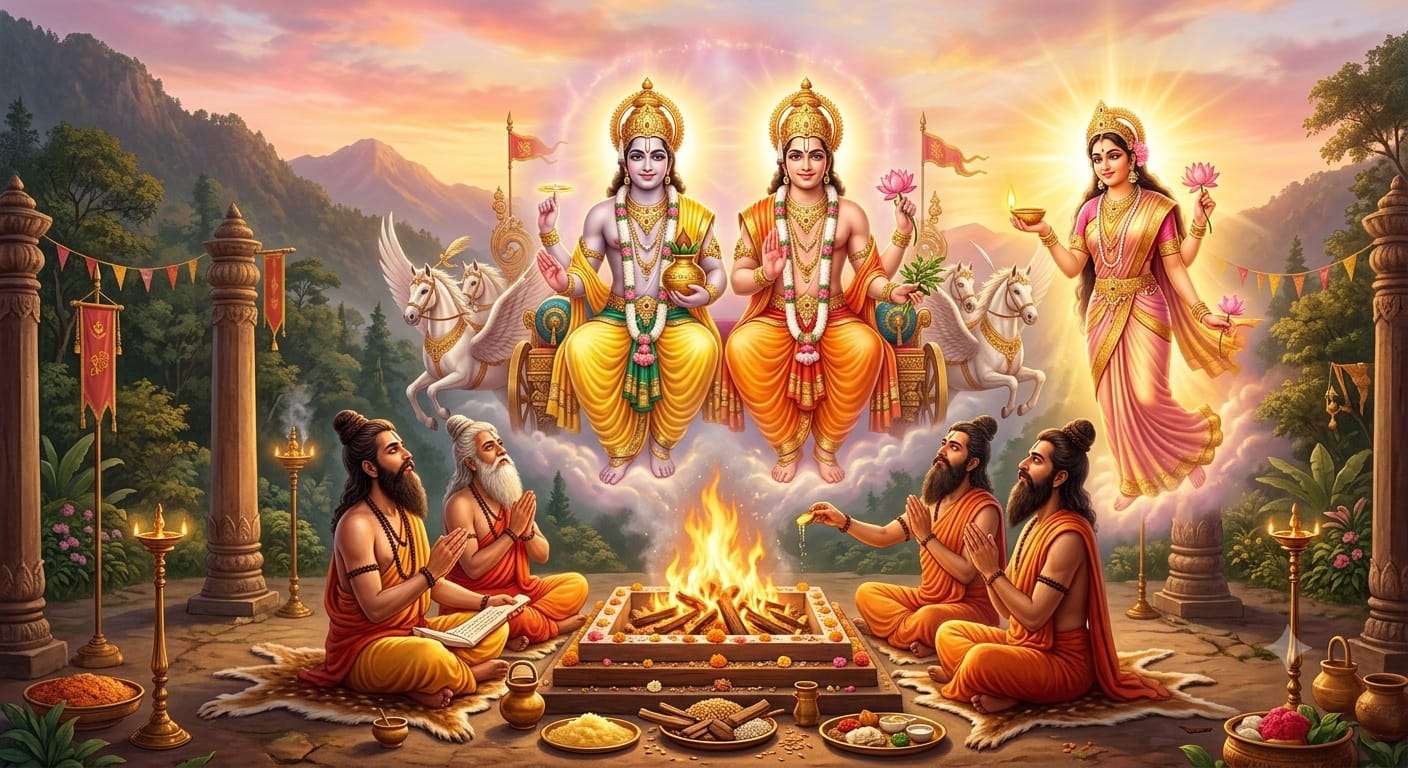
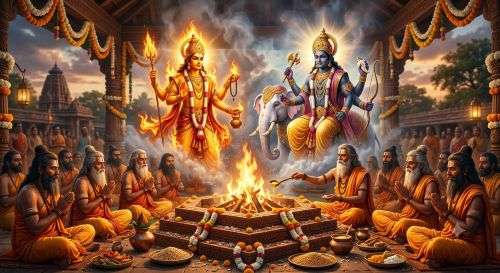
The sage Gouthama, son of Rahugana, raises his contemplative voice in measured devotion, weaving his prayer through the sacred metres of Anustup, Tristup, Jagathi, and Gayathri, thereby aligning his utterance with the rhythmic order of the cosmos. In this hymn, he invokes the dual divinity of Agni and Soma, the luminous and the vital, beseeching them to release the life-sustaining rains and to incline their awareness toward the earnest call of the sacrificer. His praise is not merely a recitation, but a conscious participation in the universal harmony, wherein the forces of fire and essence respond to the sincerity of human invocation and bestow comfort upon those who uphold the sacred order.
The sage reflects upon the patron of the sacrifice, who, with disciplined intent, performs the rituals and chants the hymns with precision and reverence. Such a one, he declares, becomes worthy of divine grace, and thus Agni and Soma are implored to grant him efficiency in action, abundance in cattle, and the strength symbolized by swift horses. These blessings are not to be seen as mere material gains, but as manifestations of a well-ordered life, where prosperity flows naturally from alignment with ṛta, the cosmic law. The offerings placed in the blazing fire, along with the sanctified cakes prepared in purity, become conduits through which the sacrificer’s aspirations ascend, returning as progeny, longevity, and continuity of lineage.
In the unfolding narrative of divine action, Agni and Soma are celebrated as heroic forces who restore balance to the world. They are remembered for reclaiming the stolen cows from the serpent-like hoarder and for overcoming the obstruction of Vritra, thereby releasing the waters and renewing the cycle of life. Their creative potency is further acknowledged in the formation of the sun, which illuminates existence for all beings. In this vision, the sage perceives not myth alone, but an early intuition of cosmic processes—the interplay of energy and matter, of combustion and transformation, giving rise to light and sustaining the universe.
The hymn deepens into a reflection on the cosmic architecture shaped by these twin deities. Agni, borne by the dynamic force of Vayu from the luminous realms, represents the descent of energy into the terrestrial sphere, while Soma, brought by the celestial eagle from the heights of Meru, signifies the ascent of life-sustaining essence into the ritual domain. This symbolic exchange mirrors a profound understanding of natural cycles—the movement of elements between heaven and earth, the circulation of vitality through different planes of existence. The placement of stars and planets, and the ordering of forces in space, are attributed to their divine intelligence, suggesting an early awareness of the structured and interconnected nature of the cosmos.
As the rivers are said to be cleansed of impurity by their influence, one may discern a subtle recognition of purification processes inherent in nature—the continuous renewal of waters, the filtering and restoring capacities that sustain ecological balance. Thus, the hymn bridges the spiritual and the observational, presenting a worldview in which sacred forces operate through discernible patterns, inviting both reverence and inquiry.
The sage continues to entreat Agni and Soma to accept the oblations offered with devotion, to bring forth rains that nourish the earth, and to dispel the fears of sickness that trouble the human condition. The ritual itself becomes a sanctuary of protection, guarded by divine presence, ensuring that no obstacle hinders its completion. The equal share of offerings granted to these deities affirms their esteemed place among the gods, and their willingness to partake signifies their intimate connection with human aspiration.
In the closing movement of the prayer, the sage gathers all intentions into a unified appeal. May Agni and Soma come together in harmony, protecting the horses that symbolize strength, the cows that yield milk and ghee, and the wealth generated through righteous offering. May they endow the sacrificer with enduring vigor and guide the ritual to its flawless fulfillment. Thus, the hymn stands as a testament to a vision where devotion, natural law, and cosmic order converge, revealing a refined synthesis of spiritual insight and an early scientific temperament that seeks to understand the universe through both reverence and reason.