



Being a perfect yogi, Krishna has no desire for achievement or gain in this world. Had he wished for a kingdom, he could have carved one for himself without effort, yet he stood on the battlefield only out of a sense of duty toward the noble and righteous cause upheld by the Pandavas. As he presents his own life as an example to Arjuna, he declares that even up to the very moment of the great war he has lived in complete detachment, having gained nothing, nor seeking anything further. He spends himself in ceaseless activity, as though work were a rapturous play of enthusiasm. Why, indeed, should Krishna work at all, and what loss would generations suffer if he were to remain inactive? Yet the masses always imitate their heroes in dress, conduct, moral values, and every branch of action, and they measure perfection by the standards of their leaders’ lives. If the Lord were to cease from work, humanity would follow his example, sink into inertia, and thus fall into an unproductive existence.
In nature, everything acts constantly and sincerely. The entire universe survives and sustains itself through activity. The ocean, though it never rises, gives rise to waves that dance upon its surface; without the ocean, the waves could not exist. Similarly, if the Lord were not to serve the world through unceasing action, the cultural life of generations would stagnate. If he were not to act, harmonious progress would be obstructed and the entire structure of universal law would collapse. The universe is not chaos; it is cosmos. Lawlessness is nowhere observed in the working of cosmic forces. Phenomena, the movements of the planets, the rhythmic dance of seasons, the music of creation, and the play of colours all occur in harmony, implicitly obeying the law of governance through the power of nature. Krishna, as the embodiment of divinity, declares this as a statement of fact: if he does not perform work, the world will perish. He represents the law governing both the outer world of beings and the inner world of thoughts and emotions.
Society is divided into four categories on the basis of individual mental temperaments. If the law governing inner temperament does not function properly, confusion in behaviour and instability of character must arise. The average person wears himself out in constant activity, regardless of conditions. Krishna explains that a person of self-realization also works in the world with equal diligence and sincerity, tireless enthusiasm, energizing joy, burning hope, and conquering fear, just as any ordinary individual striving in the field of competition. The difference lies only in motive: while the ignorant act under attachment and anxiety for results, one of divine intention and inner perfection works for the redemption of the world.
Thus, the practical method prescribed is that Arjuna should act without attachment to his limited, egocentric notions of self and relationships, and enter the battlefield as a champion fighting for a noble and righteous cause against forces that challenge the imperishable values of higher living upheld by ancient culture. When a person of balance and self-discovery enters the field of action, he becomes a true performer of sacred duty. Life is dynamic; no one can remain idle. Krishna declares a universal law to guide humanity not to revolt against the spirit of the times or against life’s own power. A society moving in a particular direction should not suddenly arrest its flow; rather, the leader should align with the generation and gradually guide it toward the right path through his own example. No wise person should unsettle others’ firm faith in action. He must himself perform ordinary duties diligently, divinely and purely, becoming an example for the world so that lesser minds may follow his unfailing steps.
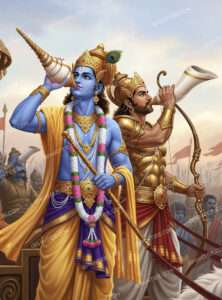
At this moment, Arjuna is significant, renowned as a heroic warrior and the greatest archer of his time. He must fight tirelessly and act in the battle of life, ruling over circumstances rather than surrendering to the arrows of attachment that fly toward him from all directions. Such mastery is the mark of the immortal hero, who can thereafter sit unarmed upon the chariots of mortal warriors and, without raising a weapon, guide the destinies of entire armies. That master hero knows the reality of the Self. Krishna’s counsel is that, while feeding the fire of life, one must carefully guide its flow into the proper channel, so that the flood of existence may water the gardens of cultural development, both in the individual and in the community.
Krishna clearly declares that Arjuna must fight, for the Pandava prince is not at present fit for the higher contemplative life of pure meditation. Action tends to create new impressions, which in turn generate further impulses toward action. To avoid this entanglement, Krishna advises acting without the spirit of ego. He further explains a method by which consummation can be achieved, saying, “Renounce all action in Me,” meaning in the Supreme Self, divine and eternal. Renunciation of action does not imply a dull life of inactivity. Rather, the purification of motive is accomplished by immersion in divine glory. Actions performed in the outer world by such a person become expressions of the Supreme, and he becomes a most efficient instrument of the divine will.
Krishna’s advice is to release oneself from predetermined channels of thought, to live in the present, and to act. There is no living being who is entirely free from imperfection, yet to attain higher fulfilment, one must seek refuge in the Divine and shed spiritual ignorance. Krishna seeks to unite the higher and the lower through self-evaluation, training humanity to live a higher way of life. Sanjaya reports to Dhritarashtra that Krishna removes all doubts by insisting upon action without attachment, leaving the consequences to the Lord. Thus, the entire responsibility for Arjuna’s effective performance on the battlefield is borne by Krishna himself.

