Upadhyayula Lakshman Rao
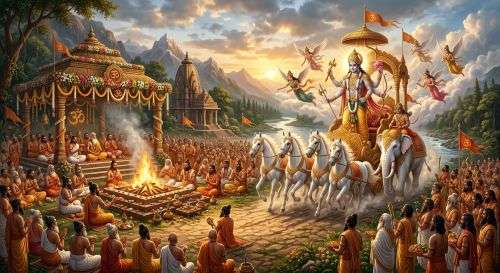
The sage Kutsa, born of the illustrious lineage of Angirasa, raises his voice in solemn devotion, weaving his prayer through the dignified measures of Tristubh and Jagati. With disciplined repetition and reverent intent, the ritual is performed again and again, not as mere habit, but as a conscious act of refinement. Each offering, each chant, deepens the bond between the sacrificer and the divine artisans, the Ribhus. The hymns flow with measured melody, carrying the resonance of cosmic order, while the Soma, abundant and purified, stands as both offering and symbol of awakened consciousness. Through the sacred utterance of “Svaha,” the oblation becomes a bridge between the human will and divine reception.
The Ribhus are not distant deities alone, but ancestral figures—kin who have traversed the path from mortality to immortality. Sons of Sudhanvan, they embody matured intelligence, disciplined effort, and luminous insight. Their journey reflects a profound truth: that divinity is not merely inherited but attained. Through austerity, contemplation, and precise action, they purified the Soma within and without, transforming both substance and self. Thus, they stand as exemplars of spiritual evolution, where the finite mind, through refinement, aligns with the infinite order.
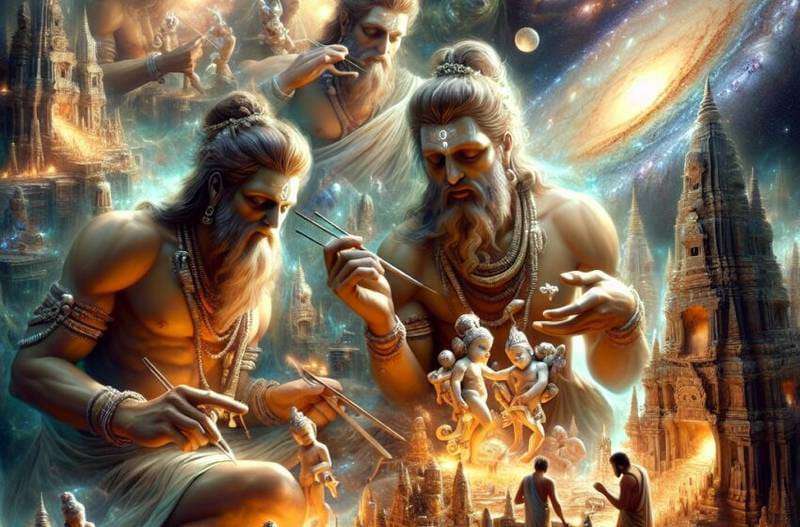
Their celebrated deeds reveal not only mythic grandeur but a subtle scientific temperament. When they divided the single vessel fashioned by Tvashtr into four, it was not merely an act of skill, but a demonstration of measurement, proportion, and creative intelligence. This act symbolizes the capacity to analyze, replicate, and multiply resources—an early reflection of structured thought and technological ingenuity. Likewise, their restoration of aged parents to youthful vitality speaks of regeneration, renewal, and the cyclical understanding of life processes, hinting at a deep observation of nature’s rhythms.
Elevated by Surya, the radiant witness of all action, the Ribhus attained divine status, signifying the illumination of intellect by truth. Their brilliance became akin to the Sun itself—steady, life-giving, and all-revealing. By sharing in the sacrificial oblations alongside the gods, they affirmed that human effort, when perfected, earns a rightful place in the cosmic order. Their association with Indra further emphasizes the union of strength and skill, of power guided by wisdom.
In their compassion and creative mastery, the Ribhus restored life where it seemed broken. They reunited the cow with its calf, symbolizing the restoration of nourishment and continuity. They fashioned the swift steeds and the resplendent chariot of Indra, embodying motion, energy, and purposeful direction. These acts reflect not only divine benevolence but also an advanced understanding of construction, function, and harmony between form and purpose.
The sacrificers, recognizing these virtues, invoke the Ribhus with sincerity and hope. They seek not only material wealth but sustainable prosperity—children, grandchildren, strength, and the continuity of righteous living. The prayer extends beyond individual gain to collective well-being, where society thrives through alignment with cosmic principles. The Ribhus are invoked alongside Indra, the Maruts, Mitra, Varuna, the Ashvins, Aditi, Earth, Ocean, and Space, forming an integrated vision of existence where all forces collaborate in balance.
Thus, the hymn unfolds as both devotion and declaration: that through repeated discipline, refined intellect, and ethical action, humanity can ascend toward divinity. The Ribhus stand as luminous proof that those who once worshipped become worthy of worship themselves. In them, the Vedic vision reveals a profound synthesis—where spirituality is not divorced from reason, and where scientific insight is sanctified by purpose. Through their grace, the seeker is assured not only of survival and victory in struggle but of a higher fulfillment where knowledge, action, and devotion converge