



Arjuna’s question arises in a mood most fitting to the Lord, for the universe itself is fashioned through an unbroken rhythm of creation and dissolution. Today rises from the ashes of yesterday; childhood vanishes before youth appears, and when youth fades, old age is born. Behind this visible play of constructive destruction stands the fundamental force that governs all life. Krishna reveals himself as mighty
Time, the world-destroyer, manifested to wipe away a generation that has decayed through false values and mistaken views of life and its purpose. This world-destroying attitude does not oppose the all-merciful Lord, for there is mercy even in destruction, as in pulling down a dilapidated bridge. By declaring that his very manifestation aims at the destruction of negative forces that choke the cultural life of the land, Krishna confirms
Arjuna’s vague hope of victory. He reassures him that in the great work of reconstruction, the Lord depends on no individual; it is Time itself that brings the renaissance and achieves revival. In such a colossal movement of universal restoration, individuals are but instruments of destiny, and whether they cooperate or not, Time’s design will prevail. The country needs renewal, the world demands human rehabilitation, and Krishna affirms that even without Arjuna, none of the warriors bound to the barren creed of materialism shall survive the war of the coming cultural upheaval. It is as though the Kaurava forces have already been slain by Time, and Arjuna, by aligning himself with the army of renewal, merely supports an assured triumph.
Therefore, as the representative of humanity across ages, Arjuna is urged to act fearlessly. Krishna consoles him directly, bidding him rise, seize the moment, and claim success and glory. Whatever the might of negative forces, the all-consuming power of change has already destroyed them, and Arjuna need only step forward, play the hero’s part, and claim the crown of victory. “I have already slain them; be only an apparent cause, O left-handed archer.” In all our undertakings, our contribution is but a fraction compared to what nature supplies and the unseen hand accomplishes. Self-surrender and service to the world in constant awareness of the Lord are not idle dreams meant to evade reality; they are essential disciplines that refine human character, strengthen efficiency, and ensure success. They sustain tireless enthusiasm and joyful inspiration. The Lord has already named the great warriors devoured by Time, showing Arjuna that the field is clear for him to advance toward the throne and claim the glory as his own.
Dhritarashtra listens to Sanjaya’s running commentary, which adds movement to the scene and offers subtle psychological insight into this awe-inspiring vision. Sanjaya, fully sympathetic to the righteous cause of the Pandavas, wishes to awaken the blind monarch to the magnitude of the impending disaster when he hears the Lord declare that all the leading warriors of the Kaurava host are already destroyed. He reports that upon hearing the words of Keshava, Arjuna, the crowned one, with folded hands and trembling with fear, spoke again. He proclaimed, “You are the primal God, the supreme Self, the creator, and the highest abode of the universe. The entire world of perception, the field of emotion, and the realm of thought experienced through body, mind, and intellect together constitute the universe, and you are both the knower and the known. You are the awareness that completes all experience. You pervade the universe as the ocean pervades its waves.” Thus far, Arjuna had praised the transcendent form of God, but now, in true understanding, he recognizes the infinite source of all potentialities in none other than Krishna himself.
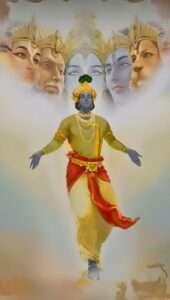
Prostrating in loyalty and adoration, Arjuna pleads for divine mercy and forgiveness. Overwhelmed by unspoken emotion and profound reverence, he addresses the Lord as the father of the entire world, of all that moves and all that does not. He affirms that there is none equal or superior to the Lord in the three worlds and begs him to bear with him as a father would with his son. He prays that the Lord resume his familiar form and relinquish the terrifying aspect of the transcendent and the universal. Though delighted by the vision he had never before seen, he confesses that in the early stages of seeking, one cannot long sustain equilibrium in that divine realm; the mind, though momentarily stilled, soon returns to activity. He longs to behold the Lord in his serene form and gentle presence. Seeing Arjuna afraid, the Lord withdraws his universal form and consoles him with sweet words.
Krishna then declares that this splendid, primeval, infinite, and universal form has not been seen by anyone else. Explaining why Arjuna alone was granted this vision, the Lord says that none can behold it merely through study of the Vedas, through sacrifice, charity, ritual, or even severe austerities. It is revealed only when the mind is steady and the intellect integrated, for no known discipline of self-development alone can produce this glorious achievement. This, he says, is his earlier form, the microcosmic representation of the divine individual. Sanjaya confirms to the blind king that Krishna returned to the very form in which he was born in the house of Vasudeva. He assumed the pleasing shape of the familiar friend of Arjuna, the beloved blue boy of the Gopikas, and thus consoled the mighty warrior.
Sanjaya continues his report from the battlefield as Arjuna admits that upon seeing the gentle form of Krishna, he feels relief from inner tension and agitation, and declares, “My mind is restored to its natural state, having seen the gracious human form of Krishna.” Sri Krishna then asks, “Have you been freed from delusion? Have you cast off ignorance?” Arjuna replies, “The dark veil has been lifted from my mind. By your grace and my complete faith in you, all my doubts have vanished. Your cosmic form has strengthened my wisdom. Guide of the universe, instruct me in what I should do.” Then, holding his Gandiva bow, Arjuna stands with folded hands before Krishna. Sanjaya reports to Dhritarashtra that, by the grace of the great seer Vyasa, he heard the sacred discourse between Krishna and Arjuna and was granted the rare fortune of beholding the divine cosmic form. He has absorbed the essence of the yoga imparted to Arjuna, and his life is enriched by the divine message of the Bhagavad Gita. The cosmic form of Sri Krishna always transports him to the summit of joy.
O King Dhritarashtra, wherever the transcendent Krishna and the master archer Arjuna stand together, that place is enriched with prosperity, righteousness, and victory. Dhritarashtra then asks Sanjaya how the Kauravas and the Pandavas, poised with pride for battle, stand upon the field, and who first loosed the arrow that began the war, urging him to narrate the events in detail. Thus Sanjaya, slowly returning from the ecstasy of the cosmic vision of Sri Krishna, prepares to continue his account.

