



All the commanders were thrown into intense strain the moment they heard the Marshal’s bugle, and each, stirred individually, lifted his own instrument and proclaimed the call to arms. Thus conches, kettle drums, tabors, trumpets, bugles, and cow horns burst forth together, hurling defiance and summoning battle. Sanjaya reported this sight to Dhritarashtra with reluctant awe, declaring it both tremendous and mind-stirring, for the sound itself seemed to shake resolve and awaken destiny.
Soon the Pandavas welcomed the challenge and answered the summons. Sanjaya described their response as terrific, resounding through heaven and earth alike. From their side, Krishna and Arjuna, seated in a magnificent chariot drawn by white horses, Madhava and Arjuna blew their divine conches, Panchajanya and Devadatta. Even in this deliberate narration there lingered a quiet hope that Dhritarashtra might yet be persuaded to withdraw his consent and halt the impending destruction. Sanjaya was careful to name each warrior’s conch with its distinct title. Panchajanya was blown by Krishna, called Hrishikesha, the Lord of the senses. The fierce doer of dreadful deeds vrukodara blew the mighty conch Paundra. King Yudhishthira, son of Kunti, sounded Anantavijaya. Nakula and Sahadeva blew Sughosha and Manipushpaka. The king of Kashi, an excellent archer, Shikhandi, the mighty commander of eleven thousand archers Drishtadyumna, Virata, Satyaki the unconquered, Drupada, the sons of Draupadi, and the sons of Subhadra, mighty in arms, all blew their respective conches.
Sanjaya proclaimed, “O Lord of Earth, the battalion commanders, filled with enthusiasm, sounded their conches again and again in rising cadence.” He recalled that the arrow which would ultimately fell Bhishma was to be released by Shikhandi, and that Satyaki, charioteer of Sri Krishna and himself a battalion commander of the Pandava host, likewise repeated his war call. Sanjaya thus offered an exhaustive description of the Pandava forces, gathering all his powers of expression to impress upon Dhritarashtra a vivid sense of their superiority. He nurtured the hope that the monarch would awaken at the last moment, perceive the disastrous end of war, and issue the command to halt this fratricidal conflict.
Sanjaya then described the readiness and arrival of the hero Arjuna upon the field, narrating the precise moment and manner of his entry in its true spirit. The shooting had not yet begun, yet it was unavoidable. It was the most tense moment, when crisis soared to its height. At this moment, Arjuna, whose banner bore Lord Hanuman, spoke the following words to Sri Krishna, his charioteer and guide. In ancient warfare each warrior bore a cherished flag, displaying a well-known symbol, by which the enemy could recognize the occupant of the chariot. A hero was not to be challenged or struck by a soldier of lower rank, but each fought his equal, and this system of recognition by emblem was observed in all ages by kings, celestials, demons, and monarchs alike. Arjuna’s ensign was that of the immortal Lord Hanuman, whose living and abundant blessings rested upon the great hero.
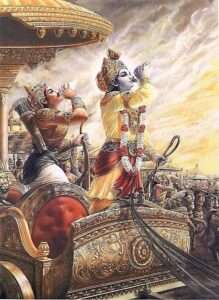
Eager to commence the great war, Arjuna raised Gandiva, the divine, power-driven weapon, declaring his readiness to fight. He commanded his charioteer, Sri Krishna, to drive the chariot between the two armies, that he might behold and recognize the prominent warriors he must confront. He wished to survey the enemy lines, revealing his chivalry, undiminishing courage, firm resolve, adventurous spirit, and commanding energy and strength. Until this moment, Arjuna’s mind, spirit, and body stood in perfect harmony, and his piercing warrior’s gaze shattered the confidence of the Kaurava forces.
The invincible Arjuna explained why he sought this survey. A man of action, he would take no risk, but desired to observe for himself those low-minded, power-mad, and greed-ridden men who had joined the Kauravas, so that he might shape his strategy. He wished to know precisely who supported the palpably tyrannical and evidently unjust cause of the unscrupulous king Duryodhana. Grinding his teeth and uttering heated words, he spoke of his relentless cousins.
At the sight of Bhishma, Drona, and the kings of many realms, the divine charioteer Krishna drew the reins and brought the royal chariot to a halt. As a dutiful guide, Krishna said to Arjuna, “Behold, O Partha, all the Kauravas gathered together.” These were the only words he spoke. Yet these words, joined with the scene upon the battlefield, struck and ignited the proud edifice of false values the great hero had built within himself, and the immense challenge shattered him inwardly. Partha, meaning son of Pritha, another name of Kunti, in the pure language of Sanskrit also bears the sense of one formed of earth, clay-born, mortal. By this name the Immortal addressed the mortal Arjuna, representative of humankind, signifying that the discourse of divine truth was about to begin.
Thus Sanjaya continued his report with skill and sympathy, seeking through his narration to move King Dhritarashtra toward compassion and to avert the war.

