



Kathopanishad: Conversation between Lord Yama and
They perceive that indescribable highest bliss as “This is That”. How shall I know that? Does it shine by itself or does it shine by another (light)?
When one goes through the process of contemplation, a journey of culminating in meditation, that is when you reach a point where you perceive the truth subjectively. ‘That’ refers to Brahman. ‘That’ you are referring to is far away beyond our reach. ‘This’ is something which is our experience and refers to the world. This world is That Brahman. You experience and realise Brahman in the world. Your experience it subjectively through the sadhana. ‘This is That.’ Everything I see is God. Now we don’t see because we see the world of plurality, otherness, names and forms. We don’t see God in the world. When we go through contemplation and meditation, then we perceive the truth intimately within us. Then we say ‘This is That’. That Brahman is within my experience. Everything I see in this world is nothing by God. That is the culmination of that experience. You can perceive God outside only when you realise it inside.
Mantra says, ‘How shall I know that?’ The Self, which is the light of wisdom, does not need any other light to light itself. Like the Sun does not require any other light to be seen. The sun itself is the very source of light, and it is responsible for you to perceive it. We are not able to perceive the Self, although the Self is self-illuminating. It is due to self-created avarana ignorance we are not able to see the Self. Ignorance creates vikshepa mental agitations. When I remove the ignorance, the Self, which is self-illuminating, reveals itself.
Eg: When a brass vessel is tarnished and we use the cleaning agent, and when the dirt is removed, the vessel shines by itself. Knowledge is like a cleaning agent. As you go through the process of cleansing yourself, removing the ignorance through knowledge, and calming the mind of its agitations, the Self which is shining within reveals itself like the Sun. You can experience the Self in every phase of life.
The brass vessel shines further when you clean again. In the same way, the more you clean yourself, the more you purify and the Self reveals itself.
The assurance you get from the shastras is that you are not able to experience the shininess because of the impurities within you. It is the intelligence that lights everything. You don’t require anything to illuminate IT. Sun does not need any other light to illuminate. Similarly, the Atman within you does not require any other light to illumine it. It is self-illuminating.
The state of Brahman, self-realisation, is being described as bliss from the highest perspective or happiness from the relative perspective. Relatively, every individual is continuously seeking happiness, which is the very purpose of life. The principle one should understand is, ‘nothing external can give internal happiness or permanent bliss’. At a relative level, when we seek happiness from external objects, we are dependent on them. All our experiences are outward with the objects and beings of the world. The joy derived from such experiences are temporary. Even at the absolute level, you cannot experience the supreme bliss objectively. You will have to experience it subjectively. The real happiness arises when you move away from objects and beings of the world and turn inward.
God is not an object of perception, emotion and thought. God is the subject within. The intellect cannot shed light on the Atman because it is the very intelligence in the intelligent. Any amount of outward ritual, external practises of spirituality will not give you the true bliss of the Self.
Happiness is a state of mind. It emanates from within you and is not derived from outside. The moment you derive from outside, it is not happiness. It is a temporary joy or excitement that you experience. This joy should not be misconstrued as true happiness.
When thick clouds veil the sun, we do not see the sunlight. Similarly, the Atman is radiating bliss, but we do not experience it because it is veiled by our ignorance. The irony is that the clouds are formed because of the sun, and yet the clouds have the capacity to veil the sun. Avidya ignorance manifests and clouds the Self in the form of vasanas, which in turn express as desires and produce agitations. When these two finite obstacles of ignorance and agitation are removed with finite knowledge, the Self reveals itself.
The sun does not shine there, nor does the moon, nor do the stars, nor the lightning and much less this fire. When He shines, everything shines after him, by His light, all these shine.
This mantra also appears in the Mundaka Upanishad, the Shvetashvatara Upanishad and similar concept in the Bhagavad Gita, Chapter 15 – Vs. 6.
This mantra is chanted during the Aarati in a temple at the end of the puja or any ritual.
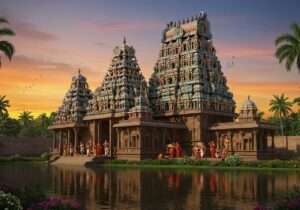
Temple symbolises the individual. The temple is constructed just as the individual is constituted.
The periphery of the temple is exposed to the sky. It represents the gross body, which is exposed to the outside world. There are two more layers before the sanctum sanctorum. These two layers represent subtle and causal bodies. The outer layers of the temple are well lit which denotes that the individual’s three layers, gross, subtle, and causal bodies, are known to him. The sanctum sanctorum is kept dark only to convey the message that you have not realised the Self within. People can see the Lord only when the aarti is shown. During the aarti, this mantra is chanted, and we can see the deity in that little light.
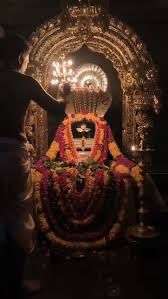
Inside the sanctum sanctorum, there is Akhanda Jyothi or Akhanda Deepam, which is always lit. It is known as the Eternal Flame. The pujari lights the camphor from that akhanda jyothi and gives the aarti to the deity. Only when camphor is getting burnt, you get a glimpse of the Lord. With the Akhanda Deepam, we don’t see the deity.
The innermost layers have three facets:
- Firstly, the sanctum sanctorum is kept in the dark intentionally.
- Secondly, the presence of the eternal flame, akhanda jyothi.
- Thirdly, is the burning of the camphor, which gives you the darshan of Lord.
While these three are connected with the backdrop of the mantra, it says the mighty sun, moon, stars, lighting cannot illumine and what this little flame aarti can illumine the Lord. This is chanted while having the darshan of the Lord.
Akanda deepam, constantly glowing at the feet of the Lord, represents the conscience. It is an aspect of subtle intellect. Conscience is the messenger of God and constantly points towards the Truth or Reality. It is the ultimate guiding factor in our life that takes us to the path of realisation. Nothing is closer to God than the conscience.
The pujari takes the camphor and lights it from the akhanda deepam. Camphor symbolises vasanas. Vas means fragrance. So, camphor is considered a consolidated fragrance. Similarly, your substantial personality is a product of insubstantial vasanas. Vasanas have no form or shape, but that creates a substantial personality. When camphor is burnt Lord is seen. Similarly, knowledge of the Self burns the vasanas, and the Self reveals itself.
Sun, stars, and lightning refer to direct light, which cannot illumine the Self. The moon refers to indirect light, which cannot illumine the Self. The fire from the aarati does not illumine the Lord. On the contrary, when He shines, everything shines after him. When the Self shines, the sun, moon, stars, lightning, and all external luminosities shine. The self is responsible for illuminating everything else.


Pranam Guruji.
You have explained the concept of Aarti illuminating the deity in Santum sanctorum when camphor is burnt. We now understand the concept why the innermost sanctum sanctorum is kept in darkness.
Anek aabhar Guruji 🙏