



The suggestion by Russian Foreign Minister Sergey Lavrov that India could emerge as a long-term mediator in the worsening West Asia crisis is not merely diplomatic courtesy. It reflects a changing geopolitical reality. The old power centres are exhausted, mistrusted, or too deeply invested in regional rivalries to act as honest brokers. Amid that vacuum, the possibility of India stepping in—carefully, selectively, and strategically—deserves serious consideration.
The question, however, is not whether India can mediate. The real question is whether India should.
For decades, New Delhi largely avoided direct political involvement in West Asian conflicts. India traditionally maintained a balancing posture—supporting the Palestinian cause historically, deepening strategic relations with Israel in recent decades, preserving civilizational ties with Iran, and simultaneously strengthening economic and security partnerships with Gulf monarchies such as United Arab Emirates and Saudi Arabia. That delicate balancing act once reflected weakness and dependency. Today, it reflects diplomatic maturity.
Unlike many Western powers, India is not viewed in the region as a colonial manipulator. Unlike China, it is not seen as an opaque economic predator. Unlike Pakistan, whose repeated attempts to position itself as the Islamic world’s political voice have steadily collapsed under economic instability and credibility deficits, India enjoys trust across ideological camps. That trust is India’s greatest strategic asset.
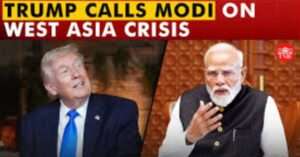
Prime Minister Narendra Modi has carefully cultivated this space over the past decade. India today speaks comfortably to Washington, Moscow, Tehran, Tel Aviv, Abu Dhabi, and Riyadh without appearing subordinate to any one bloc. Very few countries possess that flexibility anymore. That may be reason why Modi, who is now in UAE, responded positively to the Russian Foreign Minister’s suggestion.
This is why Lavrov’s remarks matter.
India also has hard national interests at stake. Nearly 3.5 million Indians live and work across the Gulf region. Any prolonged escalation threatens not only their safety but also India’s remittance economy, energy security, shipping routes, and domestic economic stability. Crude oil disruptions in West Asia directly affect inflation, trade deficits, and fiscal planning in India. Therefore, peace in West Asia is not merely a moral objective for New Delhi—it is an economic necessity.
At the same time, India must avoid romanticizing the mediator role.
West Asia is not a conventional diplomatic dispute waiting for a neutral facilitator. It is a battlefield shaped by ideology, sectarianism, proxy wars, great-power competition, historical trauma, and religious nationalism. The divisions involving the United States, Iran, Israel, Arab nations, and various militant actors are deep and emotionally charged. Even superpowers have repeatedly failed to stabilize the region despite military interventions and peace initiatives.
India must therefore resist the temptation of high-visibility diplomacy designed for headlines rather than outcomes.
There is also danger in overexposure. If India formally assumes a central mediation role without quiet consensus from all parties, any diplomatic collapse could damage relationships painstakingly built over decades. A failed mediation effort may provoke backlash from rival camps and expose India’s diaspora and energy interests to avoidable risks. Strategic neutrality is useful only as long as it remains credible.
This is where New Delhi’s current approach appears sensible.
Rather than projecting itself as a grand peace broker, India seems more comfortable playing the role of a stabilizing interlocutor—keeping communication channels open, facilitating dialogue where possible, encouraging de-escalation, and quietly building consensus behind closed doors. That approach suits India’s diplomatic culture far better than theatrical summit politics.
India’s strength lies not in coercion but in credibility.
There is another important dimension. The global order itself is changing rapidly. The moral authority of the West has weakened after years of selective interventions and inconsistent positions on sovereignty and human rights. Simultaneously, many countries in the Global South are searching for alternative centres of diplomatic leadership. India’s emergence as a balancing power is increasingly being acknowledged not only in Asia but across Africa and the Middle East.
However, leadership also demands caution.
New Delhi cannot afford to be drawn into the dangerous trap of choosing ideological camps in West Asia. India’s interests are fundamentally civilizational and pragmatic, not sectarian. It has productive ties with Jewish-majority Israel, Shia-majority Iran, Sunni Arab monarchies, and the broader Islamic world. Preserving that equilibrium is more important than chasing diplomatic glory.
The collapse of Pakistan’s credibility in the Islamic world has also altered regional equations. Once projected as a natural intermediary between Muslim nations and global powers, Islamabad today struggles with internal instability, economic dependence, and diminishing geopolitical relevance. Many Gulf nations now increasingly view India—not Pakistan—as the more reliable strategic and economic partner. That shift has opened doors that were unimaginable two decades ago.
Yet India must remember that mediation is not a trophy. It is a burden.
If New Delhi eventually accepts a larger role, it should do so only under certain conditions: clear consent from all principal stakeholders, limited and realistic objectives, and a framework focused on de-escalation rather than grand conflict resolution. India should prioritize humanitarian corridors, maritime security, energy stability, prisoner exchanges, and back-channel dialogue before attempting ambitious political settlements.
That calibrated approach aligns with India’s broader foreign policy philosophy under Modi—assertive but restrained, ambitious but interest-driven.
In the end, India neither needs to reject the mediator role outright nor rush into it recklessly. The wiser course lies somewhere in between. In a fractured world searching for credible voices, India has an opportunity to act not as a self-appointed saviour, but as a responsible stabilizing power.
And perhaps that is exactly what the world needs today—not another power seeking dominance, but one capable of building trust where trust has almost disappeared.


