



Charan Mandir is an ancient Krishna temple located in the Nahargarh hills near Amer and Jaipur in Rajasthan. The temple stands inside the forested Aravalli region on the old route leading toward Nahargarh Fort and overlooks Jaipur city, Jaigarh Fort, and the surrounding valleys. The shrine is situated in the ancient forest region traditionally known as Ambika Van, which is connected with Vaishnava traditions and legends associated with Lord Krishna.
Charan Mandir is believed to be more than 400 years old and is considered one of the oldest Krishna shrines in the Jaipur region. The temple was constructed during the reign of Mirza Raja Man Singh I of Amer in the late 16th century, long before Jaipur city was founded in 1727. According to local traditions, Raja Man Singh built the temple after receiving divine guidance in a dream revealing the sacred location of Lord Krishna’s footprints in the forests of Ambika Van.
Charan Mandir is unique because the principal object of worship is not a traditional idol of Lord Krishna but the sacred footprints of the deity, known as Charan Chinh or Charan Paduka. Devotees believe these footprints were naturally imprinted on a rock by the divine touch of Lord Krishna during the Dwapara Yuga. In Vaishnava philosophy, worship of the Lord’s feet symbolizes surrender, protection, humility, and liberation from worldly suffering.
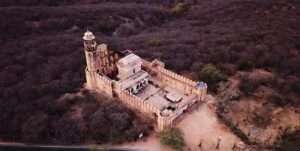
The architecture of Charan Mandir is simple and strongly influenced by Rajput hill construction styles. The temple appears more like a small fortified structure built naturally into the rocky terrain of the Aravalli hills. It contains stone walls, open courtyards, ancient pathways, and a watchtower-like structure overlooking the surrounding valleys. The minimalistic design and forest surroundings create a calm and spiritual atmosphere rarely found in crowded pilgrimage centers.
According to temple tradition, Raja Man Singh I of Amer was a devoted follower of Lord Krishna. One night, Krishna appeared in the king’s dream and instructed him to search for a sacred location hidden deep within the forests of Ambika Van. The next morning, the king entered the forest with priests and attendants in search of the divine site. After a long search, they discovered sacred footprints naturally imprinted on a rocky surface. Priests identified these marks as the footprints of Lord Krishna described in Vaishnava traditions. Believing the discovery to be divine, Raja Man Singh ordered the construction of a temple at the exact location so that devotees could worship the sacred footprints.
The sacred legend of Charan Mandir is connected with an episode described in the Shrimad Bhagavatam and preserved in local Vaishnava traditions. During the Dwapara Yuga, Lord Krishna once traveled through the forests of Ambika Van along with Nanda Baba, cowherds, and cows. In the same forest lived a celestial being named Sudarshana who had been cursed by sages of the Angira lineage to take birth as a giant python because of his arrogance and disrespect toward holy saints.
One day, while Krishna and the cowherds rested in Ambika Van, the cursed python suddenly attacked Nanda Baba and wrapped itself around him. Frightened cowherds cried out for help and prayed to Krishna for protection. Lord Krishna immediately approached the serpent and touched it with his divine right foot. The moment Krishna’s foot touched the python, the curse was broken and Sudarshana regained his celestial form. Filled with gratitude, he praised Lord Krishna and returned to his heavenly abode.
According to temple belief, the exact place where Krishna placed his divine foot became eternally sacred. The rocky surface softened due to divine energy and preserved the impression of Krishna’s footprints, which are worshipped today at Charan Mandir. Local traditions also state that nearby marks belong to the cows that accompanied Krishna during the incident.
Janmashtami is the most important festival celebrated at Charan Mandir and attracts large numbers of devotees for special pujas, bhajans, kirtans, and midnight celebrations marking the birth of Lord Krishna. Holi is celebrated with devotional singing and traditional Krishna worship, while Sharad Purnima and the holy Kartik month are observed with special prayers, meditation, and Vaishnava rituals in the peaceful hilltop atmosphere of the temple.


