Upadhayayula Lakshman Rao
The sage Kutsa, born of the illustrious lineage of Angirasa, raises his voice in the resonant cadence of Tristubh metre, invoking Indra and Agni—the twin powers of dynamic force and luminous intelligence. With reverence, he beholds them as venerable deities whose radiant chariots traverse and illumine the worlds. He invites them to descend upon these celestial vehicles and partake of the Soma elixir, the sacred essence that nourishes not only the gods but also the subtle harmony of the universe. The vastness of creation, majestic and ordered, finds fulfillment when these divine forces partake in its sustaining rhythm, for their satisfaction reflects the inner equilibrium of existence itself.
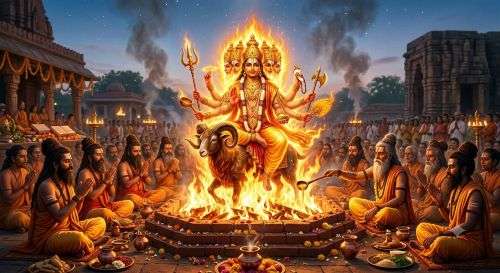
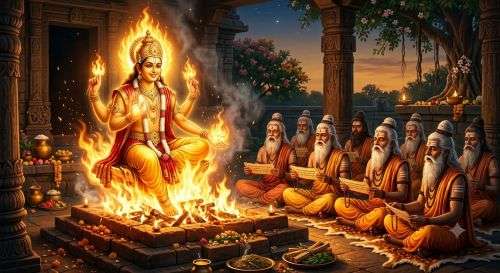
United in name and purpose, Indra and Agni move together as inseparable principles of energy and transformation. Their companionship is not merely symbolic but reflects a profound unity in cosmic function—where power and illumination cooperate in the orchestration of natural law. Together they release the rains, sustaining life and renewing the earth. Now, the sage envisions them seated upon the sacred altar, joyfully consuming Soma, while the sacrificial fires blaze with brilliance. Around them sit the priests upon sanctified grass, performing the ritual with precision, offering oblations through carefully prepared wooden ladles, embodying both devotion and disciplined knowledge.
The invocation grows more earnest as the sage calls upon them to hasten, for the Soma has been prepared with care and intention. He recalls their mighty deeds—the slaying of Vritra and other obstructing forces, acts that symbolize the triumph of order over chaos. Through their combined strength, they have generated wealth in the form of cattle and horses, archetypes of prosperity and vitality, and have caused life-giving rains to descend. Their friendship, ancient and auspicious, is rooted in shared purpose and harmony of thought, a model for unity within diversity.
The sage further reflects upon the deeper meanings embedded in the names of various peoples—Yadu, Turvasu, Druhyu, Anu, and Puru—interpreting them not merely as lineages but as symbolic representations of human tendencies. Thus, the hymn transcends historical reference and enters philosophical terrain, where human character and ethical disposition are subtly examined. Wherever Indra and Agni may reside—among kings, in distant realms, or within the cosmic expanse—they are invited without fail to partake in this sacred act, affirming the universality of divine presence.
Whether in the earthly plane, the mid-space, or the luminous heavens, the deities are called upon to arrive, bringing with them the rains and blessings that sustain life. The Soma offered is not merely a ritual substance but a symbol of refined consciousness, extracted through effort and purity. In return, the sage seeks wealth—not only material abundance but nourishment, wisdom, and continuity of lineage. He acknowledges that the power of discernment, the ability to distinguish kin from non-kin and truth from falsehood, is itself a divine gift bestowed by these deities.
With humility and devotion, the sage prays that Indra and Agni may bestow prosperity surpassing even that granted by close kin, and grant an unbroken lineage, strong and enduring like an unsevered thread. He envisions descendants endowed with strength and virtue, reflecting the continuity of dharma across generations. The hymn, newly composed, stands ready alongside the prepared Soma, as an offering of both intellect and devotion.
The deities are praised as possessors of strong steeds and vital energy, drawn by the force of hymns and offerings. They are acknowledged as creators of wealth and destroyers of obstruction, seers of all that exists. The sage invites them once more to sit upon the sacred grass and accept the offering, emphasizing their supremacy in battle and their brilliance surpassing all elements—sky, waters, mountains, and beyond.
Finally, the hymn expands into a universal prayer for protection and harmony. The forces of order—Mitra, Varuna, Aditi, along with the cosmic expanse of heaven and earth—are invoked to safeguard the ritual and its intent. The path shown by the solar radiance, guiding the ancestors to higher realms of realization, is remembered with reverence. Thus, the hymn weaves together devotion, cosmology, ethics, and a proto-scientific awareness of natural forces, presenting a vision where ritual, thought, and cosmic law converge into a unified spiritual experience.