


The cosmic form of Sri Krishna filled Arjuna with awe and wonder. Step by step, he described what he beheld: the terrible mouth of death, blazing with fire and adorned with fearful tusks, into which all beings were drawn. Bhagavad Gita presents this revelation not merely as a supernatural spectacle, but as a profound disclosure of the truth that all existence is subject to the irresistible movement of time. In silent majesty, Krishna reassured Arjuna of the victory to come, while revealing that all forms, whether noble or ignoble, must ultimately enter the devouring mouth of eternity.
This vision embodies a philosophy that embraces reality in its totality, without fear or sentimentality. Truth cannot be complete if it recognises only the pleasing and life-giving aspects of existence while ignoring destruction. Every act of creation presupposes transformation; what appears as destruction is often the dissolution of one form to make way for another. Throughout the universe, existence is nothing but a ceaseless process of becoming and passing away. Creation and destruction are not opposing forces but complementary expressions of one continuous cosmic rhythm.
The ancient seers of the Aryan tradition perceived the Divine not only as the omniscient creator and compassionate sustainer, but also as the all-powerful devourer of all names and forms. To those who view life only partially, this aspect appears terrifying. Yet to the wise, it is a necessary and sacred truth. Arjuna compared the movement of beings into the divine mouth to rivers rushing toward the ocean. Each river possesses a distinct name, shape, and character, formed by the terrain through which it flows, yet none can remain separate forever. In reaching the ocean, all distinctions dissolve, and the river regains its original identity.
Every drop of water arises from the ocean, becomes cloud, rain, stream, and river, nourishing the earth along its journey, only to return at last to its source. Likewise, individuals emerge from the Infinite, contribute to the enrichment of the world, and finally return to the very Reality from which they came. Nothing is lost in this return. The temporary individuality acquired during life is but a functional expression of the one universal Being.
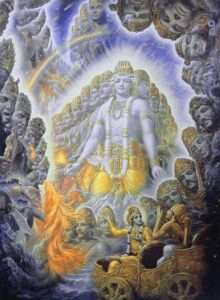
Arjuna further likened the fate of beings to moths rushing into a flame. His anguish on the battlefield arose from the belief that he alone would be responsible for the destruction before him. Krishna elevated his understanding, enabling him to perceive death as an inevitable movement within the cosmic order. As rivers seek the sea and moths rush toward light, all names and forms move toward the unmanifest. One who realises this truth becomes fearless, recognising that death is not annihilation but transition.
The insatiable mouth of the cosmic form symbolises the eternal principle of transformation. This insight illuminates the doctrine of the Trimurti: Brahma the creator, Vishnu the sustainer, and Shiva the destroyer. Though distinguished conceptually, these are inseparable functions of a single Divine Reality. Creation unfolds through transformation, preservation depends upon balance, and destruction clears the ground for renewal. The continuity of existence rests upon this constructive destruction.
When Arjuna perceived this all-encompassing splendour, radiant like countless suns, he was overwhelmed by reverence. The vision shattered his limited perspective and revealed the sacred unity underlying all events. Bowing before Krishna, he surrendered in humility and devotion.
Yet even while witnessing the fulfilment of what he inwardly desired, Arjuna sought to understand the deeper purpose behind the revelation. He asked to know the Primeval One and the meaning of the Lord’s terrible form. Like every earnest seeker, he longed not merely for favourable signs, but for direct confirmation of truth from the Divine itself.

