


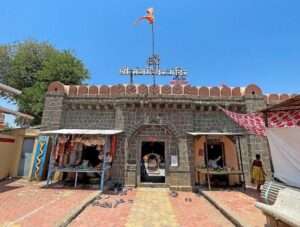
Haripur Sangameshwar Temple is located in Haripur village near Sangli city in Maharashtra. The temple stands at the sacred confluence of the Krishna and Warana rivers, which is known as a Sangam. Because the temple is situated at this holy meeting point of two rivers, Lord Shiva here is worshipped as Sangameshwar, meaning “Lord of the Sangam.”
The temple is believed to date back nearly 800 to 900 years and is associated with the Later Chalukya period of the 11th–12th century CE. Historians believe that the core structure of the temple was built during medieval Deccan rule and later renovated by local rulers, devotees, and Maratha-era patrons. Even after centuries, the temple continues to remain an active center of Shaiva worship.
The main deity of the temple is Lord Shiva, worshipped as Shri Sangameshwar Mahadev. The Shiva Lingam inside the sanctum is believed by devotees to be Swayambhu (self-manifested). The deity is considered highly powerful and spiritually active, and the temple is regarded as a Jagrut Devasthan.
A unique belief connected with the temple is that water and fine sand naturally appear near the Shiva Lingam every morning before the first puja. Devotees consider this a divine occurrence connected with the sacred rivers and the spiritual power of the deity.
Apart from the main Shiva shrine, the temple complex also contains smaller shrines dedicated to Hanuman, Dattatreya, Shani Dev, and Vitthal-Rukmini.
The temple reflects traditional medieval stone architecture seen in many ancient temples of Maharashtra and Karnataka. The structure shows a strong influence of Chalukyan and Hemadpanthi styles.
The sanctum sanctorum is built using large black stone blocks and contains beautifully carved pillars with simple yet elegant workmanship. The mandapa has sturdy stone construction designed to withstand floods from the nearby rivers.
The riverside location adds natural beauty to the temple complex, especially during the monsoon season when the Krishna and Warana rivers flow at full strength.
Haripur Sangameshwar Temple is believed to have originated during the Later Chalukya period around the 11th–12th century CE. Due to its location at the sacred Krishna–Warana Sangam, the temple gradually became an important Shaiva pilgrimage center in the Sangli region. Over the centuries, local rulers and devotees helped preserve and maintain the temple, allowing it to remain an active place of worship even today.
According to the local Sthalapurana, this sacred place became holy because of the presence of the Krishna and Warana rivers and the worship of Lord Shiva performed here by divine personalities.
It is believed that during their exile, Lord Rama, Sita, and Lakshmana travelled through this region and stopped at the river confluence for rest and worship. Seeing the spiritual power of the sangam, Lord Rama performed prayers to Lord Shiva and worshipped the Shiva Lingam at this spot for protection, strength, and victory over evil.
Another local tradition says that Lord Krishna also visited this sacred region in later ages and offered worship to Lord Shiva at the sangam. Because both Hari forms — Lord Rama and Lord Krishna, who are incarnations of Lord Vishnu — are believed to have worshipped here, the village came to be known as Haripur, meaning “the place of Hari.”
Devotees also believe that the Shiva Lingam at the temple possesses strong spiritual energy because it stands at the union of two sacred rivers. In Hindu belief, a sangam is considered highly auspicious because it symbolizes the merging of divine energies. Worship at such places is believed to remove sins, grant peace of mind, and help devotees attain spiritual progress.
Local traditions further state that saints and sages performed meditation on the banks of the rivers near the temple for many centuries. Because of this, the area around the temple is considered spiritually charged even today.
The Krishna–Warana Sangam is considered highly sacred in Hindu tradition. Devotees believe that taking a holy dip at the confluence and worshipping Sangameshwar Mahadev brings spiritual merit, peace, and divine blessings. Mondays, the Shravan month, and Mahashivaratri are regarded as especially auspicious for Shiva worship at this temple.
Mahashivaratri is the main festival celebrated at the temple, drawing thousands of Shiva devotees for special abhishekams, bhajans, and night-long prayers.
Shravan Mondays are also highly important, with special pujas and heavy devotee participation throughout the holy month.
Kartik celebrations and river worship rituals at the Krishna–Warana Sangam are observed with devotion and traditional ceremonies.


