



Sanjaya continued his subtle description of the earth, its resources, and its rich culture to King Dhritarashtra, not merely as a recital of lands and wealth but as a gentle effort to free the king’s mind from greed, the root of all disorder. O King, not only rivers and mountains, but forests also are the finest balancers of nature, bestowing comfort, health, and longevity upon living beings when wisely used. The forest dwellers are tireless in labor, and when their strength is joined with the resources of cultured society, the wealth hidden in the forests may be gathered through mutual effort. Let the king, with gentleness and sincere intent, enlist their support based on fair sharing, and they will remain loyal for generations, offering every form of service to the throne.
The ancient states and tribal kingdoms of Bharata Varsha are Panchala, Barbara, Vatsa, Magadha, Kalinga, Kukura, Konkani, Tenkana, Trigartha, Samudra, Salva, Surasena, Sudheshna, Suhma, Kuru, Karusha, Kasa, Kosala, Yavana, Yugandhara, Andhra, Sindhu, Chedi, Chola, Pulinda, Pundra, Pandya, Abheera, Souveera, Sourashtra, Maharashtra, Videha, Vidarbha, Dravila, Dasarna, Karnata, Goula, Anga, Vanga, Varata, Lata, Bahlika, Bahudana, Kiratha, Kekaya, Asmantha, Kasmira, Gandhara, Kambhoja, Kerala, Malava, Nepala, Ghurjara, Kuntala, Avanthi, Kaparoopa, and many unnamed tribes. These lands are cradles of wealth, and the people dwelling across these vast regions are known to live by the four fundamental aims of human life, which provide a framework for a balanced, ethical, and fulfilling existence: righteousness and duty, prosperity and wealth, pleasure and rightful desire, and liberation and spiritual freedom, known respectively as Dharma, Artha, Kama, and Moksha. These people understand the value of balance, ensuring a life that unites material well-being with spiritual pursuit.
Sanjaya’s geographical account clearly showed that Bharata Varsha includes regions such as Nepala, Gandhara, the lands now called Afghanistan, Kambhoja, and even distant realms known today by other names, all bound by spiritual aspiration and the harmony of life, free from dispute, depending upon the broad vision of the king guided by righteousness. In delicately worded counsel, he outlined the duties of a ruler to the blind king. The king should gather information and know all that occurs within his realm. He should guard his people as his own children, and the execution of law must flow from concern for human welfare. Kindness is the firm foundation of rule and the balance of ethical conduct. The king who governs with understanding is deemed meritorious, and the earth becomes to him like a mother of cows, raining wealth and prosperity upon his kingdom.
But kings ruled by greed and pride are never satisfied with what they possess, and they fall into disputes, striving to seize the wealth of others, sparing neither friends nor kin. This is the true cause of battles. O King, from ancient times rulers have fought for land and wealth, and now the Kauravas and Pandavas are repeating the ancient errors of kings; it is no new or singular mistake. Victory will embrace those with whom the Divine and its blessings align, and therefore you need not grieve.
Dhritarashtra listened and understood that while narrating the affairs of earthly kings, Sanjaya was directing subtle criticism against him and his wicked son Duryodhana. He recognized the indirect accusation that he had failed in his duty and violated righteous means of rule, and he felt anger rise against Sanjaya’s will. The careful narration remained as knowledge but failed to transform into wisdom within the king. Dhritarashtra then said to Sanjaya, “Go to the battlefield and inform me of the events of war.” The command carried reproach, for the subtle criticism interwoven with sincere intentions to restore balance had not penetrated his mind. He wished only to know whether his wicked son and his numerous allies would prevail over the fewer forces of the Pandavas, and he hastened Sanjaya to report the war.
Sanjaya, endowed with divine vision, sought to enlighten the blind king with foresight as a final effort to avert war. He entered the future and saw the king in deep misery over the loss of his sons, his mind cast into desolation. Then Sanjaya spoke with a choked voice, saying that Bhishma had fallen on the battlefield. He cried out, “What a play of fate, that the universal hero Bhishma lies on the ground. His arrows inspired warriors, yet he rests upon a bed of arrows. He who defeated all kings of the earth and even Parashurama was defeated by Bhishma; such a warrior has fallen to the shafts of Shikhandi. Duryodhana once defeated the Pandavas in the game of dice and lived in pride and peace, but now he has lost in the gamble of war. The very presence of Bhishma that once shook enemies, now brings joy to his foes. The darkness of the Kaurava forces, once lit by the rays of his arrows like the sun dispelling night, is now complete. The sun of the Kuru dynasty, Bhishma, has fallen and darkened the race forever.”
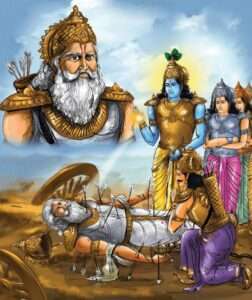
O King, the play of fate cannot be deciphered. Ten thousand kings confronted Bhishma and lost their lives, yet Shikhandi gained such renown by defeating him in battle. None can bypass the decree of destiny. The bow was Bhishma’s mouth, his arrows his teeth, his tongue a trident. He was like Lord Narasimha, the fierce incarnation of Vishnu, and not a mere mortal. Sanjaya meant that among the ten incarnations of Vishnu, Narasimha is the most terrible, and thus he likened Bhishma in battle to the fierce and invincible.
These words struck the blind king, and he fell senseless. After he was revived and aided, he wept and said, “Bhishma is capable of defeating gods and demons together in battle. That such a warrior should fall at the hands of an ordinary soldier like Shikhandi is a wonder beyond wonders. On Bhishma’s chariot, the flag bearing the palmyra tree shone like the blazing sun, worshipped as a symbol of courage by warrior clans. The roar of his bowstring was like thunder, and the blaze of enemies was halted by the rain of his arrows. How did the false wind of Shikhandi dispel the mighty cloud Bhishma? Only the Divine knows. O father, we believed you would save us as a bridge restraining the ocean of the Pandavas. An inferior soldier like Shikhandi is like a razor needle before you, a pit too small even to place a foot, and yet you were defeated by him. The ocean of Bhishma, the ocean of chivalry, filled with crocodiles of maces, sharks of tridents, and whales of pestles, how did such an unskilled swimmer as Shikhandi cross it? This is both surprise and sorrow. What shall we do now?”
He lamented further, “O Shikhandi, the great sage-warrior Parashurama attacked Bhishma for the sake of Amba and could not defeat him, yet you fought for the Pandavas and achieved victory over the universal hero. What an unbelievable feat. We trusted Bhishma’s courage, strength, fairness, and unwavering commitment, believing them undiminished.” The king then grasped Sanjaya’s hand and said, “Was there no one to guard Bhishma when he was weary and weak? What did the thousands of soldiers around him do—did they merely stand as spectators? Where were Drona, Kripa, Ashvatthama, and Shalya? Did they abandon Bhishma? I believe Bhishma’s defeat is the fall of all. It is astonishing that the Divine aided the Pandavas in seizing the kingdom by slaying the venerable grandsire of the Kuru dynasty. The righteous have fallen at the hands of the unrighteous. Is there any sin greater than fighting for land for the sake of the Kauravas while ignoring the death of Bhishma? The Kshatriya race is harsh and bereft of tenderness; it is not good to be born into this clan. Now my forces without Bhishma are like a wife without a husband. How deep is the sorrow of the Kauravas?”
He continued, “What will become of them after the fall of Bhishma? What has happened to the kings who joined the Kauravas for war? Where are the unwise counselors who forced Duryodhana into the gamble of war?” Then the king asked, “How did the battle unfold during these ten days? What strategies were adopted? How did Bhishma fail? How shall I endure the news of his defeat? My mind has become like stone. O Sanjaya, without hesitation, describe the war to me in full.”
Then Sanjaya replied, “O King, you yourself consented to the oppression of the Pandavas, who lived by righteousness. Your unwise attitude has brought about this situation; it is your own creation. Those who harm others receive the same in return. Without argument, listen to my words with attention. You commanded me to witness the war and present you with its details. By the sacred feet of Vedavyasa, I can give you the account. On your command, I went to the battlefield. Your son Duryodhana was speaking of war strategy with Bhishma and the others. They received me affectionately, and then Duryodhana said to Dushasana, ‘Our long-cherished wish for war is now near. Listen to what must be done. Bhishma stands foremost among us, and we must guard him. He will destroy all enemies and is capable of saving us all. Do not think that because Bhishma can save everyone, no one should guard him. He lives by his vow of truthfulness and has affirmed his code of war, saying that no one can confront him in battle, yet he will not fight with Shikhandi. When the lion sleeps deeply, even the fox can kill it. Be careful and guard Bhishma at all times; he will be slain by Shikhandi, like a goat killing a tiger unawares. All warriors should confront Shikhandi.’”
After saying this, Duryodhana retired to his private chambers. On your command, I first presented the future and now the present. Thus Sanjaya continued his narration, with undying hope to halt the course of fate and the march of war.

