



There’s reckless rhetoric, and then there’s outright degradation of democratic discourse. Mallikarjun Kharge has now crossed that line—spectacularly and irresponsibly.
Barely 48 hours before crucial assembly polls in Tamil Nadu and West Bengal, the Congress President chose to label Prime Minister Narendra Modi with language that has no place in civil politics. This isn’t mere criticism. It is not ideological opposition. It is a descent into verbal vandalism—one that corrodes institutions and cheapens public debate.
Let’s be clear: attacking policies is legitimate; demonising an elected Prime Minister with extreme labels is not. When such language comes from the head of a national party that governed India for decades, it is not just tasteless—it is dangerous. It signals desperation, not conviction.
And desperation, in Congress’s case, has a familiar pattern. When faced with electoral uncertainty, its leaders reach not for ideas, but for insults. This is not new. From “maut ka saudagar” to “neech,” from mocking a “chaiwala” to veiled threats, the party’s ecosystem has repeatedly normalised personal vilification of Modi. The electorate, time and again, has responded decisively—rejecting not just the rhetoric, but the mindset behind it.
Contrast this with the journey of Narendra Modi. Rising from a modest background, far removed from the privilege and entitlement that define Congress’s dynastic culture, his political ascent reflects organisational mobility rather than inherited power. The Bharatiya Janata Party, whatever its critics may argue on policy, has consistently projected leadership drawn from the grassroots—unlike the Indian National Congress, where loyalty to a single family often outweighs merit.
That contrast is precisely what rankles. Because when merit challenges entitlement, the response is rarely graceful—it is often abusive.
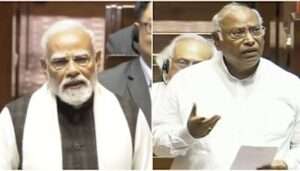
What makes Kharge’s remark even more jarring is his own personal journey. Coming from a humble background and having publicly spoken about the suffering his family endured during the Razakar movement, one would expect a greater sensitivity to language, to dignity, to restraint. Instead, what we witnessed was a lapse that raises uncomfortable questions: is this personal frustration, political compulsion, or a calculated attempt to polarise?
Either way, it demands accountability.
This is where the Election Commission of India cannot afford to look the other way. The Model Code of Conduct is not ornamental—it exists precisely to prevent such degradation during elections. If repeated violations, especially by senior leaders, go unchecked, the message is clear: anything goes.
And that is a dangerous precedent.
The BJP is justified in seeking action. But beyond party lines, this is about protecting democratic standards. If a national party president can use such language without consequence, what stops others from going further? Political discourse then becomes a race to the bottom—louder, uglier, and more toxic.
India, the world’s largest democracy, deserves better.
Strong, visible reprimand is not just necessary—it is overdue. The Election Commission must act, not merely to censure an individual, but to send a message that public life in India is not a free-for-all arena for verbal abuse.
Because once the bar of discourse collapses, institutions soon follow.
And that is a price no democracy can afford to pay.


