
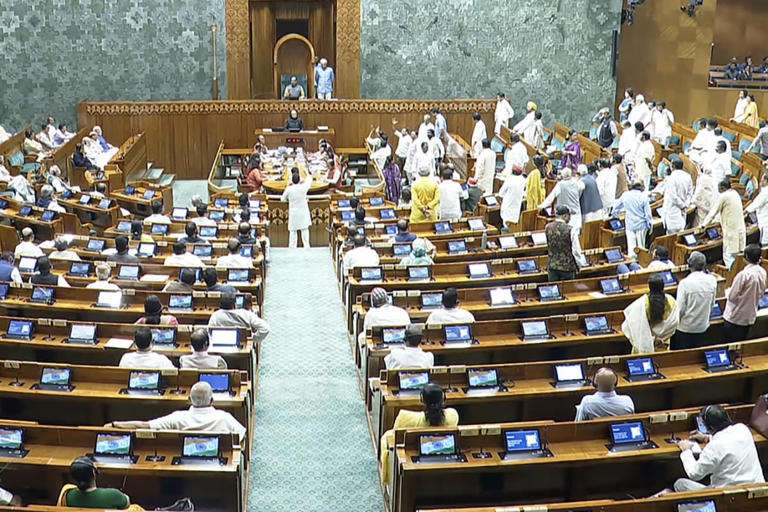
New Delhi: The Lok Sabha on Friday witnessed a high-octane discussion surrounding the three key pieces of legislation—the Constitution (131st Amendment) Bill, 2026; the Delimitation Bill, 2026; and the Union Territories Laws (Amendment) Bill, 2026.
As discussions proceeded, sharp words were exchanged between the ruling NDA and the Opposition, with a major legislative setback for the government after the defeat of the bill.
While the NDA leaders defended the bills, arguing that they were essential to finally implement the women’s reservation, which they claimed had been delayed for years, and accused the opposition of obstructing the political empowerment of women.
On the other side, an opposition bloc led by Congress MP Rahul Gandhi celebrated the defeat as a “major win” against what they termed “mathematical gerrymandering”.
BJP MPs held protests on the parliament premises after the Constitution (One Hundred and Thirty First Amendment Bill) 2026 was defeated in the Lower House.
Seconds before the Constitution 131st Amendment Bill 2026 fell with 278 votes in its favour and 211 against it, Union Home Minister Amit Shah said, “Women of India will never forgive you. Be ready to face their wrath when you go out to contest elections. You will not get an escape route.”
Following the defeat of the bills, Parliamentary Affairs Minister Kiren Rijiju launched a scathing attack on the Opposition, accusing them of a “historic betrayal” against the women of India. Rijiju asserted that while the bill was defeated today, the government’s commitment to the Nari Shakti Vandan Adhiniyam remains unshakeable.
He claimed the Opposition has exposed its “anti-women” bias by hiding behind technicalities of delimitation to stall a reform that has been pending for decades.
Meanwhile, Leader of the Opposition Rahul Gandhi spearheaded the charge, labelling the bill a “panic reaction” and an “anti-national act” that would penalise southern and northeastern states for their successful population control.
By linking the women’s quota to a fresh delimitation exercise based on 2011 Census data, the Opposition claimed the government was attempting “mathematical gerrymandering.”
The primary cause of the Bill’s defeat was a unified front by the Opposition, which argued that the legislation was less about women’s empowerment and more about a “dangerous” restructuring of India’s electoral map.
The maths in the House was equally unforgiving for the ruling NDA. With an effective strength of 543 and a requirement of two-thirds of those present and voting, the government needed substantial cross-party support that never materialised. While the 27 ayes represented a simple majority, they fell nearly 50 votes short of the constitutional threshold for an amendment. The total absence of abstentions—49 members voted in person—underscored the polarising nature of the 50-seat expansion plan.