


MS Sparsha
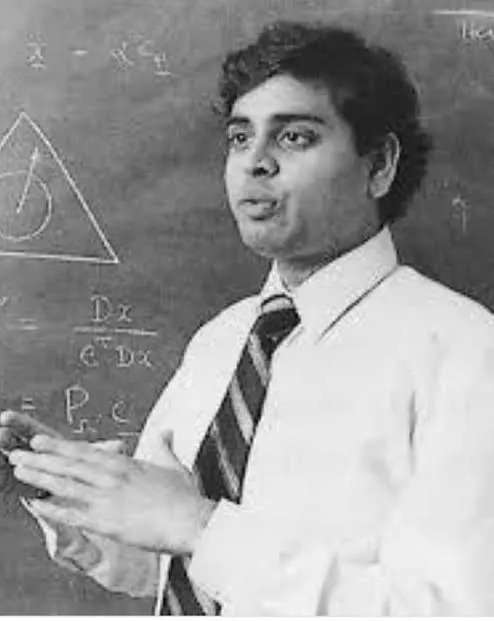
In the modern world of artificial intelligence, airline scheduling, stock market modelling, internet routing, supply chains, and industrial automation, optimization is everything. Every second, countless digital systems search for the fastest, cheapest, shortest, and most efficient solution to a problem. Yet, very few people know that one of the greatest revolutions in optimization theory came from an Indian mathematical genius — Narendra Krishna Karmarkar.
He did not become a household name like Srinivasa Ramanujan, nor did he seek celebrity status. But in the world of mathematics and computer science, Karmarkar’s breakthrough in 1984 shook the foundations of computational theory and transformed how modern systems solve complex problems.
His work was so revolutionary that the United States reportedly treated aspects of his algorithm almost like a strategic technological asset for years. It was not merely a mathematical discovery; it was a reimagining of how computers think.
Born in 1955 in Gwalior and raised in Pune — often called the “Oxford of the East” — Karmarkar displayed extraordinary brilliance from an early age. He graduated from the Indian Institute of Technology Bombay in Electrical Engineering in 1978, during a period when India’s brightest minds were increasingly moving toward advanced research abroad.
He later pursued his PhD at the University of California, Berkeley. While much of the computing world was obsessed with hardware development, Karmarkar was fascinated by something deeper — Complexity Theory, the science of understanding how efficiently a computer can solve difficult problems.
At the time, industries worldwide relied on the famous Simplex Method developed by George Dantzig for solving linear programming problems. Whether it involved airline scheduling, factory production, transport logistics, or financial planning, computers used the Simplex approach to search for optimal solutions by moving along the outer boundaries of a geometrical structure.
For nearly four decades, the scientific world believed this was the best practical method available.
Then came Karmarkar.
Instead of searching along the edges, Karmarkar proposed something radical: move through the interior.
His Interior Point Method used advanced projective geometry to cut through the center of the mathematical space, dramatically reducing computational effort. Problems involving millions of variables that once consumed enormous computing time could suddenly be solved at astonishing speed.
The impact was immediate and global.
Corporations, governments, and research institutions realized that optimization problems once considered impossibly large could now become manageable. Industries dealing with logistics, telecommunications, manufacturing, and computing saw enormous potential in his work.
Karmarkar’s algorithm was not merely an improvement; it represented a paradigm shift in applied mathematics and operations research.
So groundbreaking was the discovery that AT&T Bell Laboratories patented the algorithm — something almost unheard of in pure mathematics at the time. The move triggered a worldwide debate: can a mathematical idea or a piece of logic truly be owned?
At Bell Labs, Karmarkar became one of the most celebrated scientific minds of his generation. Yet, unlike many public intellectuals, he remained intensely private and deeply focused on systems-building rather than fame.
In the late 1990s and early 2000s, he returned to Bharat with a dream — to build world-class supercomputing infrastructure. He worked with the Tata Group through the Computational Research Laboratories initiative and played a major role in developing the EKA Supercomputer, which briefly became the fourth-fastest supercomputer in the world.
But like many visionaries returning home, Karmarkar often found himself battling slow-moving bureaucratic systems and institutional inertia. He was never content with merely teaching theories inside classrooms. He wanted to build large-scale computational ecosystems that could transform the future.
Ironically, millions of software engineers today unknowingly use methods inspired by Karmarkar’s Interior Point approach in optimization software, machine learning, and operational systems. Yet, many have never even heard his name.
That perhaps is why he remains an “unsung hero” — the invisible optimizer behind the modern digital world.
What makes Karmarkar extraordinary is not merely his intellect, but his audacity. For 40 years, the world believed there was only one practical path forward. Karmarkar dared to say there was another unseen route hidden through the middle.
And he proved it.
Like Ramanujan before him, he possessed the courage to challenge accepted wisdom. His life reminds us that the greatest breakthroughs often come from those willing to walk alone through unexplored territory.
In mathematics, as in life, the most optimal path is sometimes the one nobody else dares to take.
Well done Sparsha, bringing out the hidden jewels . Path finders are rare earth gems , silently they sow the seeds and the world rejoices forgetting their names. A well searched tribute to the innovative intelligentsia.👏🏻👏🏻