


In a country that celebrates its scientific icons in bursts of nostalgia, there exists a name that barely whispers through the corridors of Indian history—K. S. S. Nambooripad. A man who decoded structures so abstract that even the most accomplished mathematicians of the West had to travel to Kerala to understand them. A man who chose depth over display, substance over spotlight. A man who proved, quietly, that intellectual revolutions do not always need applause.
Born in 1935 in a modest village in Kerala, Nambooripad’s intellectual journey did not begin in the lecture halls of modern academia. It began in the disciplined, ancient world of Vedic learning. Until the age of 15, he was immersed in Sanskrit grammar (Vyakarana) and Indian logic (Nyaya). This was no ordinary education—it was algorithmic thinking in its purest form, a training ground for precision, abstraction, and layered reasoning. Long before he encountered modern algebra, his mind had already been shaped by a civilizational tradition that treated logic as both science and philosophy.
When he transitioned into formal education at the University of Kerala, he did not simply follow the well-trodden academic path. While most mathematicians gravitated toward the relatively “comfortable” domain of group theory—where operations can be reversed—Nambooripad chose the far more complex terrain of semigroups. In simple terms, groups deal with symmetry and reversibility; semigroups deal with processes where actions cannot always be undone. It is the mathematics of irreversibility, of one-way streets—a domain that mirrors the asymmetry of real-world systems.
It was here that Nambooripad made his defining contribution. He discovered that within regular semigroups, a special class of elements known as idempotents—those that remain unchanged when multiplied by themselves—were not scattered randomly. They formed a deeply structured entity now known as a “biordered set.” This was not merely a technical observation; it was a conceptual breakthrough. It revealed an underlying order in what appeared to be mathematical chaos and provided a unifying framework that connected different algebraic structures.
The significance of this work was not lost on the global mathematical community. A. H. Clifford, one of the towering figures in semigroup theory, was so struck by Nambooripad’s insights that he traveled to Kerala himself—a rare gesture in an academic world often tilted toward Western institutions. The direction of intellectual pilgrimage had reversed. For once, the West came East, seeking clarity from a scholar working far from the glare of elite universities.
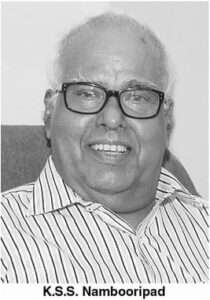
Yet, Nambooripad remained rooted. He spent his entire career at the University of Kerala, building a formidable school of algebra that attracted students and researchers from around the world. He did not chase positions at Princeton or the prestige of global academic circuits. His laboratory was a quiet room, his tools a chalkboard and an uncompromising intellect. In an age increasingly driven by visibility, he chose invisibility—and in doing so, achieved immortality within his field.
There is an almost philosophical dimension to his work. Like Srinivasa Ramanujan before him, Nambooripad did not see mathematics merely as invention, but as discovery. He once suggested that he had not created biordered sets; he had simply uncovered them, as if they already existed within the deeper logic of the universe. This perspective—where mathematics becomes a form of vision rather than construction—echoes the intellectual traditions of ancient India, where knowledge is revealed, not manufactured.
Despite his global impact, recognition at home remained muted. Yes, he was a Fellow of the Indian Academy of Sciences. Yes, he contributed to international journals and collaborated with leading mathematicians. But beyond academic circles, his name remains largely unknown. There is no major national award bearing his name, no widespread public memory of his contributions. His legacy lives quietly within equations, theories, and the minds of those who study them.
And perhaps that is fitting.
Nambooripad’s life challenges a modern obsession—the belief that greatness must be visible to be real. He stands as a reminder that the most profound transformations often occur in silence. That a “silo” is not necessarily isolation, but sometimes a sanctuary where thought can mature without distraction. That intellectual power does not always reside in global centers of fame, but can emerge from the most unassuming corners.
He was, in many ways, a ghost—unseen by the masses, yet deeply embedded in the foundations of modern algebra. But ghosts, after all, are not absences. They are presences that refuse to fade.
And in the quiet elegance of biordered sets, K. S. S. Nambooripad continues to speak.


True Sparsha. Such great mathematicians live in the form of research footprints, forever in the hearts of few students who carry their subject traditions for future generations. The legacy is somehow carried upon . Eminent Mathematicians like Namboodri ji experienced “ Revelations” like Ramanujam , a higher level of consciousness..belonging to a universal domain. Quantum physicists are trying their level best to understand that phenomenon.