



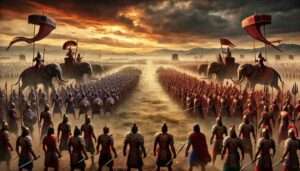
When the third dawn broke upon the field of Kurukshetra, Sanjaya thus addressed the blind monarch, describing in solemn cadence the movements of that fateful morn. At daybreak, the grandsire Bhishma, commander of the Kaurava host, assembled the vast divisions of the sons of Dhritarashtra and arranged them in the mighty formation of the eagle. He himself stood firm at the beak, the most strategic and potent point of the array, thereby lending strength and spirit to the whole design. Drona and Krithavarma were stationed as the piercing eyes; Kripa and Aswathama guarded the head; the kings of Trigartha, Bhurisrava, Salya, Bhagadatta, the ruler of Souvira, and Jayadratha of Sindhu formed the neck. Duryodhana, with his brothers, occupied the trunk; Vinda and Anuvinda, with the kings of Kamboja and Surasena, secured the tail. The rulers of Magadha and Kalinga held the right wing, while the kings of Karnata and Kosala defended the left; other warriors took their appointed places according to necessity and counsel.
Beholding this formidable array, Arjuna spoke to Drishtadyumna and advised that the Pandava forces be formed in the half-moon, a design fit to pierce and shatter the strategy of Duryodhana. Acting upon his counsel, Drishtadyumna shaped the crescent host. At its left extremity stood Bhima, supported by the forces of Pandya and Magadha; next were Virata and Drupada, aided by Drishtakethu, the king of Kasi, and the Karusha warriors. In the centre of the crescent stood Dharmaraja, accompanied by Sikhandi and Drishtadyumna, encircled by herds of war elephants for protection. On the right were Satyaki, Nakula, Sahadeva, and the sons of Draupadi; Ghatotkacha and the king of Kekaya were duly stationed within the formation. Sri Krishna, the universal saviour, stood with Arjuna at the left end, while other allied kings occupied their fitting stations.
Soon both armies, eager for combat, sounded conches and blew mighty horns; kettle-drums, tabors, pipes, and bells resounded, and the sky with all quarters trembled beneath that tumult which rode upon the rushing wind. Then Arjuna, like a blazing comet, rushed into the Kaurava ranks and threw them into confusion. Chariots were shattered, banners torn down, steeds and drivers struck to the earth; foot soldiers, horsemen, and elephant warriors alike fell before the relentless rain of his shafts. The Pandavas hastened to support him, and in the turmoil that followed, dust raised by hoof and foot rolled heavenward like clouds, so that none could discern friend from foe. Warriors shouted aloud their names, lineages, and titles to mark their identity amid the chaos. The Kaurava host fought under the command of Bhishma, and the Pandava host under the impetuous might of Bhimasena; fearless they strove, showing neither mercy nor retreat.
Sanjaya declared to Dhritarashtra that the valour displayed on either side merited noble narration, for the battle resembled the clash of celestial hosts and titanic beings; dust rose like storm clouds and was laid low by streams of blood from men, elephants, and horses, while weapons flashed like thunderbolts. Bhishma, Drona, Jayadratha of Sindhu, Sakuni, Vikarna, Purumitra, and Aswathama penetrated deep into the Pandava lines, striking with irresistible shafts; Bhima, Ghatotkacha, Satyaki, Saibya, Chekitana, and the sons of Draupadi opposed them fiercely. Duryodhana advanced with his chariot divisions toward Bhima and his sons, but Bhishma and Drona crossed before him and attacked; Arjuna, standing before Dharmaraja, poured forth a torrent of arrows and checked the swift advance of the Kauravas. Satyaki and Abhimanyu fought valiantly against the Gandhara forces; Sakuni’s men surrounded Arjuna and shattered his chariot, yet Satyaki leapt down and by skilful courage mounted Abhimanyu’s car, and together they overwhelmed Sakuni’s host with a suffocating rain of shafts.
Dharmaraja, stirred by righteous wrath, engaged directly with Bhishma; though his assault was fierce, the Kauravas stood firm, trusting in the prowess of Bhishma and the mastery of Drona. At that hour Duryodhana himself assailed Bhimasena with a volley of arrows, but Bhima, smiling, struck him with a mighty shaft that pierced his body, and the Kaurava king fell senseless. His charioteer, seized with fear, drove him swiftly from the field, and the Kaurava ranks, beholding their lord withdrawn, grew faint of heart and began to waver. Drishtadyumna pressed upon the fleeing warriors with stern resolve, while Bhimasena roared like a lion and pursued them; though Bhishma and Drona strove to rally their men, they could not wholly restrain the panic. Satyaki and Abhimanyu drove Sakuni from the field, and he departed with his kin, his proud boasts humbled.
Sanjaya proclaimed that Arjuna, unmatched in skill and strength, seemed invincible, driving the Kauravas before him as a lion scatters beasts. Meanwhile, Duryodhana regained consciousness, rebuked his charioteer, and returned to the fray with renewed fury, roaring to restore confidence among his men. Bhishma and Drona, steadfast and resolute, once more charged the Pandava ranks, and the Kaurava forces surged like ocean waves at the rising moon, slowly regaining courage and vigour. Then Duryodhana approached Drona and Bhishma and, in bitterness of heart, accused them of partiality toward the Pandavas, declaring that had he known their favour, he would not have appointed Bhishma commander nor set aside Karna. He lamented that his hope had been misplaced and that his humiliation sprang from their restraint.
The grandsire, smiling with restrained displeasure, replied that such words were unworthy of a king and that even if Indra with celestial hosts fought for the Pandavas, victory over them would not be easily won. He gently rebuked Duryodhana’s pride, reminding him that the youthful and divinely favoured Pandavas could not be overcome by mere accusation or suspicion. Yet, setting aside reproach, Bhishma vowed that within the limits of his strength, he would devastate the Pandava army, though the sons of Pandu were difficult to conquer; let Duryodhana and his kin behold his outburst upon the foe. With that, he lifted his bow and discharged a blazing shower of arrows. Encouraged, the Kauravas again sounded drums, conches, trumpets, pipes, and bells with rising spirit, and the Pandavas too answered with resounding blasts, invigorating their warriors as the great battle raged on.

