Upadhyayula Lakshman Rao
The sage Kutsa, son of the venerable Angirasa lineage, lifts his voice in solemn devotion, weaving together the sacred meters of Tristubh and Jagati in praise of Rudra, the fierce yet compassionate lord of cosmic forces. In these hymns, Rudra is not merely invoked as a deity of destruction, but as the sovereign healer, the wielder of immense power who grants refuge to warriors and solace to all beings. His presence is sought not in fear alone, but in reverence, for he is the guardian who transforms affliction into vitality, ensuring that all living beings may flourish in health, free from the grasp of disease and decay.
Rudra, adorned with matted locks and radiant brilliance, is described as Kapardin, the one crowned with divine austerity. His sons, the swift-moving Vayus, embody the life-breath that animates the cosmos, circulating energy through all realms of existence. As the wielder of celestial weapons, Rudra is victorious over adversaries, yet the sage beseeches him to set aside his wrath and extend his benevolence. Through oblations and sacred chants, the worshippers seek not conquest, but harmony—an alignment with the divine rhythm that sustains life itself. The ancient progenitor Manu is remembered as the one who bestowed upon humanity the path of fearless and wholesome living, guiding them toward both physical and spiritual well-being.
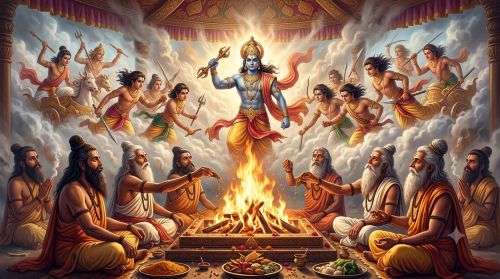
The hymns further extol Rudra as the bestower of eloquence and wisdom, for it is through divine inspiration that sacred speech arises. The fruits of such inspired verses are not merely poetic, but transformative, shaping consciousness and elevating the human spirit. Rudra’s presence is invoked to bless households with prosperity, children, and continuity of lineage, reflecting the deep Vedic aspiration for harmony between material sustenance and spiritual fulfillment. As the orchestrator of yajna, he governs the sacred order through which the cosmos itself is sustained, and his mysterious, unpredictable movements signify the subtle forces that elude human comprehension yet govern existence.
In a profound appeal, the sage implores Rudra to restrain his destructive aspect, to spare the elders, the children, and the vulnerable. The prayer reflects an acute awareness of life’s fragility and the desire to preserve continuity across generations. The imagery of the shepherd offering his cattle to the lord becomes a metaphor for surrender, as devotees place their hymns and lives in Rudra’s care, trusting in his auspicious grace. His voice, likened to the powerful resonance of a wild being, echoes through the cosmos, both fearsome and purifying, reminding humanity of the primal forces that shape existence.
Rudra is also envisioned as the divine healer, holding in his hands potent remedies that shield humanity from suffering. This reflects an early scientific temperament embedded within the Vedic vision, where medicine is not merely physical but deeply intertwined with righteousness and cosmic order. The understanding emerges that remedies yield their true efficacy only when aligned with dharma, suggesting an integration of ethical living with empirical knowledge. Thus, healing becomes both a spiritual and practical pursuit, guided by divine principles.
The invocation extends beyond Rudra alone, calling upon the cosmic assembly of Mitra, Varuna, Aditi, and the sacred river Sindhu, along with Earth and the vast expanse of space, to safeguard existence. This reflects the Vedic vision of interconnectedness, where all forces of nature and divinity collaborate in sustaining life. Protection is not sought from a single source alone, but from the harmonious interplay of all cosmic elements.
In its deepest philosophical resonance, the narrative reveals Rudra as both the cause of sorrow and its ultimate remover. He embodies the paradox of existence, where destruction paves the way for renewal, and suffering becomes a gateway to transcendence. The wisdom of the Upanishads is attributed to his grace, as is the power of speech itself, suggesting that knowledge and expression arise from the same divine source. Darkness, both literal and metaphorical, is dispelled by his illuminating presence, guiding humanity toward truth.
Thus, the hymn stands as a profound synthesis of devotion, philosophy, and early scientific insight. It portrays a universe governed by laws that are at once spiritual and rational, where health, morality, and cosmic harmony are inseparably linked. Through the grace of Rudra, humanity seeks not only protection from external threats but liberation from the inner afflictions that bind it to suffering, aspiring toward a state of balance, wisdom, and enduring peace.