



Don’t the children and teachers feel hot?
India is currently experiencing a severe heatwave. Temperatures are setting new records every year. The Meteorological Department regularly issues heatwave warnings. People are avoiding leaving their homes. Coolers and air conditioners have become commonplace in government offices, private companies, banks, malls, and large institutions. An air-conditioned environment is considered essential for the comfort and efficiency of employees. But when it comes to schools, the picture suddenly changes. Millions of children and teachers across the country are still forced to spend their days sitting in sweltering classrooms. It seems as if the system has assumed that it’s not just school children and teachers who suffer from the heat.
This isn’t just a sarcastic remark, but the sad truth of our education system. In a country where children are called the “future of the nation,” these same children are deprived of basic amenities. Grand claims are made about education, with talk of smart classes, Digital India, and a new education policy, but when one sees the actual state of government schools, all claims appear hollow. During the summer, the condition of many government schools is no less than a furnace. In some places, tin roofs are scorching hot in the sun, and in others, dozens of children are crammed into tiny rooms. In many schools, fans are broken, while in others, there is no electricity at all. Windows are either broken or so small that air cannot enter. In such an environment, children sit for hours trying to study.
Imagine, when the temperature outside is over 45 degrees and a child sitting inside is drenched in sweat, how can they concentrate on their books? Young children wake up frequently to drink water, some feel dizzy, and many become tired and restless. Sometimes, cases of heat stroke and dehydration even occur. Despite this, those in the education system seem to underestimate the seriousness of this problem. The situation of teachers is no different. They have to conduct multiple periods in the same hot environment. Writing on the board, handling children, and teaching are all difficult tasks. But the irony is that the working conditions of teachers, who are responsible for shaping the future, receive the least attention.
If the air conditioner in a government office breaks down, a complaint is filed immediately, and repairs are arranged quickly. Employee comfort is often linked to “work efficiency.” However, when discussions arise about coolers or air conditioners for school children and teachers, the response is often, “Such facilities are not feasible” or “This is an unnecessary expense.” The question is, are children’s health and education less important? If a comfortable environment can increase an employee’s efficiency, why wouldn’t the same environment enhance children’s learning and mental concentration?
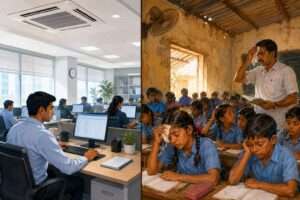
Today, air-conditioned classrooms are becoming common in private schools in major cities. Children studying there enjoy modern amenities. Meanwhile, children in government schools struggle for basic facilities. This isn’t just a gap in amenities, but a vivid example of social inequality. While wealthy children enjoy cool, smart classrooms, children from poor families are forced to sit in hot, sweaty rooms. A society that promotes equality in education often remains silent on this inequality.
Education isn’t just about books, exams, and curriculum. A healthy and positive environment is equally essential for learning. Psychologists and education experts have long noted that extreme heat affects children’s concentration, memory, and mental alertness. In hot environments, children tire quickly, and their learning capacity decreases. How can a child concentrate on their lessons if they are constantly exposed to the heat? The purpose of education isn’t just to send children to school, but to provide them with an environment where they can learn while remaining physically and mentally healthy.
Ironically, governments spend crores of rupees on digital projects to improve the quality of education, but the temperature of classrooms is rarely discussed. The truth is that children battling the heat need a cool breeze more than a smart board. The situation in schools in rural areas is even more worrisome. In many villages, electricity supply is not regular. Some schools still lack adequate classrooms. Children study under trees or in open verandas. In such places, coolers or air conditioners are difficult to imagine. Drinking water is also a serious problem in many schools. In summer, water tanks dry up or the water becomes so hot that it becomes unusable. Children often have to fetch water from far away. This situation is not only an inconvenience but also a threat to children’s health.
Every year, on Teachers’ Day, Children’s Day, and Independence Day, leaders’ speeches tout education as a top priority. Lines like “Children are the future of the nation” are repeated repeatedly. But the true priorities can be discerned by observing the state of schools. If children are truly the future of the nation, shouldn’t they at least have the right to receive an education in a respectable environment? Is it fair that office facilities take priority, while children’s basic needs are neglected?
This problem isn’t just about resources, but also about mindsets. In our society, the problems of children and teachers are often overlooked. It’s assumed that some discomfort in schools is “normal.” This mindset is the biggest problem. Climate change is driving heat in India. Temperatures in many cities have reached 47-48 degrees Celsius. Experts predict that heat waves will increase in the coming years. In such a situation, traditional school systems are no longer sufficient. Today, it’s essential to construct school buildings according to the weather. Features like adequate ventilation, green trees, cool roof designs, clean drinking water, and temperature control should be essential. This is not a luxury, but a necessity.
If the government wishes, coolers and better fans can be installed in government schools in a phased manner. Solar energy-based solutions can also be adopted. Many states have successfully implemented schemes like mid-day meals, smart classes, and digital education. Therefore, concrete steps can be taken to provide relief to children from the heat. However, this requires sensitive thinking and real prioritization. Mere announcements and advertisements will not strengthen the education system.
Society must also understand its role. We often envision the facilities of private schools for our children, but take the plight of government schools for granted. Social organizations, panchayats, local administrations, and parents must also seriously address this issue. Children’s education and health are not just the responsibility of the government, but the collective responsibility of society as a whole.
In our society, teachers are revered as “gurus.” Grand events are held on Teacher’s Day. But true respect isn’t achieved through speeches and flowers. Respect comes only when teachers are provided with better working conditions. It’s unreasonable to expect optimal performance from a teacher who is struggling with heat, fatigue, and discomfort. If we want to improve the quality of education, the working environment for teachers must be improved.
The future of any nation is shaped in its classrooms. If those classrooms turn into sweltering furnaces, all claims of development seem hollow. Children aren’t just statistics; they are dreams. And dreams need a conducive environment to flourish. Today, the need is to not make education a mere subject of policies and speeches, but to focus on its actual conditions. Children and teachers should receive the same respect and facilities as other sections of society. Because the truth is this: in a country where children are forced to sit in sweltering classrooms, the brilliance of development will be considered incomplete.Top of Form


