



When Narendra Modi reportedly asserted in a confidential setting that his government will “leave no stone unturned” to ensure the implementation of women’s reservation in legislatures, it was not just a routine political assurance. It was a loaded statement—one that carries within it both the weight of expectation and the ambiguity of intent. In Indian politics, such phrasing is rarely accidental. It is calibrated, deliberate, and often a signal of things to come—but not necessarily in the way the public might immediately assume.
At the heart of this conversation lies the long-pending issue of women’s reservation in Parliament and State Assemblies. The promise was finally formalized through the passage of the Constitution (One Hundred and Sixth Amendment) Act, 2023, hailed as a historic legislative milestone. Yet, the celebration came with a crucial caveat: its implementation has been tethered to the completion of the delimitation exercise, expected after the next Census. That single condition has allowed the government to claim credit for legislative intent while effectively pushing actual execution into an uncertain future—drawing sharp criticism from Opposition parties, who argue that the delay dilutes the spirit of the reform.
So, what does Modi’s “no stone unturned” remark really mean?
First, it signals political ownership. The BJP has already positioned itself as the architect of this reform, contrasting its record with decades of inaction under previous governments, particularly the Indian National Congress. By reiterating commitment at the highest level, Modi is reinforcing that narrative—framing the BJP as the party that not only talks about women’s empowerment but legislates it.
However, intent and implementation are two very different arenas.
The immediate question is whether the BJP will attempt a phased or indirect rollout—starting with states it governs. On paper, the current law applies to Parliament and State Assemblies only after delimitation. But politics has never been confined to the rigidity of “paper.” If the BJP truly wants to demonstrate urgency, it has several pathways:
It could push for political consensus to fast-track delimitation—though that opens a Pandora’s box of regional sensitivities, particularly for southern states wary of losing representation.
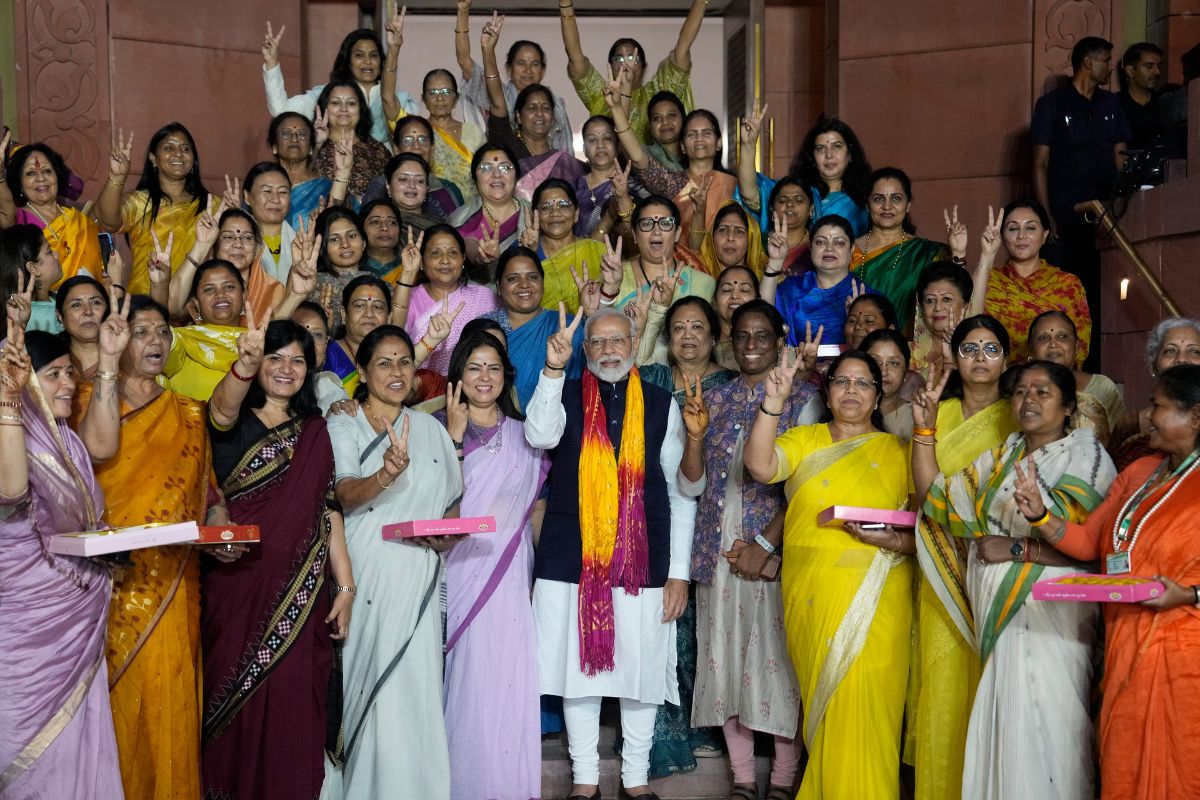
It could voluntarily enforce internal quotas within the party, allocating a higher percentage of tickets to women candidates in upcoming elections across BJP-ruled states.
Or, more strategically, it could experiment with reservation-like mechanisms in states where it holds decisive power, using candidate selection as a proxy for legislative reservation.
This is where Modi’s statement becomes less about law and more about political signalling.
The BJP has, in recent years, shown a pattern: test reforms in controlled environments before scaling them nationally. Whether it was governance models, welfare delivery mechanisms, or even ideological positioning, the party often uses BJP-ruled states as laboratories. Applying that template here would mean we could soon see a noticeable uptick in women candidates in states like Madhya Pradesh, Gujarat, Uttar Pradesh, or Assam—well before any formal constitutional trigger kicks in.
But there’s also a more cynical reading—one that cannot be dismissed.
The phrase “no stone unturned” may simply be a rhetorical flourish aimed at consolidating a crucial voter base: women. Over the past decade, women have emerged as a decisive electoral constituency, often voting in higher numbers than men in several states. The BJP has invested heavily in schemes targeting women—Ujjwala, Beti Bachao Beti Padhao, PM Awas Yojana ownership patterns—and has reaped political dividends.
In that context, reiterating commitment to women’s reservation serves as a powerful electoral message, especially with multiple state elections and a general election cycle always looming on the horizon. It reassures, without committing to a timeline.
And that brings us to the crux of the issue: the timeline.
Yes, without delimitation, the law remains in cold storage. And delimitation itself is tied to the Census—an exercise that must first be completed before any redrawing of constituencies can begin. This sequencing is built into the framework of the law.
However, to read this as an indefinite delay would be misleading. Once the Census is completed, delimitation is not an open-ended process; it is an administrative exercise that can be executed within a defined timeframe. Historically, such exercises have not stretched endlessly when backed by political intent.
Which means the real variable is not feasibility, but speed.
If the government chooses to act with urgency, the Census–delimitation cycle could realistically be compressed into a one-to-two-year window, implementing state assemblies as a plausible near-term outcome—even if parliamentary rollout takes longer due to its larger political and logistical implications.
In that sense, the phrase “no stone unturned” is not entirely hollow. It signals room for acceleration. But whether that acceleration is actually triggered will depend less on legislative barriers and more on political timing.
Is it political messaging aimed at shaping perception? Almost certainly.
The truth likely lies in a combination of all three.
What cannot be ignored, however, is the opportunity before the BJP. If it genuinely intends to “leave no stone unturned,” it doesn’t have to wait for constitutional compulsion. It can act politically, voluntarily, and visibly—by dramatically increasing women’s representation in its own ranks and candidate lists. That would not only lend credibility to its claim but also put pressure on opposition parties to follow suit.
Because ultimately, women’s reservation is not just a legislative question—it is a political choice.
And that choice can begin today, without waiting for the bureaucracy of delimitation to catch up with the urgency of representation.
Until then, Modi’s words will remain what they currently are: powerful, promising—and open to interpretation.


