The Calcutta High Court has done what constitutional institutions must in moments of political heat—stand firm, remain restrained, and uphold the larger democratic purpose. By refusing to interfere with the Election Commission of India’s decision to deploy 2,500 companies of central forces for the second phase of the West Bengal elections, the court has reinforced a simple but vital principle: free and fair elections are non-negotiable. This is not merely a legal endorsement—it is a message. A message to political actors tempted to bend the system, and more importantly, to voters who often find themselves caught between fear and franchise. The stakes in this second phase could not be higher. As many as 142 of the 294 seats are going to polls—many of them entrenched strongholds of the ruling All India Trinamool Congress led by Mamata Banerjee. In 2021, the TMC swept 123 of these 142 seats, reducing the Bharatiya Janata Party to a mere 18. This is not just another electoral round; it is, for the incumbent, a political fortress under siege. And when fortresses feel threatened, they rarely fall quietly. Reports of intimidation, coercion, and even open threats against officials have surfaced during the campaign. In one instance, a candidate reportedly warned an IPS officer of “consequences” after the results—an extraordinary display of brazenness that underlines why extraordinary security measures are not just justified, but necessary. If anything, such conduct strengthens the case for a robust central deployment. Is the presence of central forces an imposition? No—it is an assurance. It guarantees that a voter in a remote village in North 24 Parganas or a crowded lane in South Kolkata can walk to the polling booth without fear. The flag marches, the public announcements urging citizens to vote freely—these are not optics. They are instruments of confidence-building in a state where electoral violence has too often been normalized. The numbers from the first phase offer both hope and caution. A record turnout of over 93 percent signals a politically engaged electorate unwilling to sit this out. But high turnout does not automatically mean absence of fear—it often coexists with it. The real test lies not in how many vote, but in how freely they do so.
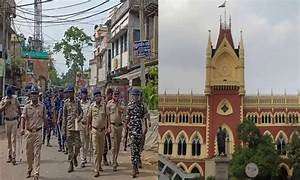
This is where the High Court’s refusal to entertain allegations of “police highhandedness” by the ruling party must be seen in context. Institutions cannot be dragged into a partisan tug-of-war. By backing the Election Commission’s judgment, the court has effectively drawn a line: the integrity of the process outweighs political discomfort. The larger contest is now unmistakably bipolar. On one side stands the entrenched machinery of the TMC; on the other, a resurgent BJP attempting to breach South Bengal after consolidating gains in the north. Narendra Modi has already interpreted the first-phase turnout as a “seal” on a wave of change. Whether that reading holds will depend not just on campaign narratives, but on whether voters feel secure enough to express their will. And that is precisely why this moment matters. Democracy does not run on ballots alone—it runs on belief. Belief that the system will protect your right to choose. Belief that your vote will not invite retribution. Belief that the machinery of the state will not be hijacked by the machinery of a party. West Bengal has, in the past, witnessed electoral violence that has scarred its democratic reputation. Pretending otherwise is denial. Acknowledging it—and acting decisively to prevent its recurrence—is responsibility. The deployment of central forces, backed by judicial restraint, is a step in that direction. But institutions alone cannot complete the task. The final, decisive act lies with the voter. Step out. Stand in line. Cast your vote—not in defiance, but in confidence. Confidence that the system, at least this time, stands with you, not against you. Fear thrives in silence. Democracy thrives in participation. West Bengal stands at a crossroads. The question is not who will win, but whether the people will truly be allowed to decide. The answer begins at the polling booth.