


Special Correspondent
Hyderabad is once again at war with itself. On one side stands the familiar promise of “development”—flyovers, elevated corridors, and ever-expanding metro infrastructure. On the other stands one of the city’s last surviving ecological lifelines: the Kasu Brahmananda Reddy National Park (KBR Park). This is no longer a quiet policy debate buried in files. It is a visible, growing confrontation—playing out on the shaded walking tracks of Jubilee Hills and Banjara Hills, where citizens are pushing back in the only way they can.
And if history is any guide, they have reason to worry.
This is not the first time Hyderabad’s precious open spaces have been placed on the chopping block. Not too long ago, the previous regime flirted with an audacious plan to construct a new state secretariat in Secunderabad by taking over the historic Gymkhana Grounds and the adjoining open land. That stretch was not just real estate—it was a thriving public space, hosting cricket, hockey, and football grounds, basketball courts, and serving as a daily refuge for walkers, athletes, and NCC cadets.
The backlash was swift and intense. What ultimately killed the proposal was not political sensitivity, but institutional resistance—the land fell under the Andhra Sub Area of the Ministry of Defence, which refused to yield. The Gymkhana and Parade Grounds survived that assault. But the episode revealed a deeper truth: in a rapidly concretising city, even the last remaining lung spaces are constantly under threat.
That same pattern now looms over KBR Park.
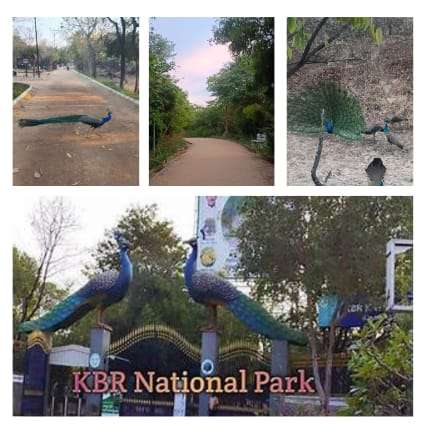
Spread across roughly 390 acres, KBR Park is not just another green patch on Hyderabad’s map. It is a rare, legally protected urban forest—an ecological relic that has somehow survived decades of encroachment pressures. Once part of the Chiran Palace estate of the erstwhile Nizam, it was formally declared a national park in 1998 after prolonged battles. Today, it hosts hundreds of plant species, diverse birdlife, and a fragile but vital ecosystem in the middle of a city that is steadily running out of breathable space.
And that fragile ecosystem is now staring at a very real threat.
The Telangana government’s plan to push a network of flyovers and metro-linked infrastructure around—and potentially slicing through—this eco-sensitive zone has triggered widespread outrage. Residents, environmentalists, and civic groups are not merely reacting to a proposal; they are reacting to the way it has been handled—quietly, ambiguously, and without transparent public engagement.
For thousands of Hyderabadis, the 5.5-kilometre outer track of KBR Park is more than a walkway. It is a daily escape from the city’s choking pollution levels—a space where air quality is visibly and measurably better. In a city where vehicular emissions continue to surge, the idea of surrounding this zone with high-speed traffic corridors feels not just misguided, but self-destructive.
What has further deepened suspicion is the shifting nature of the project itself.
What began as part of the Strategic Road Development Plan (SRDP) now appears to have morphed into a rebranded initiative under H-CITI—Hyderabad City Innovative Transport Infrastructure. On paper, it may sound like administrative evolution. In practice, it raises uncomfortable questions. Why was this transition not clearly communicated? Does the new framework expand the project’s scale and impact? And crucially, has the environmental cost been quietly escalated without public scrutiny?
Reports suggesting a significantly higher number of affected trees under the revised plan have only added to the anxiety. Yet, there has been no full, transparent disclosure—neither to citizens nor, if activists are to be believed, to the judiciary.
That silence is not procedural. It is political.
Because the Telangana High Court has, in the past, drawn clear red lines around KBR Park, restricting any activity that could compromise its ecological integrity. Those safeguards were meant to act as a legal firewall. What is now unfolding appears to be an attempt to test, if not bypass, those very protections through technical reclassification and administrative opacity.
For residents, this is no longer about one park. It is about a pattern that has defined Hyderabad’s urban expansion over the past two decades—lakes shrinking into real estate parcels, open lands vanishing under concrete, and environmental considerations repeatedly pushed aside in the race for infrastructure.
KBR Park stands as one of the last symbols of resistance to that trend. If it can be compromised, nothing else is truly safe.
The government, predictably, will argue necessity. Traffic congestion is real. Connectivity needs are growing. Infrastructure expansion is, to an extent, inevitable. But the question citizens are now asking is both simple and fundamental: must development always come at the cost of survival?
Cities across the world have already moved beyond this false binary. Sustainable urban planning is no longer a luxury—it is a necessity. Roads can be rerouted. Alignments can be redesigned. Engineering solutions exist that do not demand ecological sacrifice. What is required is not innovation, but intent.
And that is precisely what appears to be missing.
It is easy to dismiss the protests around KBR Park as the noise of an urban elite protecting its backyard. That would be a grave misreading. What is being defended here is not privilege, but a public ecological asset—one that sustains air quality, biodiversity, and climate resilience for the entire city.
This is not a NIMBY agitation.
It is a warning.
A warning that Hyderabad is running out of second chances.



Biodiversity is the need of the hour .. the city is getting hotter and hotter, Such green zone’s lushness is a Nature’s boon ..alternative civil engineering models should be tried out ! Hope the warning is taken seriously!