



Kindness in front of the camera, indifference towards humans
Early in the morning, a scene often plays out in the streets of cities and towns. Someone stops their bike, takes a five-rupee loaf from their bag, throws a few pieces toward stray dogs on the roadside, then turns on their mobile camera and takes a video. A short while later, the same video is uploaded to social media, captioned, “Love animals, keep humanity alive.” People comment, “Wow! Humanity still exists.”
The question is, is this really humanity? Has donating five rupees worth of bread and ten rupees worth of milk become the ultimate example of animal love? Or is this just a new ostentation of our times, where even sentiments are being determined by cameras and likes?
Kindness and compassion toward animals are indeed hallmarks of a civilized society. A society that isn’t sensitive toward animals can’t be very humane toward humans either. But the problem begins when animal love becomes more of a display than a sensitivity. For many people, it’s become a new way to achieve social status. They post videos of themselves feeding biscuits to stray dogs, but they don’t notice the hungry human sitting on the same street. A poor child’s torn slippers don’t bother them, but posting a photo of themselves feeding milk to a dog proves them “compassionate.”
Social media has even commodified our society’s emotions. Service has become less important than performance. Transporting an injured worker to the hospital doesn’t attract camera attention, so fewer people engage in that work. But a video of someone feeding bread to a dog can go viral, so sensitivity suddenly increases. This superficial compassion is gradually pushing society into a strange moral dilemma, where symbolic actions are given more importance than real problems.
Ironically, those who proclaim themselves animal lovers by feeding street dogs often don’t bother to provide medication for their elderly parents. They don’t see the suffering of a poor family in the neighborhood. They don’t have time to help a sick person, but they have all the time for Instagram reels. What kind of compassion is this, one that’s more focused on the camera than on the person?
The stray dog problem in India is not just an emotional issue, but also a matter of public safety. Thousands of people are bitten by dogs every year. Attacks on young children and the elderly are regularly reported. Packs of dogs chasing bikers at night cause accidents. In many colonies, people are afraid to even take morning walks. But when this problem is discussed, society is divided. One side labels every dog ”poor” and places the entire responsibility on the public, while the other side resorts to the language of cruelty. Both positions are wrong.
What’s truly needed is balance and responsibility. Simply throwing bread won’t solve the problem. This often leads to stray dogs gathering in one place, increasing their numbers and causing problems for the people living nearby. If there’s true animal love, there should be talk of sterilization, vaccination, shelters, and responsible care. But all of this requires hard work and responsibility. Therefore, the easy way out is chosen—throw bread, post a photo, and be called sensitive.
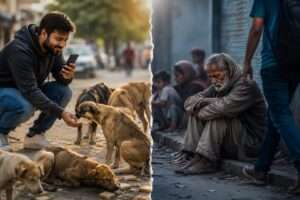
Our society is going through a strange phase today. Human hunger has become common news, but feeding a dog a biscuit is considered “emotional content.” Thousands of people can be found sitting hungry outside railway stations, bus stops, and hospitals. Children of laborers can be seen picking plastic from garbage. Poor patients can be seen suffering without medicines. But cameras rarely focus on them, because there, not just photos, but responsibility is required.
This article is not against animal love. Compassion for animals is essential, but if society’s sensitivity is limited to animals and begins to turn a blind eye to human suffering, it’s a dangerous situation. Compassion implies balance, not pretense. True animal love is one that involves responsibility. Treating injured animals, helping with sterilization and vaccination campaigns, ensuring the safety of others, and maintaining cleanliness—these are all part of genuine sensitivity. But today, many people feed dogs simply to be perceived as “good people.”
In modern society, morality is becoming fashionable. Just as some people post pictures of themselves with books more than they read them, many people display more service than they actually do. By providing ten rupees worth of milk, they feel they have performed a great virtue. But to truly change society, we must move beyond symbolic sentiments. Funding a poor child’s education, providing medicine for a sick person, supporting an elderly person—these are acts that require heart, not a camera.
A civilized society is one where both humans and animals are safe. Where there is no cruelty to animals and no disregard for human safety. But today, the problem is that people have become less sensitive and more emotional. They don’t want solutions, they only want to prove themselves compassionate. This is why, in many places, even animal love has become a social display.
Milk for ten rupees and bread for five rupees are not wrong. It’s wrong when they’re considered the greatest proof of humanity. Society must move beyond this superficial love for animals. Humanity isn’t just about showing kindness for the camera, but about making someone’s life easier without making a fuss. Ultimately, the true measure of sensitivity isn’t how many dogs you’ve fed bread to, but how many humans and creatures you’ve helped lead safe, dignified, and balanced lives.

