



The real purpose of childhood and education is drowned out by the glitter of marks.
These days, as soon as exam results are announced, a strange competition is visible outside schools. Large billboards are displayed, colorful posters are displayed, and social media is constantly flooded with photos. Some students are listed with 99% marks, some with 98% marks, and some with 97% marks. Schools present these photos as if they have achieved some professional accomplishment. The message to viewing parents is that this is the institution where “success” is achieved. Education is gradually becoming less a medium of knowledge and more a means of publicity. This is why the question is being raised seriously: has education become less of an education and more of an advertisement?
Undoubtedly, students who work hard deserve respect. Good results are a source of pride for any student, teacher, and parent. But the problem begins when schools begin to portray only a select few as the epitome of success. The rest of the students, who worked hard to the best of their ability, struggled, and overcame circumstances to pass their exams, are left behind in this glitz and glamour. Their pictures aren’t on school posters, and their efforts aren’t celebrated. Gradually, they begin to feel that they’re not good enough.
Today, the educational environment has become highly competitive. Children are no longer studying to gain knowledge, but to achieve a high standard. Parental expectations, societal comparisons, and school promotion policies combine to create such pressure on children that they begin to measure themselves by their marks. A child scoring 95% is considered “gifted,” but a child scoring 70% is considered mediocre or weak. This mindset is against the spirit of education.
Every child is different. Some are interested in science, some in literature, some excel in sports, some in art, music, or technical skills. But the current education system has limited the definition of success to exam results. Schools also seem to be moving in the direction that bestows them with the most publicity and the highest number of admissions. As a result, children are becoming less “students” and more “result products.”
Of greatest concern is the impact this type of publicity has on children’s mental health. Students who score relatively low marks begin to feel inferior. Many children suffer from depression, stress, and an inferiority complex. Some become so stressed that they withdraw from family and society. Today, suicides are even reported in the country after exam results. This is not merely a personal weakness, but a result of the constant social and educational pressure placed on children.
Schools must understand that education isn’t just about creating toppers. A capable teacher isn’t defined by how many of their students score 95%, but by how many they inspire confidence in. True education is one that prepares a child for life’s challenges, sensitizes them, and cultivates morality and humanity. Even if a child scores average marks in exams but becomes a good person and a responsible person, that too is a testament to the success of education.
Today, many schools use exam results as a business strategy. Constant posts on social media, advertisements in newspapers, banners across the city—all of this is indicative of the commercialization of education. Parents, too, are influenced by these stellar results and choose schools. They assume that the school with the most toppers is the best. But the quality of education cannot be determined by the percentage of students alone. The true identity of a school should be determined by how average and weak students are treated, and the support and encouragement they receive.
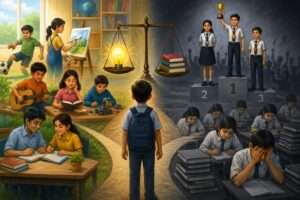
It’s also true that many schools deliberately focus on bright students to make their results appear good. Weaker students often face neglect. They are often made to feel like a burden on the school’s “prestige.” This situation is extremely unfortunate. Equal opportunity and equal respect are the most essential elements of education. If schools themselves begin to discriminate between children, how will sensitivity develop in society?
The role of parents is also crucial here. Many parents begin to compare their children with others. Statements like, “Look, Sharma ji’s son scored 98%,” shatter children’s self-confidence. Every child learns at their own pace and ability. The need is to understand and encourage them, not to constantly prove them inferior to others. Children need to feel that they are valued not just because of their marks, but because their personality and efforts are also important.
We also need to understand that success in life isn’t just about exam results. History is replete with examples of average or mediocre students who went on to become great scientists, writers, artists, entrepreneurs, and leaders. Many of the world’s most successful people weren’t “toppers” in the traditional education system. Their confidence, creativity, and struggle were their true strengths. Therefore, judging children solely on percentages limits their future.
If schools truly want to inspire children, instead of just posting pictures of toppers, they should recognize every student who has worked hard. Someone who improved from the previous year, someone who continued studying under difficult circumstances, someone who passed the exam despite financial difficulties—these achievements are equally important. The purpose of education should be cooperation rather than competition.
Today, there’s a need to rehumanize education. Children should be taught that their worth isn’t determined solely by their report cards. Schools should foster a culture where every child feels respected and confident. Teachers should foster a curiosity for learning, not a mere pursuit of marks. Education will be meaningful when it transforms children into better people, not just a higher percentage.
The government and education departments should also seriously consider this issue. There should be guidelines for excessive display of children’s photos and grades for school promotions. Educational institutions must understand that children are not a medium for advertising. Their emotions, self-esteem, and mental health are more important than any publicity.
Society also needs to change its mindset. If we only honor those with high scores, other children will begin to see themselves as failures. We must recognize that every child is unique and every talent is important. Some children will become doctors, some artists, some farmers, some soldiers, some teachers—every role is essential to society. The goal of education should not be to mold everyone into a single mold, but to develop their individual potential.
Today, when education is becoming a mere “advertisement,” sensitivity is what’s most needed. Schools should foster children’s self-confidence, not turn them into machines for comparison and performance. Children are the future, not percentages. They should be valued not just for their marks, but for their efforts, struggles, and dreams.
If education is reduced to posters and percentages, we may gain good grades but lose good people. Therefore, the need of the hour is to let education become education again, not advertising.


