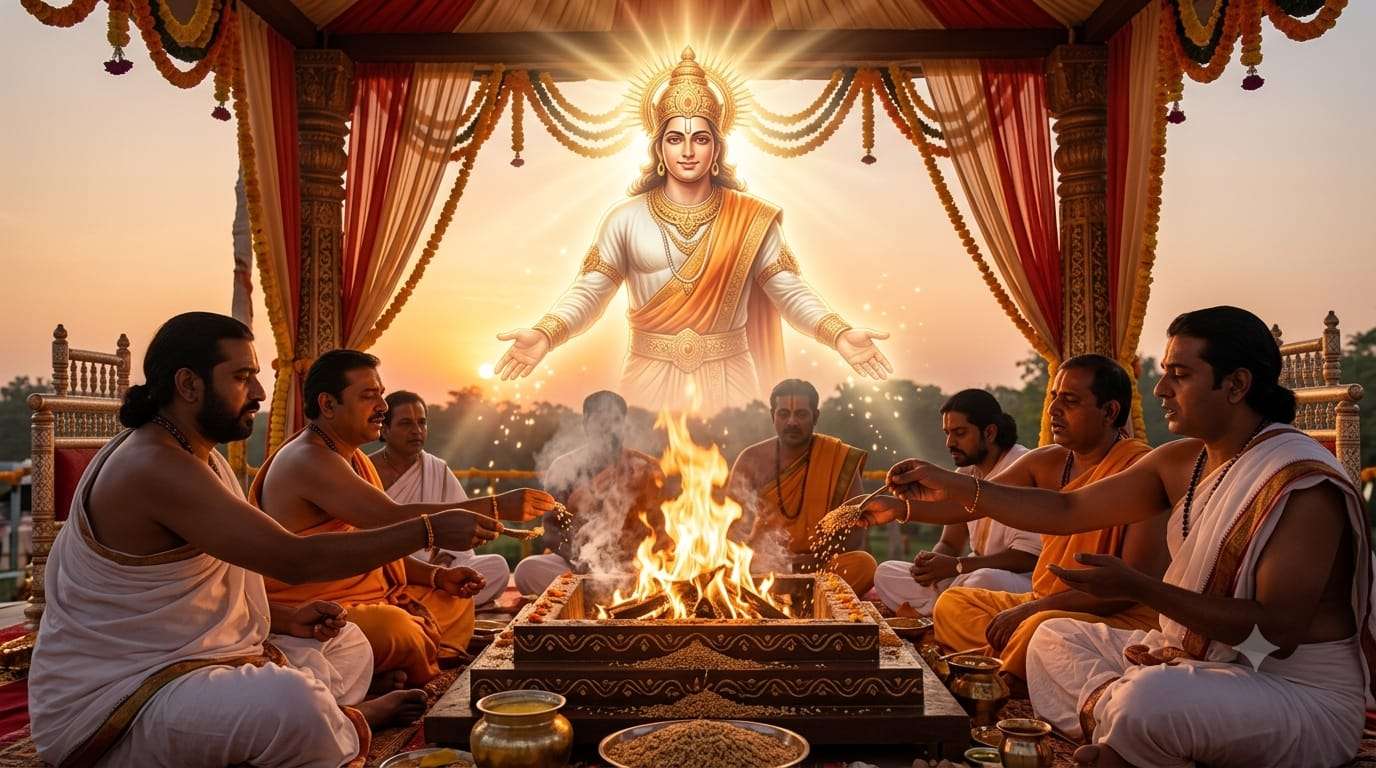
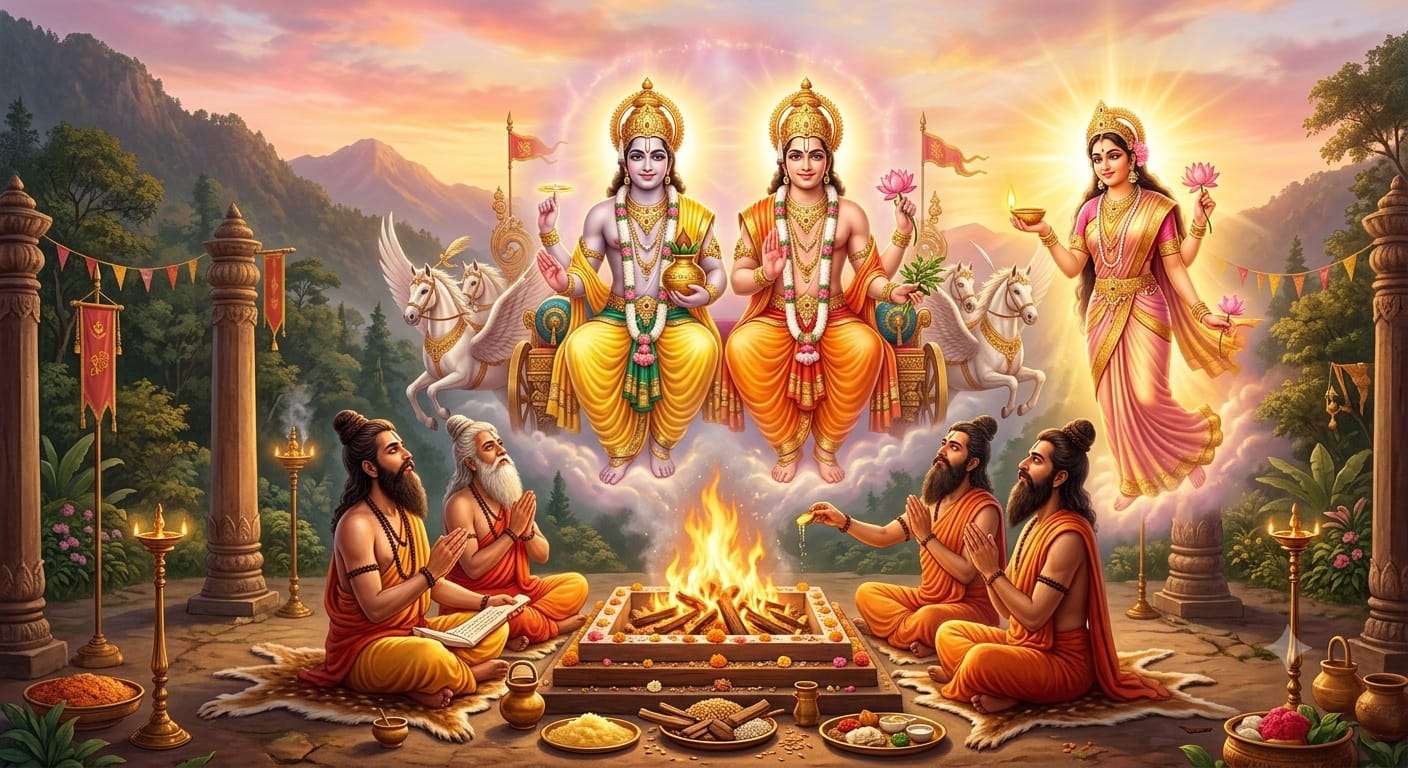
The sage Nodhas, invoking Agni through hymns of the Trishtubh in the Rigveda, unfolds a profound vision of unity between nature and the cosmos. His contemplative mind observes the universe with keen sensitivity and expresses its mysteries in simple yet penetrating comparisons. The sage recognizes that the forces governing the outer universe are reflected within the human body and mind. In this spiritual inquiry, Agni is not merely the ritual fire but the universal principle of energy that connects heaven, earth, and life itself.
Agni appears in many manifestations, and the sage describes them as branches of the same eternal flame. The cosmic fire shining in the heavens, the sacrificial fire burning upon the altar, and the digestive fire working silently within the human body are all expressions of one universal energy. This inner flame, installed at the navel of human beings, sustains life through digestion and transformation. In the cosmic order, Agni stands as the head of heaven while the earth forms its navel, symbolizing the intimate connection between the celestial and terrestrial realms.
The brilliant forms of Agni, known as Vaishvanara and Jatharagni, were established by the gods for the welfare of humanity. These fires sustain both physical and spiritual life. Just as the sun radiates unceasing rays across the sky, Agni possesses inexhaustible wealth and energy. His presence permeates mountains, herbs, waters, and living beings, making him the unseen lord of all natural resources. Thus, Agni becomes the guardian of prosperity hidden within nature.
The hymns describe Agni as the son of heaven and earth, born from their sacred union. The parents rejoice in the brilliance of their offspring, just as the cosmos delights in the radiance of the sacred fire. In moments of distress, a prisoner prays to the king for liberation; likewise the priest approaches Agni with reverence and praise. Through countless hymns and invocations, the seers celebrate his glory, recognizing him as the universal fire that perceives every being born into existence.
Agni’s greatness surpasses even the vastness of the mid-region of space. His glory shines above the heavens, and he stands as the king among mortals. The hymns recall the ancient cosmic struggles in which divine forces restored harmony to the universe. In those sacred narratives, the thunderbolt of Indra struck down Vritra, releasing the life-giving rains. In the same cosmic drama, Agni’s electric brilliance shattered the fortresses of darkness, burning hostile forces and restoring the stolen wealth of the gods.
The sages also remember how Agni destroyed powerful adversaries such as Sambara and reduced the forces of ignorance to ashes. Through his blazing power the clouds released rain, nourishing the earth and sustaining life. Because of this divine intervention, humanity learned to seek refuge in Agni, trusting him as the protector and purifier who guards the cosmic order.
Agni performs the sacred role of messenger between worlds. Every offering placed in the sacrificial fire is carried by him to the gods with unfailing speed. Born from the friction of the sacred aranis, the ritual fire becomes the visible link between mortals and immortals. Through Agni the offerings of devotees reach the divine realms, and the blessings of the gods descend to humanity. Thus, the fire altar becomes the meeting point of heaven and earth.
The hymns further recount how Agni fostered harmony among divine and human communities. He forged bonds of friendship among ancient seers such as the clan of Bhrigu and guardians of cosmic order like Mitra. In this role Agni acts as a law-giver, sustaining the principles of truth, duty, and mutual respect that uphold the moral structure of the universe.
Because he accepts the offerings of patrons and priests alike, both gods and humans praise Agni with devotion. He deserves a place in every home and every sacred space, for he is the visible symbol of divine presence. As the lord of people and protector of households, he embodies the creative authority of Prajapati. The sages even declare that Agni’s existence precedes the rising of the sun, for the principle of energy and transformation existed before the visible light of the world.
Within the human being Agni shines again as the subtle flame of life located in the heart. Its movements resemble waves and ripples of luminous energy spreading through the body. This inner fire represents consciousness itself, inspiring thought, vitality, and spiritual aspiration. The prayer offered to Agni therefore spreads continuously, renewing itself like an ever-fresh flame.
Agni demands offerings not out of hunger but as a sacred exchange between humanity and the cosmos. Through the ritual he purifies all that he touches and transforms material gifts into spiritual merit. He stands as the foundation and support of life, the unseen force that sustains nourishment and prosperity. For this reason, the sages proclaim that Agni’s presence is indispensable in the world.
Installed in the sacred seat of the yajna, Agni rules the household and guards the welfare of the community. He grants wealth, sustains food, and protects the righteous from their enemies. His brilliance frightens destructive forces and brings courage to those who walk in the path of truth.
The seers belonging to the lineage of Gautama offer their prayers with devotion. Just as a groom carefully cleanses and prepares a noble horse, they refine their words through sacred hymns before presenting them to Agni. With disciplined intellect and reverent speech, they seek his blessings. They pray that Agni may gather wealth through wisdom and bring prosperity to the community at the break of dawn.
Thus, the hymn becomes more than a ritual invocation; it is a reflection of the Vedic mind exploring reality with both spiritual intuition and careful observation. The sages perceive nature not as separate from humanity but as an interconnected web of forces governed by cosmic intelligence. Their thought travels across vast stretches of existence, linking the minute processes of the human body with the grand movements of the universe.
In this vision Agni stands at the centre of creation as the eternal flame of transformation. He is energy, consciousness, messenger, protector, and guide. The hymn therefore celebrates Agni as the universal principle through which matter becomes life, life becomes awareness, and awareness rises toward the divine. Through such profound contemplation the Vedic seers revealed a worldview where spirituality and scientific curiosity merge into one luminous understanding of the cosmos.