Upadhyayula Lakshman Rao
The sage Savya Āṅgirasa, a descendant of the illustrious lineage of Angiras, offered his prayer to Indra in the sacred hymns of the Rigveda. These hymns were composed in the majestic Tristubh and the gentle Anustubh metres. The seer’s praise, though simple in expression, possesses a depth that continues to dwell in the memory of thoughtful observers. It opens new possibilities for reflection and study on the relationship between cosmic phenomena and human consciousness.
In the Vedic tradition, prayer is never static. The deity remains eternal, yet the form of invocation adapts to the circumstance of the moment. Thus, the sage’s hymn is not merely a repetition of earlier praises, nor is it confined to a single interpretation of the divine. Instead, it reflects a dynamic dialogue between the expanding universe and the observing human mind. The cosmic order and human perception move together in harmony through the medium of praise and contemplation.
The sage addresses Indra with reverence: O Indra, your power is immeasurable and without end. You stride across the roaring rivers whose waves thunder with force. It is by you might that the waters surge and the rivers roar. The three worlds tremble at the magnitude of your energy. Protect us, therefore, from downfall in war and from the errors of sin.
Indra is portrayed as a deity of immense strength and keen wisdom. He delights in hymns of praise and responds to the devotion of those who sing them. Rich in heroic energy, he defeats hostile forces and preserves cosmic balance. In the Vedic imagination, he shines like a jewel adorning both earth and heaven. He is the divine master of rain, the sustainer of fertility, and the protector of righteous communities.
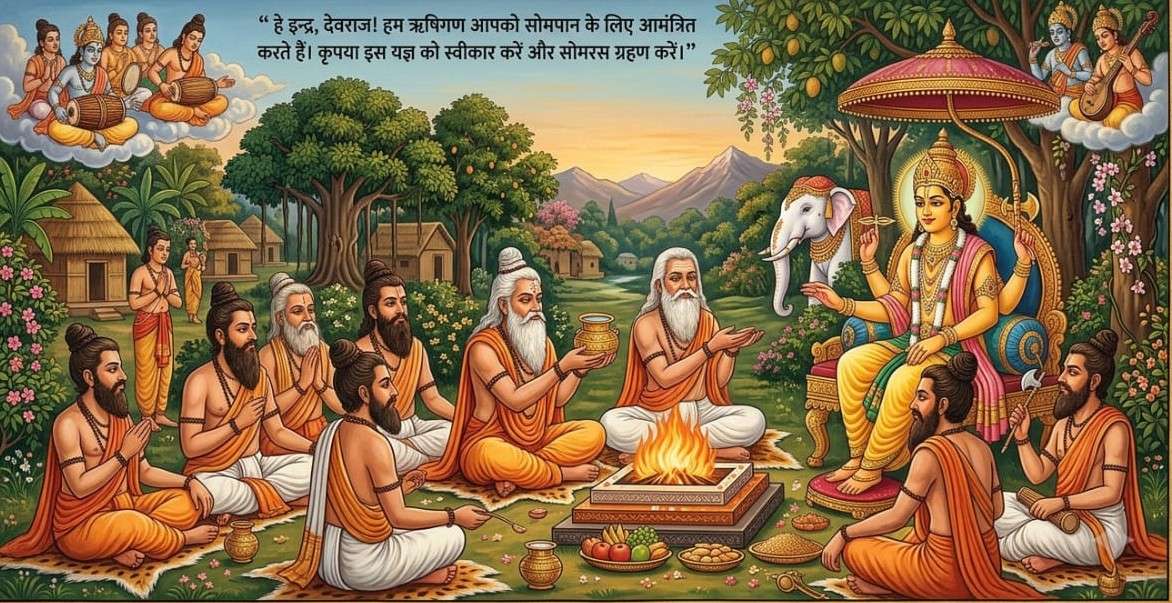
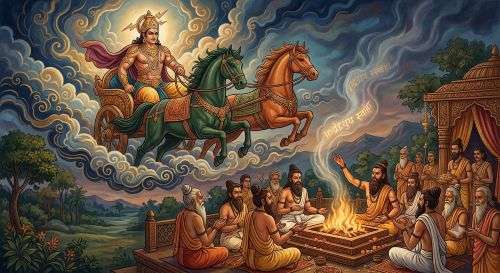
Priests and seers worship Indra with solemn rites. They invoke him from every direction of space, acknowledging that the divine presence pervades all quarters of the universe. When approached with sincerity and sacred hymns, Indra fulfills the aspirations of devotees. He is glorious, radiant, and victorious over adversaries. Swift horses draw his chariot, symbolizing the swift movement of divine power through the heavens. In battle, he stands firm in mind and resolute in purpose.
The sages therefore, urge the priests: praise Indra with auspicious and noble hymns. The demonic forces, armed with deception, sorcery, and illusion, threaten the order of the world. Yet Indra, unwavering in determination, hurls his thunderbolt—the Vajra—against the hosts of demons. When the weapon strikes, the skies themselves tremble. Among those foes was the mighty demon Sambara, whom Indra struck down, shattering his fortified dwellings.
Indra is envisioned as seated above the winds that roar through the sky and stir the rain-bearing clouds. These clouds nurture crops and fruits that sustain human life. At the same time the sun, another power within the cosmic order, can dry the waters and regulate the cycle of fertility. Thus, the hymn subtly reveals the Vedic understanding of natural processes: wind, cloud, rain, and sunlight operate together within a grand ecological balance.
Indra restrains the restless and unrestrained enemies who threaten this order. By releasing rain, he nourishes the earth, and therefore the sage proclaims that none excels him. Gratitude arises naturally in the heart of the worshipper who observes this cosmic generosity.
The hymns recall how Indra protected ancient kings such as Naryu, Turvasa, and Yadu, preserving them in times of danger. He also safeguarded sages like Turvitha, Radha, and Yethasu. The ninety-nine fortified dwellings of the demon Sambara were destroyed by Indra’s power, symbolizing the removal of obstacles that imprison the forces of life.
Those who offer oblations, chant Vedic hymns, and perform daily sacred rites in honour of Indra are regarded as noble persons. Through these disciplined acts they cultivate self-development and spiritual refinement. Their devotion harmonizes human life with the rhythms of the cosmos. For such noble people, Indra releases life-giving rains.
The strength of Indra is vast, and his wisdom surpasses measure. Those who prepare and offer the sacred Soma, the celebrated elixir of vitality, grow in prosperity and spiritual merit. The offering of soma symbolizes dedication, discipline, and participation in the cosmic sacrifice. In return, the worshippers receive glory, strength, and vitality.
The soma ritual itself reflects careful scientific observation and ritual precision. The plant is crushed between stones, its juice filtered and purified, and then collected in sacred vessels. This process represents purification of both substance and intention. The sage addresses Indra: this holy elixir is prepared for you; accept it with delight and grant wealth and prosperity.
One of the most celebrated acts of Indra is the slaying of Vritra. According to the hymn, the dark demon had restrained the waters, holding the rain-clouds captive within his vast body. The life-giving waters could not descend to the earth. When Indra struck Vritra with the thunderbolt, the imprisoned waters were released and flowed downward to nourish the world. This myth symbolically reflects the breaking of drought and the arrival of monsoon rains—an event of immense importance for early Vedic communities.
Through this victory, humanity receives comfort, prosperity, and protection from enemies. The sage therefore prays that Indra should guide society and rule with benevolent strength. May he grant riches, food, nourishment, children, and peace. May he also protect scholars and seekers of knowledge, ensuring the flourishing of wisdom.
The wish of the sage appears simple, yet it carries profound social significance. Each prayer connects the individual to the wider network of society and nature. Through responsible actions and sacred observances, the human community aligns itself with the universe. Spiritual life thus becomes a bridge between cosmic processes and human welfare.
In the Vedic worldview, the ultimate aim of the sages is to establish harmony between the universe and human consciousness. Every hymn, every ritual, and every act of praise becomes a step toward that integration. The prayer to Indra therefore represents more than a mythological narrative; it embodies an early attempt to understand natural forces, social order, and spiritual aspiration as parts of one unified cosmic reality.