
There was a time when the occupant of the White House spoke and the world listened. Now, the world listens, checks the time, and waits for the next version.
US President Donald Trump has turned war into a daily bulletin – like weather, except less predictable and far more dangerous. At breakfast, the war with Iran is over. By high tea, it is back on the menu. By dinner, it comes with conditions. It is not strategy. It is improvisation.
The problem is not merely inconsistency. It is the casualness with which life-and-death matters are tossed about. A ceasefire is announced with the flourish of a tweet; a fresh ultimatum follows before the ink dries – if there is any ink at all. Diplomacy, once a craft honed over months, now resembles a running commentary.
Statesman versus showman
Compare this with the presidents America once presented to the world – leaders who, whatever their flaws, understood the weight of words. They spoke less, calibrated more. Their pronouncements were signals, not sound bites.
Trump, on the other hand, treats the presidency like a live stage. The White House has not merely become political – it has become theatrical. Not theatre in the grand Shakespearean sense, but theatre of the absurd, where the script changes mid-scene and the protagonist forgets which role he is playing.
One moment, he is the peacemaker who has ended a war before it properly began. The next, he is the dealmaker insisting Iran must fall in line. Somewhere in between, he appears convinced that a regime would collapse simply because he expected it to.
The war that refused to follow the script
The original assumption was breathtakingly simple – remove a few key figures, apply pressure, and Iran would fold like a poorly stacked deck of cards. It was to be swift, decisive, and above all, televisual.
But wars, inconveniently, do not read from prepared scripts.
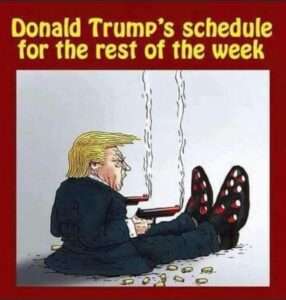
Fifty days on, the conflict drags on, stubbornly indifferent to presidential timelines. Iran has neither collapsed nor conceded. Instead, the region has expanded into a theatre of unintended consequences.
Gulf countries, which were never meant to be more than spectators, now find themselves unwilling participants. Oil routes tremble, markets jitter, and the idea of ‘collateral damage’ has acquired an uncomfortable proximity.
A doctrine of declarations
What emerges is a peculiar doctrine – policy by proclamation. Announce victory first, negotiate later. Declare closure, then reopen the file.
The difficulty with such an approach is not just credibility, though that has taken a visible hit. It is the erosion of trust. Allies are unsure whether to act on what is said today or wait for tomorrow’s correction. Adversaries, meanwhile, learn to discount the noise and watch for the signal – if any exists.
In this environment, even genuine moves towards de-escalation risk being dismissed as yet another episode in an ongoing performance.
The cost of flippancy
There is a certain charm to unpredictability in business negotiations. It keeps opponents guessing. In geopolitics, it keeps everyone uneasy – including those who would rather not be part of the game.
A flippant tongue may win headlines, but it rarely wins stability. Each reversal chips away at the seriousness expected of leadership. Over time, the spectacle begins to overshadow the substance.
And that is where the real cost lies – not in one decision or another, but in the gradual redefinition of what leadership looks like.
Curtain call, or interval?
The war with Iran may eventually end – wars usually do, though rarely on schedule. When it does, it will not be because it was declared over at breakfast. It will end when realities on the ground compel it to.
Until then, the world watches a curious performance. A war that ends and restarts within the same news cycle. A presidency that speaks in headlines rather than histories.
And a White House that, for the moment, resembles less a seat of power and more a stage – where the lines are improvised, the plot is uncertain, and the audience is left wondering whether the next announcement is a conclusion or merely the next act.