


Kathopanishad: Conversation between Lord Yama and Nachiketa
The One, controller of all beings, transforms One form into manifold. The wise men who perceive Him dwelling in their own selves, they enjoy eternal happiness, and not the others.
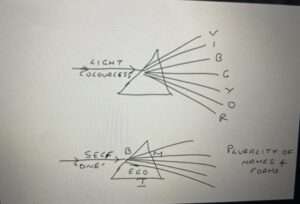
The diagram shows that when white light passes through the prism, you get the rainbow colours. Self is one in all of us. Similarly, when the Self when passes through the prism of the ego of the body, mind, and intellect, it creates a plurality of names and forms. One form transforms into multifold forms. One Atman has become aneka roopam, many forms.
When a person is least evolved, he sees plurality of names and forms. He conflicts with the world because of plurality, otherness. As you evolve the plurality becomes duality and then ekam, non-duality.
The three steps of spirituality are:
- Plurality – Sees names and forms
- Duality – You and God
- Non-duality – Transcend, and you become God
Eg: In a family, we see different relationships, which are the plurality. When you say my family, it becomes duality.
When we see God everywhere, it is God and me, and so it is duality. It is savikalpa samadhi or partial realisation. You see God in a sinner or a saint. When you see God, there is still duality ‘you and God’. The highest state is nirvikalpa samadhi, total realisation. You become God, one with reality.
The more you progress to duality and non-duality, the otherness reduces and oneness increases. Such a person revels in the bliss. Mantra says ‘one who dwells in one’s own self, they enjoy eternal happiness’. One who does not see the oneness and sees otherness, for him there is no happiness.
Q: The Shastras says not to identify with the body, mind, and intellect and exclude everything. Whereas this mantra says, to include everything and see myself in all. Is it not contradictory?
A: Concept of non-identification, creating otherness vis-à-vis creating identification, seeing the oneness is different to negation and assertion. These two are independent concepts. Non-identification creates otherness, which is the root of sorrow. Identification creates oneness, which creates peace and harmony, and happiness.
Another concept is that the negation of the lower and assertion of the higher cannot be linked to identification and non-identification.
Eternal among the ephemeral, the intelligence in the intelligent, One who fulfils the desires of many, the wise men who perceive Him dwelling in their own self, they enjoy eternal peace, and not the others.
Ephemeral means that which is subject to change. Eternal means changeless. The Shastras say the world is ephemeral and is in constant flux of change. The environment and experiences you go through keep changing. Our physical body is changing. Old cells die, and new cells are born. Your habits change, mental perceptions, thoughts, ideas, and spiritual values keep changing. Everything in your life is subject to change, and you must try to see the changeless.
Philosophically, change means sorrow. Change also unsettles you as you need to adapt to the new environment, people, food etc. So, whenever one is subjected to change, one goes through pain, suffering, and sorrow. If you want to experience joy, you must attune to the changeless.
Q: How does one perceive the changeless in the change?

The quality one needs to practise to remain changeless is to be a witness to the change. You must learn to practise the quality of mental detachment, to be a witness and observe the changes around you.
Eg, A judge in a courtroom distances himself mentally and observes the proceedings. In his presence, every case is taken up and nothing happens in his absence. He does not get involved or prejudiced by the arguments happening in front of him. He objectively takes the proceedings and comes to a rational and correct decision, so that justice prevails.
Initially, one should be detached and be a witness to others’ actions. If we are attached to our family, business, objects and beings it becomes a source of misery. Once you start being a witness to others, then you can practise being a witness to your own actions, emotions, thoughts. One can have a feeling vis-à-vis being affected/paralysed by the feeling. The moment emotions overwhelms and paralyses, it destroys your ability to think or act, it means you have become a victim of your emotions. You start observing the kind of thoughts and perceptions that comes to you. When you start practising detachment, it is then that you are not subjected to change. If you bind yourself to things that you are relating to, you will be entangled into it. It is the very nature of world. Do not identify with it and be a witness in your own life. You will then see a paradigm shift in your experiences. There is peace, comfort and happiness. You need to be the change in the change.
This knowledge gives you the ability to be an observer. You will see things happening around you but you remain unaffected. To be a witness one has to do a lot of sadhana. One has to cultivate viveka discriminate between changeless and change and then develop vairagya detachment. Having discriminated you negate the lower and assert the higher.
Spiritual sadhana is to negate things which causes pain which is the source of disturbance. You withdraw your thought and invest in something higher. That process of intelligent investment of your thoughts into something higher is the sadhana. Once you do that over a period of time, you come to a point where you attain vairagya detachment. Faith gives you viveka but to get the vairagya one has to surrender, sharanagati.
Q: When does one surrender and how do you know that you have surrendered to this knowledge?
A: Surrender happens in the areas of helplessness and ignorance. One has to ask themselves whether they have surrendered to this knowledge.
Eg: When Draupadi was being de-robed in the parliament, she felt helpless and let go the last piece of cloth. She surrendered to Lord Krishna, who helped her. This is total surrender.
Swami Rama Tirtha said in his speech to the people of America that ‘trust your own Self and not the mighty dollar’. One’s own Self is mightier than the dollar.
You must not seek this knowledge in moments of despair. You ensure your health when you are in good health. Similarly, you seek this knowledge at the best moments of your life and not in an emergency.
Our ego ‘I know’ attitude holds us back from surrendering totally. As long as you think you know and do not surrender, you will not get any help. When you put aside your ego and surrender, help comes to you. That spirit of sharanagati is essential to get the benefit which is vairagya.
The mantra says that when you take away the intelligence from intelligence, there is nothing left. It is the very essential aspect of life. When Lord Yama says “One who fulfils desires of many”, it is an indication of how Atman is responsible for everything you achieve in life. Pursuit of desire is the cause, and the effect is getting the object of desire or the fruit of action. The law of karma says for every cause there is an effect. Karma, action, is the cause, and karma phala, the fruit of action, is the effect. Atman is responsible for getting the effect of every karma phala. Without Atman, you will not get what you seek in life. When you get the fruit, you think of the Lord who is responsible for it.

