

There are moments in the civilizational journey of a nation when political shifts are not merely electoral outcomes but deeper reflections of social awakening. Bharat, today, appears to be passing through one such phase. The churn is not just political; it is cultural, ideological, historical, and even psychological. What the country is witnessing is not merely the rise of one political party or the decline of another, but the collapse of a post-Independence narrative that dominated national discourse for decades.
For far too long, Bharat’s political ecosystem functioned under an intellectual monopoly carefully crafted after 1947. Successive generations were taught selective history, selective nationalism, and selective secularism. Entire chapters of Bharat’s ancient civilizational glory were either diluted, distorted, or buried. Heroes who sacrificed everything for the nation were pushed to the margins, while politically convenient personalities were elevated to near-divine status. This imbalance did not happen accidentally; it was institutionalized.
Bharat is not merely a modern nation-state born in 1947. It is one of the world’s oldest surviving civilizations, with a cultural continuity stretching thousands of years. From the Vedic age to the great universities of Takshashila and Nalanda, from the philosophical contributions of Adi Shankaracharya to the spiritual awakening led by saints and reformers across centuries, Bharat’s civilizational foundations remained remarkably resilient despite repeated invasions and occupations.
History records how foreign rulers attempted to weaken this civilizational identity. The Mughal era witnessed political domination accompanied by destruction of temples, institutions, and indigenous systems. Colonial British rule systematically dismantled Bharat’s economic backbone, altered education systems, and attempted to implant a mindset of inferiority among Bharatiyas. Yet, despite centuries of invasions and foreign rule, Bharat’s spiritual and cultural identity survived because its roots were too deep to be erased.
Ironically, many believe the greater damage came after Independence — not through foreign invasions, but through intellectual manipulation and political opportunism. The tragedy of Partition itself remains one of the most painful chapters in Bharat’s history. Millions suffered displacement, violence, and trauma. Yet, instead of learning from that catastrophe and building a stronger national identity rooted in civilizational confidence, sections of the political leadership continued policies that many critics describe as appeasement-driven and vote-bank oriented.
Over decades, a dangerous political culture evolved where questioning distorted narratives became taboo. Any attempt to speak about Bharat’s civilizational heritage was branded regressive. Expressions of Hindu identity were often caricatured as communal, while minority appeasement was projected as secularism. This imbalance gradually alienated large sections of society, particularly the silent majority that felt culturally insulted but politically voiceless.
What changed in recent years is the democratization of information. Social media, independent platforms, and alternative narratives challenged decades of one-sided storytelling. Younger generations began questioning what they were taught. Forgotten revolutionaries, suppressed historical accounts, and uncomfortable truths started reaching ordinary citizens directly. Whether one agrees fully or partially with these emerging narratives, one undeniable reality remains: the monopoly over public discourse has broken.
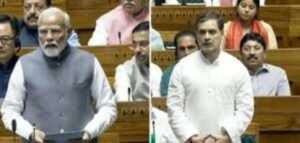
This explains the massive political transformation taking place across Bharat today.
The rise of the Bharatiya Janata Party is not merely a political phenomenon; it is the manifestation of this deeper civilizational assertion. The BJP succeeded because it understood the emotional and cultural pulse of millions who felt disconnected from the elite political discourse dominating Delhi for decades. Its emphasis on nationalism, cultural pride, development, and unapologetic articulation of majority concerns resonated widely.
Critics may disagree with the BJP’s methods or rhetoric, but dismissing its rise as mere electoral arithmetic would be intellectually dishonest. No political party can continue expanding across the country unless it taps into genuine public sentiment. Today, with governance influence extending across much of Bharat, the BJP has positioned itself not just as a ruling party but as the principal ideological force shaping modern Bharat.
The developments in West Bengal illustrate this changing political mood. Bengal, once the land of intellectual renaissance and cultural pride associated with giants like Rabindranath Tagore, Swami Vivekananda, Bankim Chandra Chattopadhyay, and Syama Prasad Mukherjee, has undergone intense political turbulence over the decades. The electorate’s growing shift reflects fatigue against corruption, political violence, communal polarization, and governance failures. The message emerging from Bengal is not merely about one state election; it reflects a broader national demand for governance rooted in accountability and national interest.
At the same time, the Opposition’s decline raises an equally serious concern.
A democracy as large and complex as Bharat cannot function effectively without a credible Opposition. A strong ruling party is important, but a constructive and responsible Opposition is equally essential. Unfortunately, much of the present Opposition appears trapped in outdated politics rooted in dynasty, caste arithmetic, regional insecurities, and selective secularism. Instead of introspection, many Opposition parties continue blaming electronic voting machines, media narratives, investigative agencies, or imaginary conspiracies for their repeated defeats.
The Congress, in particular, faces an existential crisis. Once the dominant political force of Bharat, it now appears disconnected from grassroots realities. Its inability to understand the aspirations of new Bharat has accelerated its decline. Many regional parties, too, have relied excessively on identity politics and short-term populism without presenting a coherent national vision.
The real problem is not that the Opposition is losing elections. The real problem is that it is losing relevance.
When Opposition politics becomes synonymous with anti-majority rhetoric, perpetual negativity, or opportunistic alliances without ideological coherence, voters eventually reject it. Bharatiyas today are more aspirational, informed, and assertive than ever before. They seek development, national pride, security, economic opportunity, and cultural confidence simultaneously. Political parties refusing to adapt to this reality risk political extinction.
However, the weakening of the Opposition also carries dangers. Democracies thrive on accountability, debate, and institutional balance. An ineffective Opposition creates a political vacuum, weakens parliamentary scrutiny, and reduces policy debate into one-sided discourse. Bharat needs an Opposition that questions the government constructively without appearing hostile to national interests. It needs leaders who can challenge policies intelligently instead of relying solely on emotional sloganeering or fear-based politics.
The path ahead for Opposition parties is difficult but not im