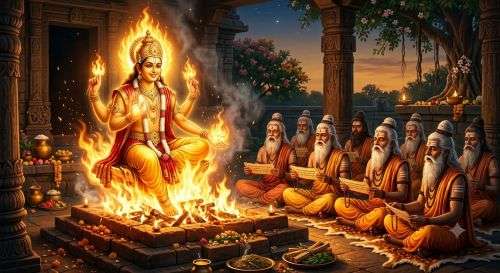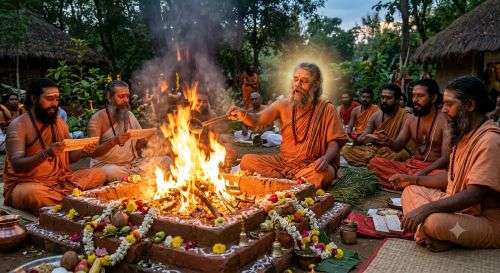

In the शांत and sanctified stillness of the sacrificial ground, where the sacred fires are kindled and the winds move with measured gentleness, the sage Parāśara raises his contemplative voice in the cadence of Triṣṭubh chandas, as preserved in the ancient hymns of the Ṛgveda. His prayer is not merely uttered in sound but arises as a profound current of consciousness, flowing from the depths of awakened perception. In this serene atmosphere, where ritual, nature, and spirit converge, the sage’s thought penetrates beyond the visible, seeking to unveil the subtle architecture of human emotion as an inseparable extension of the cosmic order. Thus, his hymn becomes an opening of the inner gates through which divine energy streams forth, illuminating both the universe and the human heart.
Agni, the divine fire, is invoked not only as a physical presence but as the living embodiment of cosmic intelligence, the mediator between the mortal and the eternal. The sage envisions Agni as the nourishing force who sustains life, bestowing food and prosperity upon the devoted patrons just as a compassionate father enriches his sons. Yet, this nourishment is not confined to material sustenance; it extends into the realms of knowledge and inner illumination. Like a learned scholar who dispels ignorance, Agni kindles the light of discernment within the seeker, granting clarity, warmth, and spiritual comfort. In the gentle symbolism of hospitality, he is also seen as a cherished guest, resting in contentment when honored with sincerity and care.
The hymn unfolds further, portraying Agni as the ever-active priest, the purohita, who fosters the growth and elevation of those who revere him. His brilliance is likened to the sun, radiant and all-pervading, revealing truth and dissolving darkness. In this role, Agni becomes the guide who leads humanity safely across the turbulent oceans of conflict and uncertainty, carrying them to the secure shores of peace and fulfillment. Eternal and unwavering, he stands as the witness and sustainer of all cycles, granting happiness and bliss that resonate with the very essence of the soul.
The relationship between the devotee and Agni is expressed through the intimate imagery of father and son, suggesting a bond of trust, continuity, and sacred duty. When both patron and priest gather before the fire, a harmonious unity arises, wherein the act of offering becomes an act of purification. Agni, thus revered, is adorned with all that is offered, much like the sun that envelops the world in its rays. He pleases and protects like a sovereign king, whose enduring presence ensures order and prosperity.
In villages and ritual dwellings alike, Agni is the luminous center around which life is organized. Devotees offer oblations with reverence, recognizing that all nourishment and abundance originate from him. Through these sacred acts, they align themselves with the cosmic rhythm, seeking not only prosperity but also sanctification. Those who worship with sincerity and knowledge are blessed with longevity and strength, their lives extended as a testament to the harmony between disciplined action and divine grace.
The hymn also reflects a deeper natural philosophy, where the imagery of the divine cow yielding life-sustaining milk symbolizes the generosity of nature, and the mountains releasing pure streams evoke the continuous flow of renewal within the earth. These metaphors reveal a scientific temperament embedded within the spiritual vision—an understanding that the forces governing the cosmos are interconnected, sustaining life through cycles of energy, transformation, and balance. Agni, present in the heavens, the earth, and the intermediary space, is the unifying principle that sustains these processes.
The sage acknowledges the cosmic order that assigns the hues of existence—the dark stillness of night and the radiant emergence of dawn—recognizing them as expressions of divine regulation. Within this framework, humanity is encouraged to strive, to earn, and to act with courage and intelligence. Agni is invoked as the protector of all realms, granting safety and strength to individuals and communities alike. The aspiration extends to societal well-being, where warriors are empowered to defend righteousness, and children are nurtured in knowledge, discipline, and awareness of the world around them.
In this grand vision, education, health, and longevity are not separate pursuits but integral aspects of a life aligned with sacred principles. The prayer seeks a full span of existence, enriched with wisdom and vitality, where each generation carries forward the light of understanding. Agni, as the embodiment of intellect and insight, is entreated to accept these offerings of thought and devotion, to be pleased by the sincerity of human aspiration.
Thus, the hymn culminates in a profound realization: that the act of offering is itself a cycle of divine reciprocity. What is given by Agni is returned through ritual, and what is offered returns as grace. Human effort and cosmic energy become synchronized in this sacred exchange, creating a continuum of harmony. In this unity of spirit, nature, and ritual, the sage beholds the ultimate truth—that the universe itself is a living sacrifice, sustained by the eternal flame of Agni, who binds all existence into a single, luminous order.