



Sanjaya said that Duryodhana, after issuing the necessary commands for the protection of the grandsire and commander-in-chief of the army, rose early the next morning, completed his daily rites, and summoned his generals to assemble the forces upon the battlefield. Conches, kettle drums, and war trumpets resounded; the silent plain was suddenly filled with clamour and motion. Clan leaders and captains instructed their divisions; elephants trumpeted, horses neighed, and the wheels of chariots rolled with grinding thunder. Soldiers called aloud to one another, and all these sounds merged into a single mighty note, like the roar of the ocean at the rising of the moon. The station of the army reverberated with fervour, the air visibly rent by waves of victory cries.
The herds of elephants, adorned with heavy gold, appeared like blazing hills; the rhythmic snorting of horses resembled the dancing of ocean waves. Great chariots, studded with jewels and laden with treasures, looked like moving villages rich with wealth, while the shining steeds that drew them gleamed like distant golden mountains. Armoured soldiers of massive frame, walking as guards of the wheels, seemed like embodied demons. In the midst of this host, Bhishma, chief of the army, shone like the moon upon an ocean of Kauravas forces, distinct and resplendent. His garments were radiant, his chariot unique and arresting, his horses trampling in measured gallop, and his bow, studded with diamonds, glittered like stars in his mighty hands. His golden, gem-studded flagstaff sparkled, and the banner bearing the palmyra emblem fluttered, striking fear into enemies. His armour gleamed like the tender sun, and his chariot bore the white royal umbrella, standing apart from all others.
The flag of Dronacharya bore the emblem of the golden sacred altar; that of Kripacharya displayed a golden cow; the banner of Ashwatthama carried a lion’s tail wrought in gems; and the Madra king Shalya bore a flag marked with a jewelled banana tree. The standards of Drona, Ashvatthama, Kripa, and Shalya dazzled the sky as the fourfold army advanced toward the field, exchanging courteous greetings. In the ancient world the flag was a noble sign, by which a warrior was recognized from afar, and its bearing was a meticulous art. Champions and brave men advanced with sportive spirit, as though proceeding to a festival, for the battlefield was the sporting ground of chivalrous kings and warriors. Other commanders displayed the pride of their achievements, their fluttering banners stirring their martial joy, while the colours, shapes, and forms of their weapons proclaimed the distinctive codes of their warfare.
Sanjaya continued, saying, “O King, listen while I explain in detail. Kritavarma is a steadfast warrior, and his Yadava forces, composed of chariots, elephants, horses, and foot soldiers, appear exceedingly strong, their gait like a pride of lions. Their costumes, body paint, ornaments, armour, shields, swords, tridents, bows and arrows, maces, pestles, and sickles are distinct and fashioned for precise and crushing power. They shine with flashing splendour and march fiercely toward the battlefield. The renowned Krishna of the Yadava clan stands with the Pandavas; yet Kritavarma, though a famed Yadava, stands with Duryodhana, for his enmity toward Krishna outweighs his regard for the Kaurava prince. Thus, the principle that the enemy of one’s enemy is a friend drew Kritavarma to the Kaurava camp. Of all charioteers, only three survived the great war: Kritavarma, Kripacharya, and Ashvatthama. After the war, the divisions among the Yadavas endured for twenty years, and in their internal strife both Kritavarma, who fought for the Kauravas, and Satyaki, who fought for the Pandavas, lost their lives as a result of unending enmity.”
The lord of Sindhu, Jayadratha, a mighty warrior, arrived with his retinue, filled with ardour for battle. The forces on your side, O King, surged with pride and power, delighting the eyes. The brothers Vinda and Anuvinda, and Bhagadatta, king of Kalinga, advanced with vast elephant forces that looked like a moving range of mountains. Bhagadatta was renowned for his mastery in elephant warfare and for crushing his foes. Shakuni, son of Subala, came with pride of power and ostentatious wealth, his gait and bearing marked by cunning design. The aged warrior Bahlika, together with his son Somadatta and grandson Bhurishrava, arrived with their retinues, their dignity such as might rival the lord of the gods. These three generations of warriors were glorious in their record of victory, each capable of contending with the others in valour, all fighting for the Kuru cause against the Pandavas.
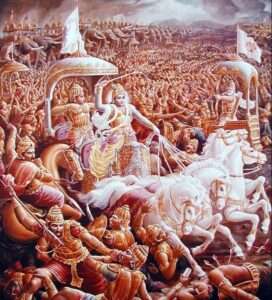
Sudakshina, king of Kamboja, reached the field with mighty forces, as did Brihadbala, king of Kosala; Neela, king of Mahishmati; Susarma, king of Trigarta; the demon Alambasa; and the rulers of Halayudha, Salva, Sauveera, Surasena, Abheera, and Yavana. They came with fourfold armies, with herds of elephants and horses, their banners fluttering from chariots like a festival to the beholders. All were eager to plunge into battle, awaiting only the command to advance, their martial ardour astonishing. The assembled host numbered ten akshauhinis upon the field of Kurukshetra.
Your son Duryodhana, mounted upon a royal elephant adorned beyond measure, surrounded by vast elephant forces, with the white royal umbrella flashing like stars of daylight and attendants waving golden fans studded with diamonds, moved in splendour toward the battlefield at the head of one akshauhini. He appeared as terror to his enemies, with gleaming armour, a massive mace, a powerful sword, and many weapons. His brothers Dushasana, Durmarshana, Vivimshati, and Vikarna advanced in their chariots, guarding him, their distinctive banners fluttering as though shaking the sky. They bore immense reserves of weapons—bows, arrows, swords, sickles, axes, tridents, maces, pestles, spears, double-pointed lances, armour, shields, and countless other arms—so that the Kaurava forces appeared invincible. They seemed fierce and powerful, as though they would consume the earth itself. They wore special armour for the stomach, head, hands, fingers, legs, and toes, and the craftsmanship of their war gear drew applause from every quarter. These special implements were distributed among the kings who fought on their behalf. The diamonds in their ornaments shone like swans, the sapphires like bumblebees, the rubies like red lotuses, so that the Kaurava host resembled a lake blooming with crimson lotuses.
At that time the commander-in-chief, Bhishma, addressed the kings, saying, “When one reflects carefully, it becomes clear that war is the gateway to heaven for kings. In ancient times, many rulers trod this path, and you too should follow it. It is believed that heroic warriors who die bravely on the battlefield attain the heavenly realms. There are only two ways: to win or to die, and both demand courage and boldness. It is sinful for a king to die of disease; the battlefield is the harvest field of kings, and to enter it is to reach a treasure house.” Thus spoke Bhishma to you, O Dhritarashtra, and upon his words the kings took their oaths and stood in their appointed ranks.
Bhishma then said to Duryodhana, “O King, your friend Karna shall not take part in the war as long as I remain active on the field; likewise, his sons, kinsmen, retinue, and counsellors shall not fight.” Duryodhana replied, “To set aside certain persons on any pretext is to assume full responsibility. I honour your resolve.” Thereupon, Bhishma prepared himself and burst forth upon the battlefield like a blazing fireball. Your sons then requested him to form the strategy, and Bhishma devised a formation shaped like a human figure. The face was set toward the west, and at the face he himself stood with his banner, accompanied by Dronacharya. On the right stood Kripacharya, on the left Kritavarma and Shalya, all armed and ready. Behind them were Bahlika, Somadatta, and Bhurishrava. In the centre stood Duryodhana with his brothers, and before him Susarma with his forces. They took an oath, saying, “Either we shall slay Arjuna, or we shall die by his hand.” Around ten thousand warriors guarded your son.
The beauty of this battalion lay in its layered defence: the front line was formed by elephants as a living shield; before the elephants stood chariots; behind the elephants were horsemen; archers guarded the horsemen; and the archers were protected by foot soldiers bearing swords and spears. Celestials, gods, and ancient kings descended from the heavens to witness the war from the skies. Thus, Sanjaya narrated to the blind king the assembled forces and their powers, addressing his anxious curiosity with a full account of the Kaurava host, while the preparations of the Pandavas were to be described thereafter, for the king’s mind was wholly intent upon this domain.

