



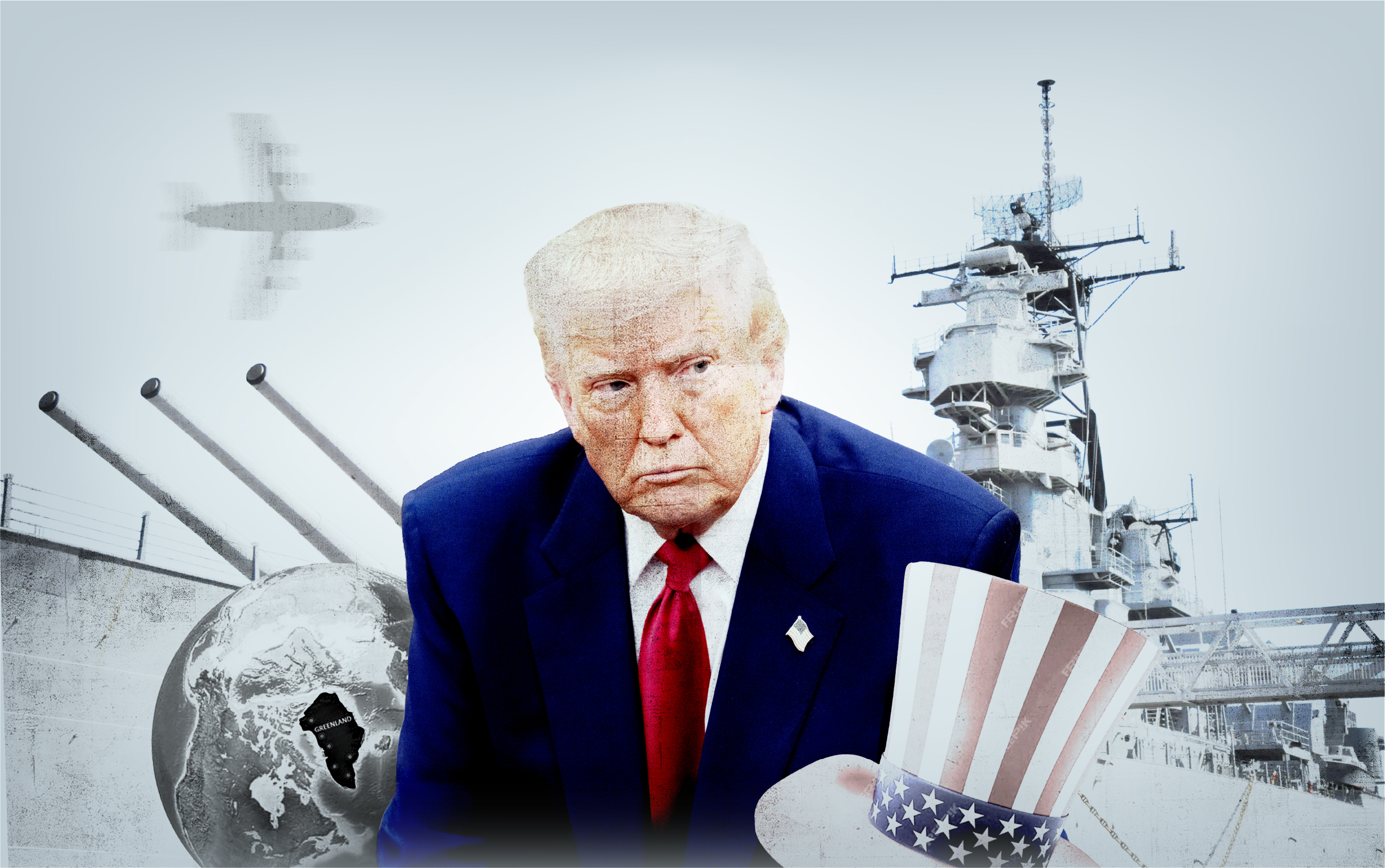
How can threats of bombardment and invitations to negotiate coexist in the same breath? That contradiction sits at the heart of the current West Asia crisis—and at the centre of the diplomatic posture adopted by Donald Trump. It is not merely confusing; it risks being counterproductive at a moment when clarity, credibility, and consistency are essential.
History offers few precedents where a global power openly mixes coercive signalling with simultaneous appeals for dialogue. Strategic ambiguity has its place, but what we are witnessing borders on strategic incoherence. On one hand, Washington signals readiness for talks; on the other, it escalates militarily and keeps the threat of wider strikes alive. Diplomacy backed by force is one thing. Diplomacy undermined by unpredictability is quite another.
The larger geopolitical theatre makes this contradiction even more glaring. The conflict involving Iran and Israel has long ceased to be a regional flashpoint. It is now a global economic disruptor. Energy markets are jittery, shipping routes are under stress, and inflationary pressures—especially in energy-importing economies like India—are intensifying. The chokepoint remains the Strait of Hormuz, through which roughly a fifth of the world’s oil supply flows. Any sustained instability here reverberates across continents.
Washington’s strategic objective—containing Iran’s regional influence and its nuclear ambitions—has been consistent across administrations. Tehran’s support for groups such as Hezbollah and Houthi movement is well-documented and widely acknowledged as a destabilising factor in the region. Likewise, Israel’s security concerns are not abstract; they are rooted in repeated attacks and explicit threats from hostile actors.
However, the question is not whether Iran’s conduct warrants pressure. It is whether the current method of applying that pressure is strategically sound. Claims of “decisive damage” to Iranian capabilities—military or nuclear—have not been independently verified at a level that would justify the conclusion that the conflict is effectively over. If Iran were truly “neutralised,” the persistence of hostilities—and the continued risk to global trade routes—would be difficult to explain.
This brings us to the more puzzling dimension: the reported reliance on Pakistan as a potential intermediary or venue in backchannel diplomacy. Pakistan’s historical record complicates any such role. For decades, it has faced allegations—some substantiated, others contested—of providing safe havens to militant networks. From the presence of Osama bin Laden in Abbottabad until 2011, to ongoing concerns flagged in international forums like the Financial Action Task Force, the perception problem is real and persistent.
That does not automatically disqualify Pakistan from diplomatic engagement—many states with contested records have played constructive roles in negotiations—but it raises legitimate questions about optics and trust. Why opt for a politically sensitive intermediary when more neutral platforms exist? Countries such as Oman and Qatar have previously hosted delicate negotiations involving Iran and Western powers. Even multilateral frameworks under the United Nations offer institutional legitimacy that bilateral backchannels often lack.
Speculation about economic inducements—be it rare earth access, financial arrangements, or emerging sectors like cryptocurrency—remains just that: speculation. There is no credible, publicly verified evidence to suggest that such factors are driving U.S. diplomatic choices in this context. Similarly, assertions about “U.S. nuclear assets in Pakistan” fall outside established, verifiable strategic disclosures. What can be said with confidence is that Washington’s decisions are typically guided by a mix of security calculus, regional alliances, and immediate tactical considerations rather than singular transactional motives.
Yet, even within that framework, coherence matters. If the objective is de-escalation, then the pathway must inspire confidence among all stakeholders—not just allies, but also adversaries who must be brought to the negotiating table. Mixed messaging erodes that confidence.
Meanwhile, the economic toll is mounting. Prolonged instability in West Asia has historically translated into oil price spikes, supply chain disruptions, and capital market volatility. For developing economies already grappling with post-pandemic recovery and tight fiscal conditions, this is not a distant crisis—it is a direct threat to growth and stability.
The uncomfortable truth is that wars rarely end because one side declares victory. They end when political conditions make continuation untenable. If, as claimed, key strategic objectives have been achieved, then prolonging hostilities risks diminishing returns while amplifying global costs.
The United States, as the pre-eminent global power, carries a disproportionate responsibility. Its actions set the tone, shape alliances, and influence outcomes far beyond the immediate theatre of conflict. That responsibility demands not just strength, but consistency; not just leverage, but legitimacy.
Peace cannot be brokered through contradiction. It requires a clear endgame, credible intermediaries, and a willingness to align rhetoric with action. Until then, the world remains hostage—not just to conflict in West Asia, but to the uncertainty of a strategy that has yet to fully explain itself.


Shanker I agree totally! Your interpretation is valid and everyone witnessing the present conflict is echoing the same which you have put in words. Today we are all in a weird situation caught up in crossfires and definitely Trumps presidential style of functioning needs to be blamed inspite of other undercurrents of idealogical and geo strategic situations. History is vast with its repeated lessons on Canal and sea water controls. Nothing is new , it’s ironic that America has chosen to have a president who is totally illiterate with regard to diplomacy. His flamboyant diplomacy of a Trojan horse has failed thoroughly ..it’s so important to have knowledgeable diplomats and academically sound foreign ministers. Let me tell you we had a way of studying back in seventies and eighties..of preserving news paper cuttings of prominent headlines..even professors did that , to say how important to remember these facts . USA ignored all these and there fore the present situation the way it is !