Upadhyayula Lakshman Rao
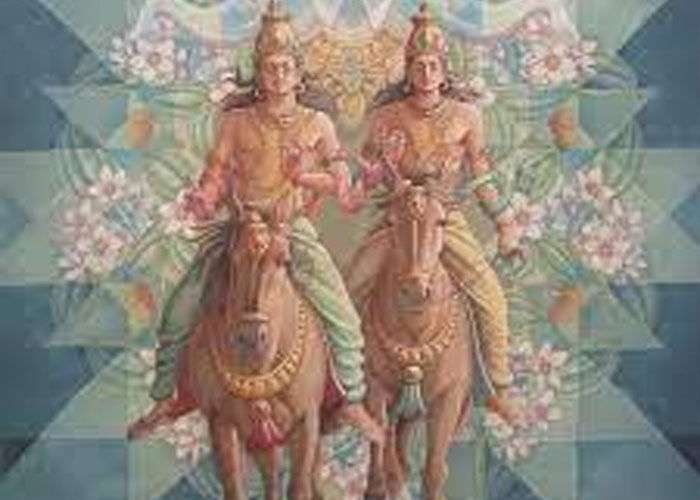
The sage Kakshivantha, immersed in the sacred cadence of Tristubh chandas, raises his voice in reverent praise of the Ashwins through the hymns of the Rigveda. His perception transcends mere conjecture and ventures into a realm of refined insight, where the divine acts of the twin celestial physicians are not only observed but deeply understood. With delicate discernment, the seer unfolds their immeasurable utility and boundless grace, revealing that their stature exceeds all conventional definitions of divinity. His vision stretches beyond the confines of nature and human comprehension, linking the mortal realm with the vast and mysterious expanse of cosmic play, where unseen forces shape existence.
In this elevated contemplation, the sage embodies sincerity, faith, and unwavering devotion. His expression becomes a testament to the latent potential within humanity, suggesting that human capabilities are not limited but await awakening through harmony with the universe and its subtle rhythms. He conveys a profound belief that the human spirit, when aligned with ideal conditions of balance and awareness, flourishes in both material and spiritual dimensions. Thus, his hymn is not merely a prayer but a philosophical affirmation of the unity between man and cosmos.
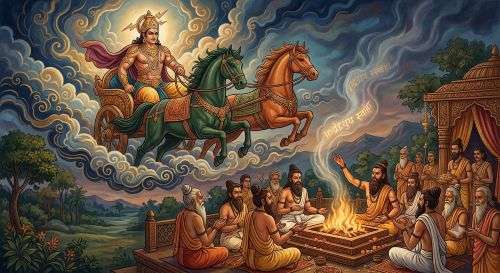
The Ashwins are invoked as bestowers of boons, arriving in their wondrous chariot, a marvel of divine craftsmanship. This chariot, adorned with three wheels and guided by three seats of control, moves with the swiftness of thought itself. It is resplendent in form, abundant in essence, and steady even at its highest गति. The sage calls upon this celestial vehicle to appear before them, approaching from afar with purpose and grace. Its design reflects not only physical excellence but also symbolic depth, representing adaptability, balance, and completeness in all endeavors.
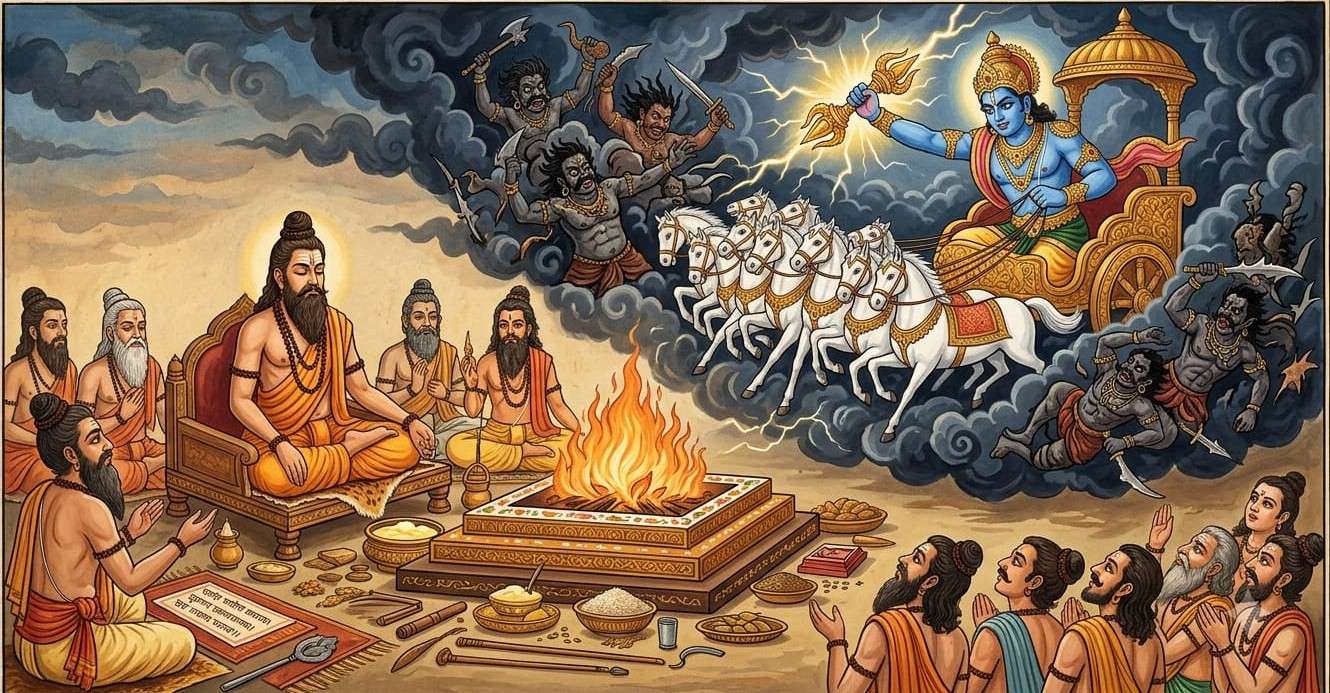
The seer implores the Ashwins to bless the earthly domain with prosperity and vitality. Let the cows become fertile and yield nourishing milk; let the horses embody strength and victory; let the descendants grow in wisdom, continuing the sacred traditions and layered knowledge of Vedic hymns. Such prayers echo the aspirations of ancient scholars, who sought not only material wealth but also liberation from poverty and the enrichment of life in its fullest sense. With devotion-laden hymns, they invite the Ashwins to listen and respond, to descend upon their chariot and partake in the sacred offerings.
The imagery of the Ashwins’ arrival is vivid and dynamic. Their horses are likened to flowing waters—swift, unrestrained, and life-sustaining—and to eagles that traverse the skies with effortless mastery. They are urged to come unfailingly, yoked to their radiant chariot, to accept oblations and bless the devotees. The Ashwins are portrayed as enhancers of life force, energizing all beings. The graceful daughter of Surya is said to have ascended their chariot, adding a dimension of divine elegance and cosmic union to their journey.
Their benevolence is illustrated through numerous legendary acts of compassion and intervention. They rescued Vandana and Rebha from peril, brought Bhujyu, the son of Tugra, safely from the ocean’s depths, and restored youth to the aged sage Chyavana. They extinguished consuming dangers, liberated Atri from distress, and provided him with nourishment and comfort. They restored sight to the sage Kanva, removing the obstructions that clouded his vision. Each act symbolizes not only physical rescue but also the removal of ignorance, suffering, and limitation.
The Ashwins’ kindness extends to all forms of life. They aided the humble sage Sayu by making his cattle fruitful, thus sustaining his livelihood. They protected even a small sparrow, demonstrating that no life is insignificant in their eyes. They granted Vispala a new limb, restoring her strength and dignity. They bestowed a divine horse upon Rajarshi Veda, a gift of unmatched vigor and resilience, capable of enduring battles and embodying youthful vitality. These narratives reflect a profound ethical and scientific temperament, where observation, empathy, and intervention coexist harmoniously.
In conclusion, the sage glorifies the Ashwins as beings of noble origin and radiant existence. He prays for their protection and their presence, inviting them to arrive with their treasure-filled chariot and bring comfort and abundance. At the luminous hour of dawn, when Usha unfolds her brilliance, they are called to partake in offerings and bless the devotees. The hymn thus becomes a bridge between devotion and insight, between the seen and the unseen, affirming that divine grace, when invoked with purity, descends swiftly to uplift and transform life.