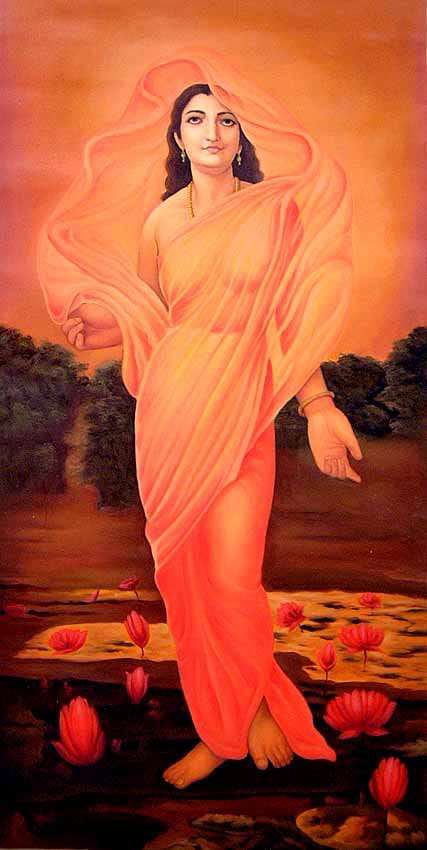
Upadhyayula Lakshman Rao
In the sacred lineage of seers, the son of Angiras, the venerable Kutsa, raises his voice in devotion to the divine Ushas through the measured cadence of Trishtubh chandas, as preserved in the hymns of the Rigveda. His chant flows not merely as poetry but as a revelation of cosmic order, where sound becomes a bridge between mortal perception and divine illumination. Ushas, the harbinger of light, emerges in the eastern horizon, gently yet irresistibly expanding her radiance across all directions, awakening the universe from the stillness of night.
In the profound symbolism of Vedic thought, night and dawn are not adversaries but sisters born of the same eternal rhythm. Alongside the ever-resplendent Surya, they move in harmonious succession, each fulfilling its ordained role without conflict. Their path is vast and unending, governed by cosmic law, where alternation ensures balance. Though night, dawn, and the waters appear distinct in form, they are united in essence, revealing the Vedic insight that multiplicity is but an expression of underlying unity. Their mutual exclusivity—never appearing simultaneously—reflects not separation, but disciplined harmony within the cosmic cycle.
Ushas is described as a cluster of living light, the sovereign of speech and awakening. At her arrival, all beings find their voice; consciousness stirs, and life resumes its activity. She illumines not only the physical world but also the inner faculties, bringing clarity to the dim-sighted and vitality to all realms. As the instigator of rituals and the sustainer of prosperity, she stands at the threshold where the sacred and the material converge. To some, her dawn brings wealth; to others, nourishment; and to yet others, the call to duty, trade, or service. Thus, she is the unseen organizer of human endeavor, aligning individual action with cosmic rhythm.
Clad in purity and adorned with the riches of the earth, Ushas is the radiant daughter of the luminous expanse, slicing through darkness with effortless grace. She is invited into the sacred precincts of yajna, where her presence sanctifies action and intention. Each dawn follows the path of its predecessors, preserving an unbroken tradition while guiding those yet to come. In this continuity lies her immortality—she neither ages nor diminishes, but renews herself endlessly, embodying the principle of eternal recurrence that governs the cosmos.
The philosophical depth of the hymn extends into a contemplation of time itself. Countless dawns have arisen and faded, witnessed by generations now gone; yet the present dawn appears with the same splendor, untouched by the passage of ages. Future dawns, though inevitable, remain unseen, emphasizing the transient nature of human existence against the backdrop of eternal cycles. Ushas thus becomes a symbol of both continuity and impermanence, reminding humanity of its fleeting presence within an enduring universe.
From a scientific perspective, the hymn reflects an intuitive understanding of natural phenomena. The progression from night to dawn to day mirrors the rotation of the Earth, though expressed in poetic imagery. The red chariot of Ushas signifies the scattering of sunlight through the atmosphere, producing the hues of early morning. Her role in awakening life corresponds to the circadian rhythms that govern biological processes, where light acts as a regulator of activity and rest. In this way, Vedic insight harmonizes spiritual vision with empirical observation, revealing a culture deeply attuned to the laws of nature.
Ushas is ever-youthful, untouched by decay or death, moving ceaselessly with her luminous chariot. She dispels darkness not only of the external world but also of ignorance, ushering in wisdom and clarity. At her arrival, the universe is animated; the inert becomes active, and the dormant springs to life. The first dawn is enriched by the memory of those that came before and the promise of those yet to arise, forming a continuum of light that transcends temporal boundaries.
The sages, including Rebha, extol her as the benefactor of those who perform sacred rites, bestowing cattle, strength, and abundance upon the devoted. She grants prosperity to priests and patrons alike, sustaining the cycle of offering and reward that underpins Vedic society. As the mother of divine forces and the upholder of yajna, she stands in intimate association with deities such as Mitra, Varuna, and Aditi, while the elements—rivers, earth, and sky—join in safeguarding the cosmic order she reveals.
Thus, Ushas is not merely the dawn but the eternal principle of awakening, the luminous thread that binds time, nature, and consciousness into a single tapestry. Her coming is a call to rise, to act, and to partake in the unfolding of existence. As darkness recedes and light prevails, humanity is invited to move toward sustenance, purpose, and realization, guided by the ever-renewing grace of the divine dawn.