


MS Shanker
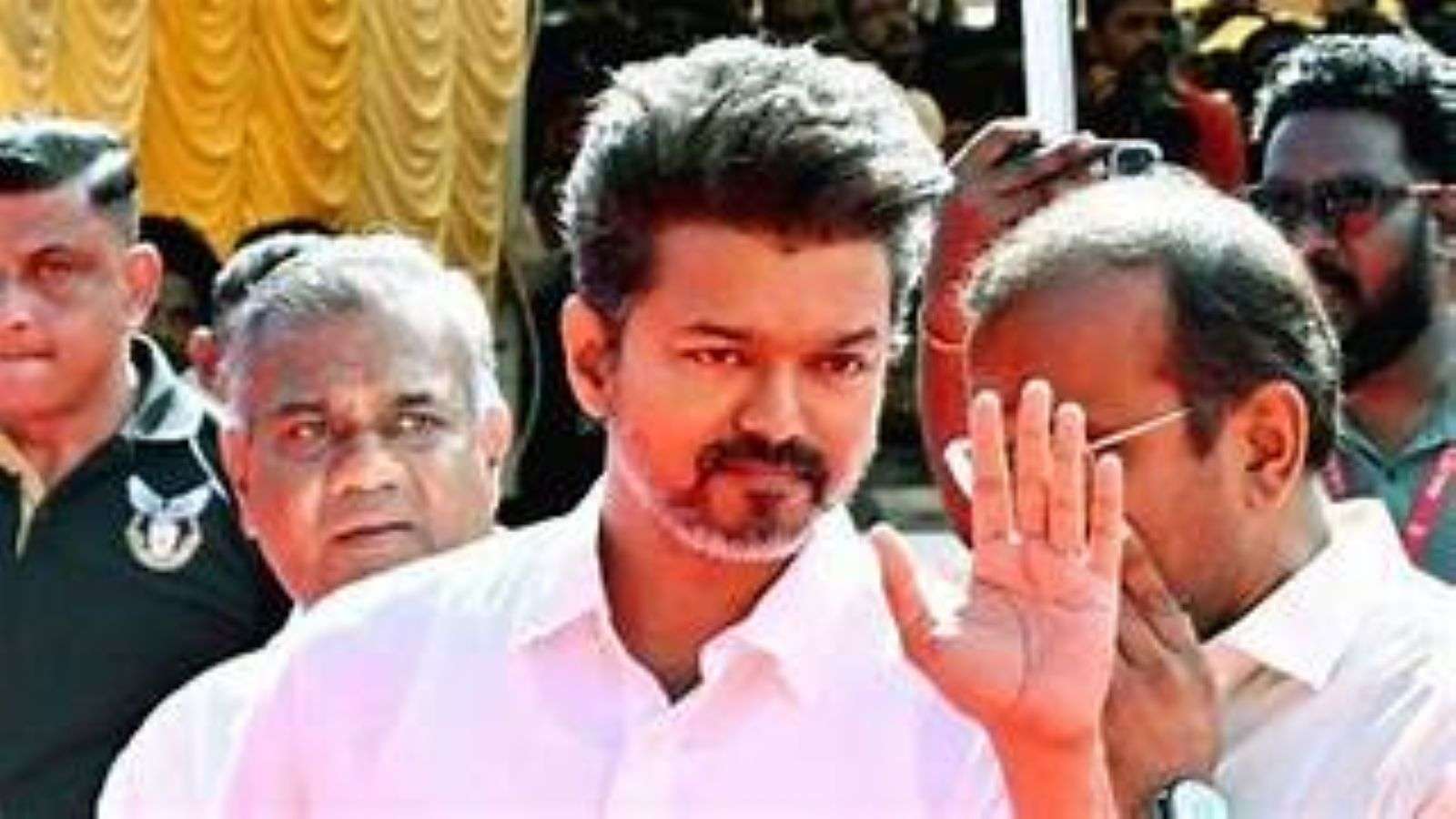
The idea that Joseph Vijay can simply ride charisma into stable governance needs a reality check. Electoral momentum is one thing; managing a fractured mandate in Tamil Nadu’s deeply entrenched political ecosystem is quite another.
Actor-turned-politician Joseph Vijay has undeniably altered the state’s political landscape. For a political debutant to emerge as the single largest party in a 234-member Assembly is no small feat. It places him in a league that even established stars like Kamal Haasan struggled to enter electorally. Yet, the numbers tell a more sobering story: falling short of the majority mark means Vijay’s triumph is incomplete, and the road ahead is riddled with strategic dilemmas.
Constitutionally, as leader of the largest party, Vijay is well within his right to be invited by the Governor to form a government and prove his majority on the floor of the House. But this procedural advantage should not be mistaken for political stability. Minority governments, especially those built on fragile post-poll arrangements, often become hostage to shifting loyalties and opportunistic bargaining. For a newcomer still learning the grammar of governance, this is a high-risk proposition.
Tamil Nadu is not just another state—it is a political arena dominated for over half a century by two formidable Dravidian giants: the Dravida Munnetra Kazhagam and the All India Anna Dravida Munnetra Kazhagam. Both parties possess deep-rooted organizational networks, caste coalitions, and administrative experience that cannot be replicated overnight by a personality-driven formation. Vijay’s campaign may have successfully capitalized on anti-incumbency against the DMK, but converting that sentiment into durable governance is an entirely different challenge.
The DMK, led by M. K. Stalin, appears inclined to sit in the Opposition after a significant electoral setback. This effectively shuts one door for Vijay. Moreover, his campaign strategy—sharp attacks on the DMK while maintaining relative restraint towards the AIADMK—suggests that he may have consciously kept post-poll options open. If so, the moment of decision has now arrived.
The arithmetic is unforgiving. Smaller players, including factions aligned with the Indian National Congress or regional outfits like the Pattali Makkal Katchi, can offer marginal support. But such piecemeal alliances rarely translate into stability. They create governments that are constantly negotiating their survival rather than focusing on governance. For a first-time Chief Minister, that is a recipe for administrative paralysis.
This leaves Vijay with a stark, perhaps uncomfortable, but practical option: engaging with the AIADMK. With a substantial legislative presence, the AIADMK can provide the numerical cushion required for a stable government. More importantly, it offers institutional experience and a relatively cohesive support base. Unlike the DMK’s recent controversies and ideological posturing, the AIADMK has often maintained a more balanced political stance, which could make it a less contentious partner for a broad-based coalition.
There is also a larger national dimension to consider. The AIADMK’s historical alignment with the Bharatiya Janata Party at the Centre could facilitate smoother Centre-State coordination, especially in securing funds and clearances for development projects. For a leader stepping into governance for the first time, this is not a trivial advantage. Administrative success in the initial years often determines whether a political experiment matures into a lasting force or fades into irrelevance.
However, such a move is not without risks. Vijay’s electoral appeal has been built on the promise of change—positioning himself as an alternative to both Dravidian majors. Aligning with one of them could dilute that narrative and invite criticism of political opportunism. Yet, politics is ultimately the art of the possible. Ideological purity without administrative viability rarely sustains public trust.
The larger question Vijay must confront is this: does he want to be a symbolic disruptor or a governing reformer? The former allows him to preserve political capital while blaming systemic constraints. The latter demands compromise, coalition-building, and the willingness to navigate contradictions.
History offers lessons. Charismatic leaders like N. T. Rama Rao and J. Jayalalithaa faced setbacks, recalibrated strategies, and returned stronger because they understood the mechanics of power beyond popularity. Vijay now stands at a similar crossroads.
If he rushes into forming a government without securing a stable majority, he risks reducing a historic mandate to a short-lived experiment. If he hesitates too long, he may squander the political momentum he has painstakingly built.
The mandate he has received is not just a reward for cinematic charisma—it is a test of political maturity. Navigating this moment will determine whether Vijay becomes a fleeting phenomenon or a durable force in Tamil Nadu politics.


I agree to this totally. Normally, Tamilians are shrewd and always go with any party that is in at Centre. yes. It should not fall into Congress trap. Leakapothe vaalla karma.
Absolutely this is going to happen! Vijay in his first political innings has to learn to deal with the sharks that are already there in the ocean. How he maintains his political balance with overriding tides is to be seen .A single wrong step will cost him to get into the pandora box . Vigilance, political maturity needed to maintain amicable relations with the centre, instead of antagonism. The path may become smoother