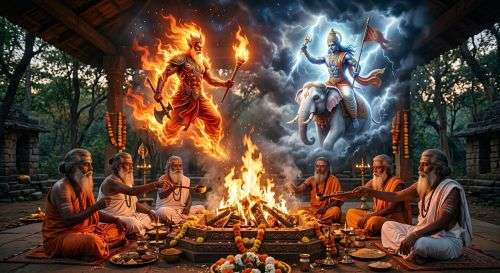
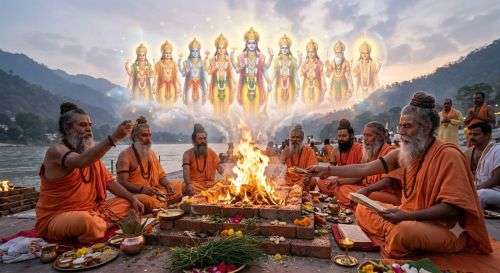
In the sacred corpus of the Rigveda, the sage Nodhas raises his voice in profound devotion through hymns composed in the majestic cadence of the Tristubh chandas. These hymns are not merely poetic utterances; they are luminous expressions of cosmic awareness, revealing the harmony between the spiritual vision of the seer and the dynamic order of the universe. In Nodhas’ contemplation, the divine presence of Indra rises to new heights of human excellence, embodying courage, generosity, wisdom, and the unrestrained power that sustains both the celestial and mortal worlds.
Indra, celebrated in these hymns, is described as rich in glory and strength. He lives eternally within the sacred verses of prayer, for the Vedic hymn itself is considered a living bridge between the human mind and the cosmic intelligence. Unrestrainable in energy, Indra is portrayed as a compassionate guardian who keeps nourishment ready for the hungry and prosperity for the devoted. Just as people prepare food for honored guests, the sages prepare offerings and ancient hymns inherited from revered elders. These hymns are preserved with care and devotion, much like sustaining food for humanity, and they are presented to Indra as sacred nourishment of sound and meaning.
The sage declares that Indra is the follower of eternal tradition and the master of his own self. With disciplined mind and awakened intellect, the poet renders hymns to him, carefully composed and rhythmically chanted. Each verse carries depth of meaning, sweetness of spirit, and clarity of thought. Vedic chanting is not only musical but intellectual; it reflects a profound understanding of sound, meter, and meaning. In this sense, the sage acts like a skilled artisan. Just as a chariot builder sends a finely crafted chariot to its rightful owner, the poet sends these well-formed hymns toward Indra, offering them as vehicles of devotion and knowledge. The words of praise are described as sharp shafts, like sacred arrows of truth directed toward the divine presence.
The offerings made in the ritual fire are presented to the intelligent Indra, who is revered as the victorious conqueror of hostile forces. He is the benefactor of humanity, the destroyer of oppressive strongholds, and the guardian of prosperity. As a chariot is strengthened by the harnessing of swift horses, so the sage strengthens Indra through continuous chanting and praise. Indra is portrayed as the tormentor of enemies, the master of wealth, and the embodiment of immense power. With his divine weapon, the Vajra, he overcame the mighty serpent-demon Vritra, releasing the life-giving waters that had been held captive.
The Vajra itself carries symbolic and philosophical significance. It was fashioned by the celestial craftsman Vishvakarma, representing the union of divine intelligence and cosmic craftsmanship. The thunderbolt is not an instrument of destruction alone but a force directed toward the restoration of balance and order. In Vedic symbolism, Indra’s battle with Vritra reflects natural processes observed by ancient seers: the obstruction of clouds and the subsequent release of rain through atmospheric tension. Thus, the myth carries within it an early scientific temperament—an intuitive recognition of natural cycles of evaporation, cloud formation, and rainfall.
In the sacrificial arena of the Yajna, the sacred extraction and purification of the Soma elixir become a central act. The ritual pressing of Soma symbolizes the refinement of nature’s essence into a form worthy of divine participation. Indra, the heroic recipient of Soma, partakes of this energizing drink during the ritual, accepting the oblations offered by devoted worshippers. Through this sacred exchange, the divine and human realms become interconnected. The rains that follow are interpreted not merely as meteorological events but as blessings flowing from cosmic harmony established through ritual order.
Indra’s majesty extends throughout the universe. He seizes the riches of oppressive forces and redistributes them among those who uphold sacred duty. His thunderbolt breaks the imprisoning clouds, releasing torrents of rain that nourish the earth. The waters liberated by his strength form rivers and oceans, sustaining life across the world. In Vedic imagery, the ocean itself thrives through the luminous power of Indra. Though he becomes rich in his own glory, he also shares prosperity with patrons who faithfully perform offerings.
The hymns describe how Indra shelters allies and rescue the devoted in moments of conflict. He is said to have arranged protection and prosperity for Turvethu and to have intervened in the struggle involving Yethasu and the son of Suvasva. According to the narrative tradition, the sage Suvasvu obtained a son through the grace of Surya. When conflict arose between this son and Yethasu, Indra protected Yethasu, who had offered Soma with devotion. Such episodes illustrate Indra’s role not only as a warrior of cosmic battles but also as a guardian of righteous patrons who uphold sacrificial order.
The brilliance of Indra radiates through the three worlds—earth, atmosphere, and heaven. His glory is immeasurable, surpassing even the vastness of space. The hymns proclaim that neither earth nor sky can exceed the majesty of Indra. When he confronts Vritra, the demon shrivels under the burning force of divine energy, and the hidden waters burst forth in freedom. The image reflects the dramatic transformation of the natural world during storms: lightning cleaving the sky, thunder shaking mountains, and rain reviving the earth.
The sages who composed these hymns recognized the power of sacred sound to preserve cosmic memory. Their stanzas spread across earth and sky, echoing the triumph of divine order over chaos. Mountains stand firm out of reverence for Indra’s might, and the worlds themselves tremble at the manifestation of his power. Yet the hymns do not celebrate fear alone; they praise Indra’s protective grace. Sage Nodhas repeatedly invokes the shining protection of Indra, affirming that the deity’s strength safeguards both ritual order and the welfare of humanity.
Thus, the hymn becomes a union of poetry, philosophy, and observation of nature. The sage from the Gotama lineage composes these sacred verses not merely as praise but as intellectual offerings shaped by reflection and insight. The creators of such hymns pray that their work may be rewarded with prosperity and divine presence. They invite Indra to visit again at the dawn of the next day, symbolizing the renewal of cosmic order with each rising sun. In this continuous cycle of praise, ritual, and natural harmony, the Vedic vision reveals a profound synthesis of spiritual devotion and scientific curiosity, where the movements of clouds, thunder, and rain become living symbols of divine intelligence guiding the universe.