Upadhyayula Lakshman Rao
In the sacred hymns of the Rigveda, composed in the majestic rhythm of the Jagatī chandas, the sage Savya Angirasa raises his contemplative voice in praise of Indra. His prayer is not merely devotion; it is an observation of cosmic order where spiritual insight and natural phenomena move together like two currents of the same river.
The authority of Indra stretches beyond the vault of heaven and extends beneath the breadth of the earth. His glory cannot be confined to the sky alone, nor measured by the horizons of the world. In the vision of the seer, Indra appears as the dynamic principle governing movement, force, and transformation in the universe. To the enemies of harmony and order he is a terror; to the righteous he is the vigilant protector. The sage perceives that the drought of hostility and injustice dries the hearts of men, and Indra—by the thunder of his presence—creates thirst in the enemies of truth, exhausting their strength and ambition.
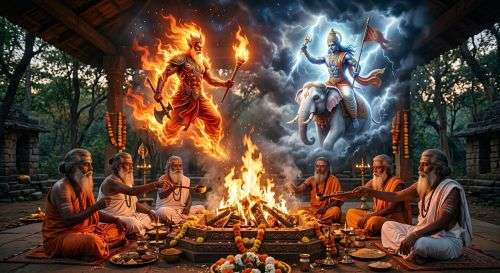
Savya Angirasa describes the divine warrior sharpening his Vajra, just as a powerful bull sharpens its horns against the rock before entering battle. This metaphor reflects the ancient Vedic understanding of natural power: thunder, lightning, and atmospheric energy appearing as the weaponry of a cosmic guardian. The vajra is therefore not only a mythic symbol but also the lightning force that pierces clouds and awakens the skies.
The sage contemplates a profound natural cycle. The oceans gather waters flowing from rivers across the earth; similarly, Indra gathers the subtle waters of the upper atmosphere from the vast reaches of space. This poetic observation reflects an early intuition of the hydrological cycle—the movement of water between earth, sky, and cloud. The Vedic seers saw in this process the living activity of Indra, who collects the waters, commands the clouds, and releases the nourishing rains that sustain life.
Indra’s adventures, celebrated in countless hymns, are long remembered because they represent the perpetual struggle between order and chaos. The god is inspired to drink the divine elixir, the sacred Soma, which energizes him with celestial vigour. In the symbolic language of the Vedas, Soma represents both spiritual inspiration and the invigorating forces of nature that awaken consciousness.
Yet Indra does not create clouds for his own pleasure. The lord of the atmosphere governs immense wealth, but his riches are not hoarded. They are expressed in rain, fertility, vitality, and protection for the living world. His power is therefore not selfish but distributive; it circulates like the wind and water, sustaining the rhythm of existence.
When anger rises against forces that threaten harmony, Indra stands at the helm of cosmic affairs like a vigilant ruler guiding a vast ship through turbulent waters. His vitality is legendary among gods and humans alike. In forests and settlements, among hermitages and sacrificial grounds, people salute his presence. They lift their voices in praise, recognizing the unseen energies that sustain their lives.
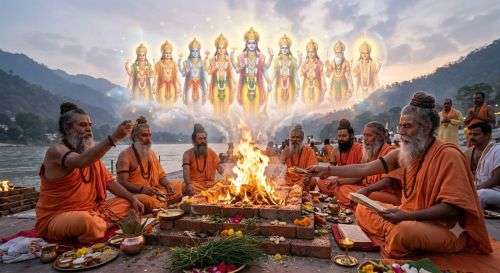
The wealthy patrons who conduct sacred rituals offer oblations into the sacred fire, invoking Indra through hymns. Their offerings are not merely material gifts but expressions of gratitude toward the cosmic powers that nurture prosperity. In response, Indra fulfills their needs, guiding them toward abundance and stability.
Indra is foremost a warrior—not one who fights for conquest alone but one who defends the people. With the vajra he confronts destructive forces, whether they appear as drought, disorder, or hostile powers. In the Vedic imagination these battles symbolize the transformation of energy itself: lightning breaking clouds, winds dispersing storms, and rains renewing the earth.
Because he engages with every form of energy—thunder, wind, rain, and celestial light—Indra shines with resplendent brilliance. Through these actions he gains the trust of the people, who see in him the guardian of balance between heaven and earth.
To establish his reputation, the hymns declare that Indra destroyed the artificial fortresses of enemies—symbolic barriers that obstructed the free movement of waters and life. In Vedic cosmology this act also represents the breaking of stagnation, releasing the rivers of vitality that nourish civilization.
The seers poetically proclaim that Indra grew alongside the earth itself, expanding with the cosmos. His influence seems to erase the boundaries between the sun, the moon, and the stars, for his storms and luminous lightning move across the sky that contains them all. By releasing rain, he protects the sacrificial rituals and the patrons who uphold them, ensuring that the cycle of offering and nourishment continues unbroken.
The sage therefore prays: O Indra, lover of Soma, attentive listener to hymns and prayers, grant us clarity of mind and purposeful thought. Let your awareness inspire our actions. Your charioteers are brave and capable of facing dangers; let your swift horses approach us in friendship. No enemy can oppress one who walks under your protection.
Indra is celebrated as inherently rich, possessing inexhaustible wealth. His strength cannot be subdued by hostile powers because it arises from the very forces of nature. Just as villagers gather around a well to draw water essential for life, the stories of Indra’s great deeds gather around his name, nourishing the cultural memory of the people.
The prayer offered by Savya Angirasa is subtle and composed with purity of intention. It is free from restless emotion, guided instead by thoughtful observation of nature and cosmic order. The sage seeks glory not for personal gain but for unity and welfare among people.
Thus, the hymn becomes more than praise—it becomes a profound narrative linking human aspiration with the movements of the universe. The rains, the lightning, the gathering of waters, the courage of warriors, and the faith of communities all converge in the figure of Indra. Through this synthesis the Vedic mind reveals a remarkable harmony between spirituality and scientific curiosity, recognizing that the forces governing the cosmos also guide the destiny of humanity.