Upadhyayula Lakshman Rao
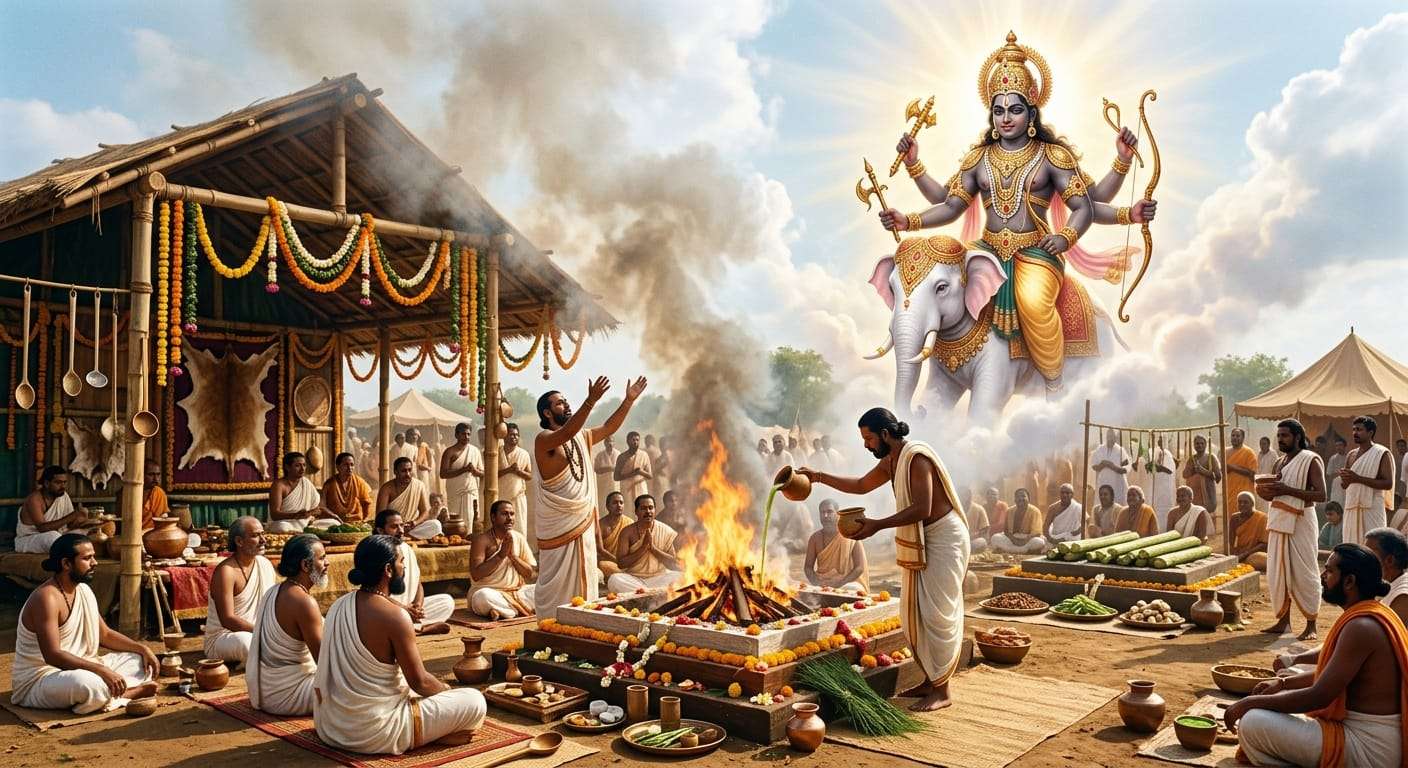
In the hymns of the Rigveda composed in the Tristubh metre, the sage Savya Angirasa praises and invokes the mighty deity, Indra. These hymns present Indra not merely as a warrior god but as a cosmic force sustaining order, knowledge, rain, prosperity, and the moral balance between opposing powers. The narrative of these hymns interweaves spiritual insight with symbolic descriptions of natural processes and human aspirations.
Indra is celebrated as the invincible conqueror of enemies and the supreme bestower of wealth and prosperity. The priests are urged to worship him through sacred recitations of Ruks, for he is the protector and well-wisher of humanity. Just as the rays of the sun nourish and illuminate the world, Indra spreads welfare among people. His intelligence, strength, and heroic energy make him worthy of constant praise in Vedic rituals.
The hymns describe Indra as the power that illuminates the vast regions of space and overcomes cunning and deceptive adversaries. His companions, the storm deities known as the Maruts, remain steadfast in their devotion to him. An ancient episode recounts the great cosmic conflict between Indra and the serpent-like demon Vritra. During that prolonged struggle many celestial beings withdrew, and some warriors deserted the battlefield. Yet the Maruts stood unwavering beside Indra, fighting until the battle’s end. Their loyalty reflects the Vedic ideal that divine cooperation sustains cosmic order.
Through his command the clouds release rain for the sages of the Angirasa lineage. The hymns portray several miraculous acts of Indra that symbolize the restoration of harmony. The sage Atri is said to have been trapped in a mysterious cosmic enclosure—often interpreted as darkness or confinement within ignorance. Indra liberated him through noble power and wisdom. Similarly, the sage Vimada received nourishment and protection through Indra’s grace.
Indra’s thunderbolt weapon, the Vajra, symbolizes the decisive force that removes obstruction. With it he destroys enemies and protects devotees. His most celebrated victory is the slaying of Vritra, who had restrained the waters within the mountains. When Indra struck him down, the waters flowed freely, the rains returned, and the sun appeared in the sky. Thus, the hymn poetically links Indra’s heroic act with the natural cycle of storms, rain, and sunlight that sustains life.
Several other episodes demonstrate Indra’s intervention in human affairs. He shattered the cavern of the demon Pipru and released the imprisoned cows—symbols of wealth, light, and knowledge. In battle he rescued the warrior Rijisvan. During the war against the demon Shushna he protected the hero, Kutsa. He fought the powerful adversary Shambara in order to assist the devotee Atithigva. Another demon, Arbuda, was crushed beneath his feet. Through such acts Indra manifests as the defender of those who uphold sacred order.
The hymns also portray Indra as a guardian of ritual purity. Those who deceptively obtain offerings—referred to as Dasyus—are subdued by him through the same cunning methods they employ. Indra is described as discerning between Arya and Dasyu, terms that often denote differing cultural or spiritual orientations rather than rigid ethnic divisions. The Arya way of life is portrayed as disciplined, devoted to sacred learning, ritual practice, and moral conduct.
Another dimension of the narrative concerns Indra’s relationship with Soma, the sacred elixir of inspiration and immortality. Drawn by its energizing power, Indra eagerly approaches the sacrificial altar where Soma is pressed. The king Saryati is said to have obtained this Soma for him. Drinking Soma symbolizes the awakening of divine energy that empowers Indra to perform his heroic deeds.
The hymns also remember the prayers of devoted sages. The seer Kakshivan invoked Indra while preparing to conduct a great sacrifice. Pleased by his devotion, Indra bestowed upon him a servant maid named Vrucha and abundant prosperity. The sage sought not only material wealth but also the wealth of knowledge, cattle, and horses—symbols of prosperity and dynamic life.
The narrative also touches upon the influence of Shukracharya, the teacher of the Dasyus. At times his spiritual power challenged Indra, yet Indra’s strength continued to expand without restraint. His celestial horses, swift as the wind, draw his chariot to the sacrificial grounds where offerings await him. Even when adversaries attempted to divert his course, Indra controlled the clouds and released abundant rain, demonstrating mastery over natural forces.
These stories illustrate a deeper philosophical idea. The Vedic sages often used mythic language to describe the interplay between cosmic principles: light and darkness, knowledge and ignorance, order and chaos. The slaying of Vritra represents the release of waters and energy locked within nature; the liberation of cows symbolizes the emergence of knowledge from concealment; and the victory over deceptive forces reflects the triumph of truth over falsehood.
Within this tradition the word Arya gradually appears in the hymns, suggesting a cultured way of life grounded in reverence for knowledge, discipline, and devotion to the divine. Some later interpretations describe Aryas as children of the Supreme Being, committed to righteous living. Yet despite conflicts between Aryas and Dasyus in mythic narratives, the deeper spiritual insight of the Vedic vision acknowledges a unified cosmic plane where sincere seekers of truth may converge.
The sage Angirasa himself is associated with the creative power of the universe. In Vedic lore he is sometimes linked with Agni, for when Agni was absent Angirasa fulfilled the duties of sacred fire. When Agni returned, Angirasa was established as the Prathama-Agni, the first among sacred fires. In a similar manner the sage Atri is described as a mind-born son of Brahma. These genealogies symbolize the continuity of spiritual knowledge across generations of seers.
Thus, the Rigvedic hymns of Savya Angirasa portray Indra as a dynamic embodiment of cosmic intelligence and heroic action. He commands the rains, illuminates the heavens, protects sages, supports righteous patrons, and destroys forces that obstruct the sacred order. His story connects natural phenomena, social ideals, and spiritual aspiration into a single narrative framework.
Through disciplined worship, reflective inquiry, and poetic imagination, the Vedic sages transformed observations of nature into profound metaphors of human consciousness. The hymns therefore represent not only religious devotion but also an early scientific temperament—an attempt to understand the laws of the cosmos through symbolic language, keen observation, and intellectual exploration. In praising Indra, the sages ultimately celebrate the triumph of awakened intelligence over ignorance and the harmonious cooperation between divine forces and human endeavour.