


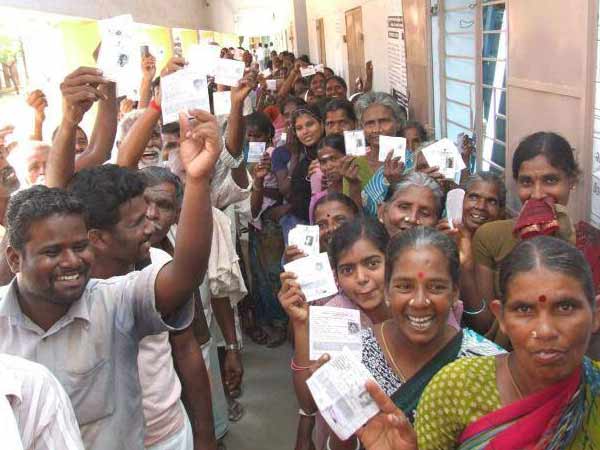
As Tamil Nadu heads into a single-phase showdown and West Bengal advances through a crucial first phase, the spotlight has sharply turned to women voters—now being actively courted through competing narratives around the Women’s Reservation framework.
While the legislation itself was passed in 2023, its delayed implementation—linked to the Census and delimitation—has been weaponised politically.
In these two high-stakes states, where women form nearly half the electorate and often निर्णे electoral outcomes, the question is no longer about the Bill’s passage, but about perception: will women voters in Tamil Nadu and West Bengal respond to welfare-driven governance models, or will the debate around representation and intent reshape their electoral choices?
The premise itself needs a reality check before any serious analysis: the Women’s Reservation Bill was not “defeated” in 2026. The legislation—officially the Constitution (106th Amendment) Act—was passed in 2023 with near-unanimous political backing. What continues to generate debate is not its passage, but its implementation timeline, which is tied to the next Census and subsequent delimitation exercise. That distinction matters because political narratives in Tamil Nadu and West Bengal are now being shaped less by legislative failure and more by perception management.
With polling underway in Tamil Nadu and phases progressing in West Bengal, the key question is not whether women feel “betrayed” by a failed Bill—but whether they trust competing narratives about its implementation and intent.
Women Voters: Not a Monolith
Women constitute nearly 48–50% of the electorate in both Tamil Nadu and West Bengal. In recent elections, their turnout has often equalled or even exceeded male participation, making them a decisive voting bloc. Yet, Indian electoral history consistently shows that women do not vote as a uniform category. Their choices are shaped by a mix of welfare access, local leadership credibility, caste equations, and household economics—not merely by symbolic legislation.
In 2019, for instance, several analysts credited the BJP with gaining traction among women due to schemes like Ujjwala (free LPG connections), Swachh Bharat (toilet access), and the criminalisation of Triple Talaq. However, by the 2024 general elections, that momentum showed signs of fragmentation, with regional parties regaining influence among women voters through state-specific welfare programs.
Tamil Nadu: Welfare vs Narrative
Tamil Nadu presents a complex battleground. The ruling DMK has leaned heavily on targeted welfare schemes for women, including free bus travel and cash assistance programs. These are tangible, immediate benefits—often more electorally potent than future-oriented constitutional promises.
The AIADMK-led alliance, meanwhile, is attempting a comeback by capitalising on anti-incumbency and governance fatigue, while the BJP seeks incremental gains by expanding its footprint. The Women’s Reservation debate here is unlikely to trigger a sweeping shift, but it may influence marginal voters, particularly urban and first-time female voters who are more politically aware.
A 3–4% swing among women voters—especially those previously aligned with DMK—could tighten contests in several constituencies. However, the bigger disruptor in Tamil Nadu may not be the Reservation debate, but vote fragmentation, particularly if newer entrants split anti-incumbent votes.
West Bengal: Polarisation and Consolidation
West Bengal is a different story altogether. The political landscape is sharply polarised between the ruling Trinamool Congress (TMC) and the BJP. Mamata Banerjee has built a strong support base among women through schemes like Lakshmir Bhandar, which provides direct cash transfers.
At the same time, the BJP has steadily expanded its presence, rising dramatically from 3 seats in 2016 to 77 (later 84) in the 2021 Assembly elections. Its strategy hinges on consolidating votes across gender lines through a mix of national security, identity politics, and central welfare schemes.
Here, the Women’s Reservation narrative could play a subtle but strategic role. If the BJP successfully frames the delay in implementation as a procedural necessity rather than political reluctance, it may retain credibility among women voters who value long-term representation. Conversely, if opposition parties succeed in portraying it as a deliberate postponement, it could reinforce TMC’s hold among its core female electorate.
Sentiment vs Substance
The critical insight is this: women voters respond more to lived experience than legislative symbolism. A constitutional amendment promising 33% reservation in legislatures—while historic—remains abstract until operationalised. In contrast, welfare schemes, safety perceptions, and economic stability are immediate and measurable.
This is why the impact of the Women’s Reservation debate is likely to be incremental rather than transformational. It may influence swing voters at the margins, but it is unlikely to override entrenched political loyalties or welfare-driven voting patterns.
In both Tamil Nadu and West Bengal, the electoral outcome will hinge less on the fate of a Bill already passed, and more on which narrative voters believe:
- Is the delay in women’s reservation a constitutional necessity or a political excuse?
- Do immediate welfare benefits outweigh future political representation?
- And most importantly, which party appears more credible and consistent in addressing women’s aspirations?
If there is any measurable impact, it will likely be in narrow vote-share shifts—the kind that decide close contests but rarely overturn dominant political structures on their own.
In short, the Women’s Reservation issue is a factor—but not the factor.



Women vote bank is a decisive factor very well realised by the aspiring candidates and alluring them with instant cash reliefs should be banned. The policy of empowering women should not be on encashing their economic conditions but to provide with an an educational and Employment based platform for a constant growth. Don’t give a fish but teach them how to catch a fish . Nevertheless feel very confident of women intelligence slowly increasing and a time will come when they will consciously decide to accept these baits or not !